The Mass of TOI-1883 b: A Low Density Super-Neptune In The Ridge Regime Transiting An Early-M dwarf
Recent large-scale transit surveys conducted by space telescopes such as Kepler and TESS have revealed a vast number of exoplanets, uncovering the diversity of their population.
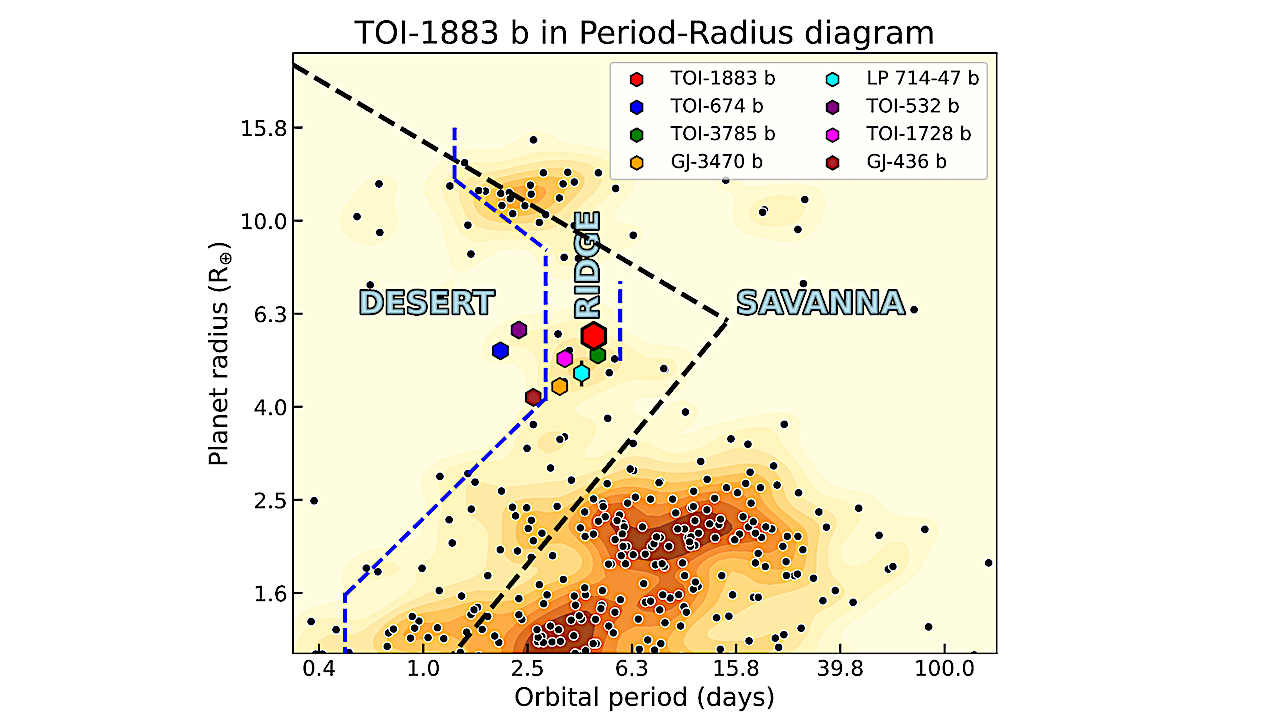
One of the remarkable findings is the presence of a deficiency region in the period-radius distribution of short-period (< 10 days) Neptune-sized planets (4-8 Earth radii). This region is classified into the Neptune desert (< 3.2 days), the ridge (3.2-5.7 days), and the savanna (> 5.7 days) based on orbital period, each likely reflecting distinct evolutionary pathways.
In this study, we used the InfraRed Doppler (IRD) instrument on the Subaru Telescope to determine the mass of the super-Neptune TOI-1883 b, which resides in the ridge region (P ~ 4.51 days) orbiting an M dwarf.
We measured a planetary mass of Mp = 13.7 +6.8/-6.5 Earth masses and a mean density of 0.4 +0.3/-0.2 g cm^-3, with 3-sigma upper limits of 34.1 Earth masses, and 5-sigma upper limits of 47.7 Earth masses. These results suggest that TOI-1883 b is likely a low density super-Neptune.
We also find that the boundary of the Neptune desert defined by planets orbiting FGK-type stars exhibits a similar distribution for planets around M-type stars. According to the population-based argument of Bourrier et al. (2025), this suggests that TOI-1883 b may have undergone disk-driven migration to reach its current orbit and experienced early atmospheric photoevaporation driven by strong stellar XUV irradiation. The derived planetary mass is comparable to or exceeds the conventional critical core mass.
We suggest that the high metallicity of the host star ([Fe/H] = 0.32 +/- 0.18) may have suppressed the onset of runaway gas accretion. Furthermore, TOI-1883 b has a high Transmission Spectroscopy Metric (TSM > 140), making it an excellent target for future atmospheric characterization via transmission spectroscopy.
Izuru Fukuda, Norio Narita, Akihiko Fukui, Teruyuki Hirano, Masayuki Kuzuhara, Hiroyuki Kurokawa, Kai Ikuta, Jerome P. De Leon, Takuya Takarada, Hiroki Harakawa, Hiroyuki Tako Ishikawa, Yasunori Hori, Tadahiro Kimura, Takanori Kodama, Masahiro Ikoma, Akitoshi Ueda, Aoi Takahashi, Enric Palle, Felipe Murgas, Gaia Lacedelli, Hannu Parviainen, John H. Livingston, Jun Nishikawa, Keisuke Isogai, Kiyoe Kawauchi, Masashi Omiya, Mayuko Mori, Motohide Tamura, Nobuhiko Kusakabe, Noriharu Watanabe, Sébastien Vievard, Taiki Kagetani, Takashi Kurokawa, Takayuki Kotani, Takuma Serizawa, Tomoyuki Kudo, Vigneshwaran Krishnamurthy, Yugo Kawai, Yuya Hayashi
Comments: 15 pages, 17 figures, accepted for publication in PASJ. arXiv admin note: text overlap with arXiv:2507.16222
Subjects: Earth and Planetary Astrophysics (astro-ph.EP)
Cite as: arXiv:2606.06868 [astro-ph.EP] (or arXiv:2606.06868v1 [astro-ph.EP] for this version)
https://doi.org/10.48550/arXiv.2606.06868
Focus to learn more
Submission history
From: Izuru Fukuda
[v1] Fri, 5 Jun 2026 03:35:52 UTC (2,580 KB)
https://arxiv.org/abs/2606.06868
Astrobiology,