Determining the Host Stars of Planets in Binary Star Systems with Asterodensity Profiling: Investigating the Canonical Radius Gap
Over the past 30 years, thousands of exoplanets have been discovered, revealing detailed demographics of planets outside the Solar System.
One of the most dramatic features of the planet radius distribution is the radius gap, a lack of planets between ∼1.8-2 R⊕. The radius gap is thought to mark the distinction between rocky and gas planets. Recent research has found that the radius gap may not be present in binary star systems.
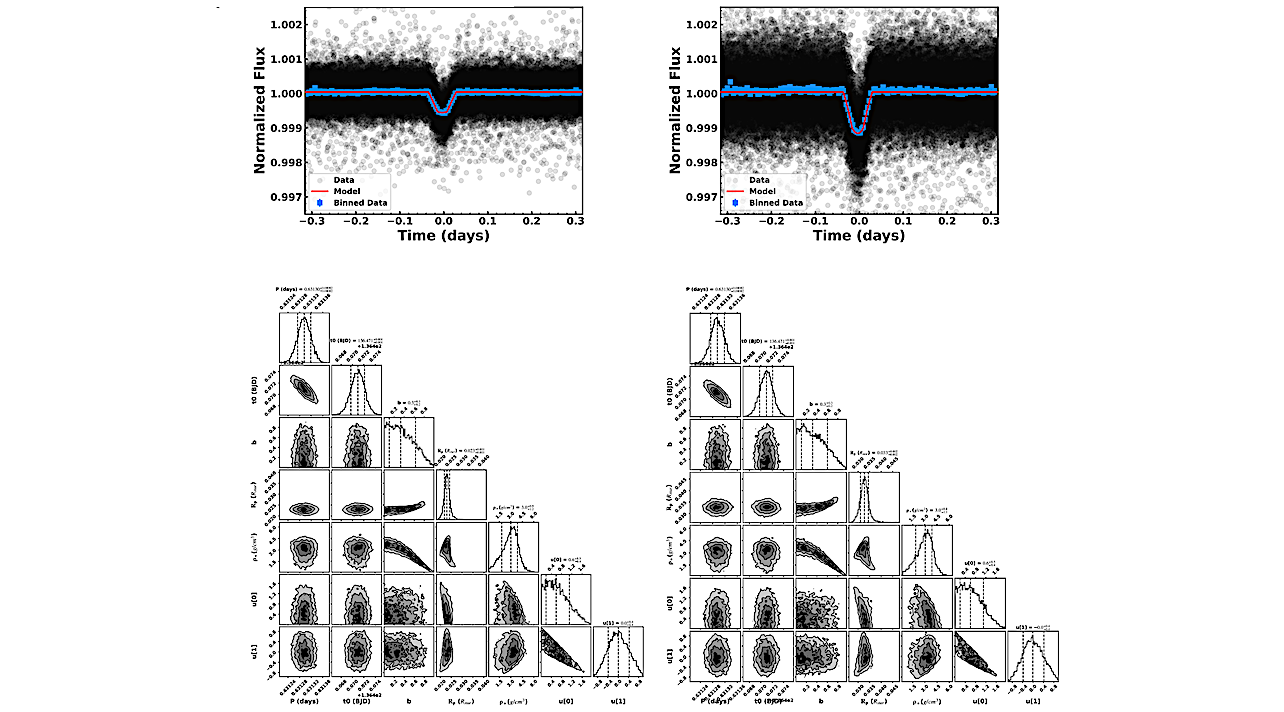
In past studies of planets in binary star systems, the common assumption has been that all of the planets are hosted by the primary star. In many cases, the radius of the planet would be significantly larger if it were orbiting the companion star, which could potentially affect the true radius distribution. It is possible to identify the host stars of planets through stellar density estimates obtained from transit fitting.
Using this method, we made probabilistic estimates for the host stars of a sample of 15 transiting exoplanets across 10 binary star systems hosting either 1 or 2 planets, at least one of which would reside in the canonical radius gap if it was circumprimary. We found that 5 of the planets are highly likely to be circumprimary, while the remainder have ambiguous host stars.
The lack of unambiguously circumsecondary planets is caused by physical and observational biases that favor circumprimary planets. Nonetheless, the summed posterior probabilities suggest that the canonical radius gap appears less vacant for planets in binaries.
Nathanael Burns-Watson, Kendall Sullivan, Adam Kraus
Comments: 15 pages, 9 figures
Subjects: Earth and Planetary Astrophysics (astro-ph.EP); Solar and Stellar Astrophysics (astro-ph.SR)
Cite as: arXiv:2604.06388 [astro-ph.EP] (or arXiv:2604.06388v1 [astro-ph.EP] for this version)
https://doi.org/10.48550/arXiv.2604.06388
Focus to learn more
Submission history
From: Nathanael Burns-Watson
[v1] Tue, 7 Apr 2026 19:19:28 UTC (1,265 KB)
https://arxiv.org/abs/2604.06388
Astrobiology, exoplanet,