Spatial Distribution Of Organics In The Horsehead Nebula: Signposts Of Chemistry Driven By Atomic Carbon
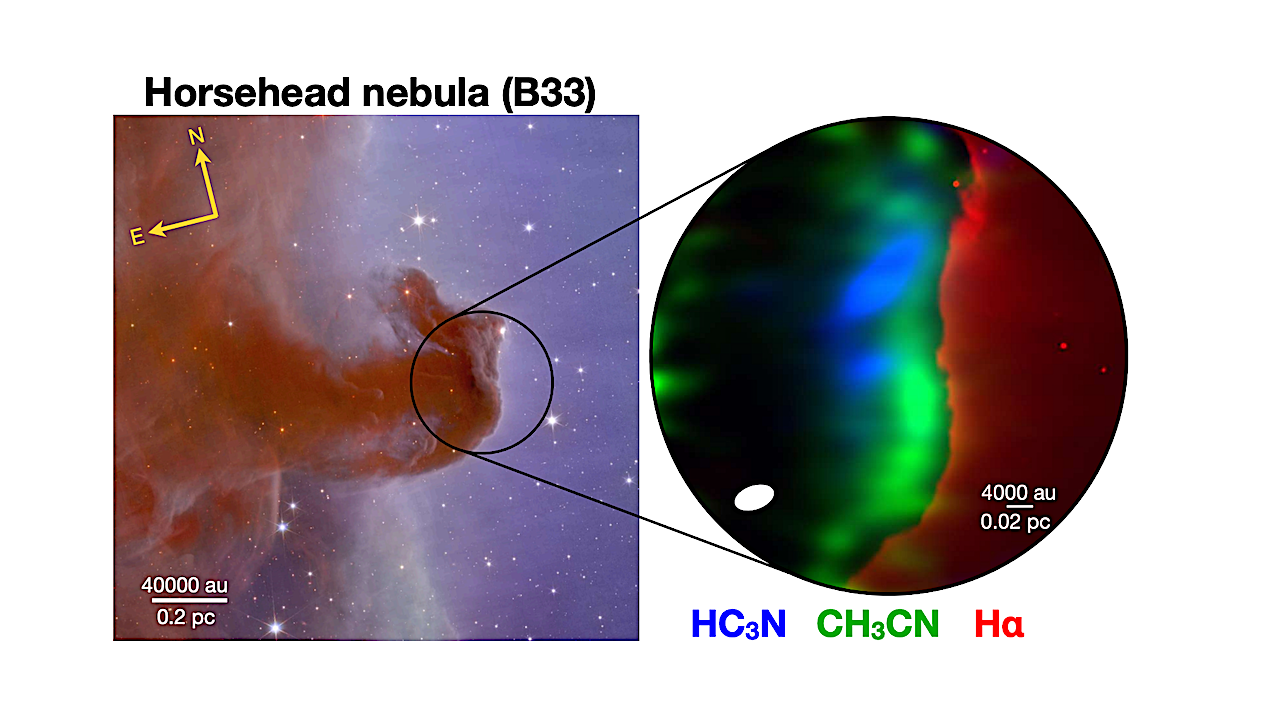
(Abridged) Complex organic molecules (COMs) are considered essential precursors to prebiotic species. While COMs were once expected to be efficiently destroyed under UV-irradiated conditions, detections in photodissociation regions (PDRs) have challenged this view.
However, the mechanisms by which UV radiation contributes to their formation are still uncertain. Here, we present moderately resolved maps of simple and complex organic molecules at the UV-illuminated edge of the Horsehead nebula, obtained by combining ALMA and IRAM 30m single-dish observations at ∼15′′ resolution.
We analyze the spatial distribution of species such as C17O, CH2CO, CH3CHO, HNCO, CH3CN, and HC3N. By incorporating previous C17O and C18O single-dish data as well as PdBI maps of H2CO and CH3OH, we derive profiles of gas density, temperature, thermal pressure, and column densities of the organic species as a function of distance from the UV source.
Our results show that most organic species−particularly H2CO, CH2CO, CH3CHO, HNCO, and CH3CN−exhibit enhanced column densities at the UV-illuminated edge compared to cloud interiors, possibly indicating efficient dust-grain surface chemistry driven by the diffusion of atomic C and radicals produced via photodissociation of CO and CH3OH, as supported by recent laboratory experiments. The exceptions, HC3N and CH3OH, can be attributed to inefficient formation on dust grains and ineffective non-thermal desorption into the gas phase, respectively.
Additionally, contributions from gas-phase hydrocarbon photochemistry−possibly seeded by grain-surface products−cannot be ruled out. Further chemical modeling is needed to confirm the efficiency of these pathways for the studied species, which could have important implications for other cold, UV-irradiated environments such as protoplanetary disks.
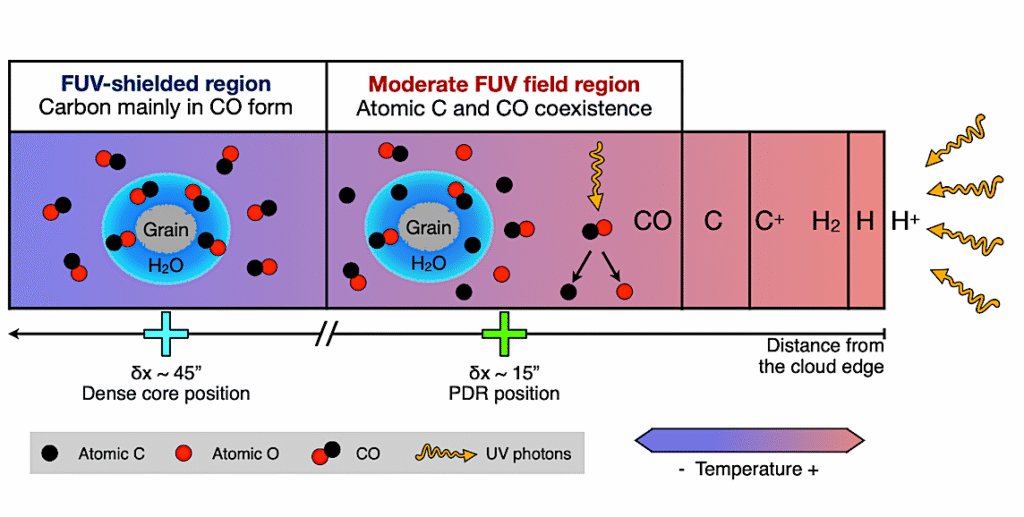
Schematic summary of the proposed scenario at the edge of the Horsehead nebula. The two crosses indicate the PDR and dense core positions, as in Fig. 2. At the PDR, the moderate FUV field enables the coexistence of C and CO, together with a sufficiently high Tdust to allow efficient diffusion of atomic C on grain surfaces. These conditions may favor the formation of H2CO, CH2CO, CH3CHO, HNCO, and CH3CN, likely through a combination of gas-phase and grain-surface pathways. Interestingly, for the two species with the lowest PDR abundances, CH3OH and HC3N, previous studies suggest ineffective photodesorption and inefficient grain-surface formation, respectively. In the case of the dense core, the FUV-shielded conditions limit CO photodissociation, and the low Tdust makes the diffusion of atomic C on grains inefficient. These conditions may favor the grain-surface formation of H2CO and CH3OH, and also contribute to the prevalence of HC3N in the gas phase, as it is less efficiently photodissociated. — astro-ph.SR
Claudio Hernández-Vera, Viviana V. Guzmán, Jérôme Pety, Ka Tat Wong, Javier R. Goicoechea, Franck Le Petit, Maryvonne Gerin, Aquiles den Braber, John M. Carpenter, Vincent Maillard, Emeric Bron, Pierre Gratier, Evelyne Roueff
Comments: 21 pages, 4 tables, 10 figures; Accepted for publication in A&A
Subjects: Astrophysics of Galaxies (astro-ph.GA); Earth and Planetary Astrophysics (astro-ph.EP); Solar and Stellar Astrophysics (astro-ph.SR)
Cite as: arXiv:2601.20146 [astro-ph.GA] (or arXiv:2601.20146v1 [astro-ph.GA] for this version)
https://doi.org/10.48550/arXiv.2601.20146
Focus to learn more
Submission history
From: Claudio Hernández-Vera
[v1] Wed, 28 Jan 2026 00:43:08 UTC (3,128 KB)
https://arxiv.org/abs/2601.20146
Astrobiology

![Discovery Of 1H-cyclopent[cd]indene (c-C11H8) In TMC-1 With The QUIJOTE Line Survey: A New Three-ringed Polycyclic Aromatic Hydrocarbon](https://astrobiology.com/wp-content/uploads/2026/01/Discovery-of-1H-cyclopentcdindene-1024x573.png)