Post-Perihelion Integral Field Spectroscopy Of The Interstellar Comet 3I/ATLAS
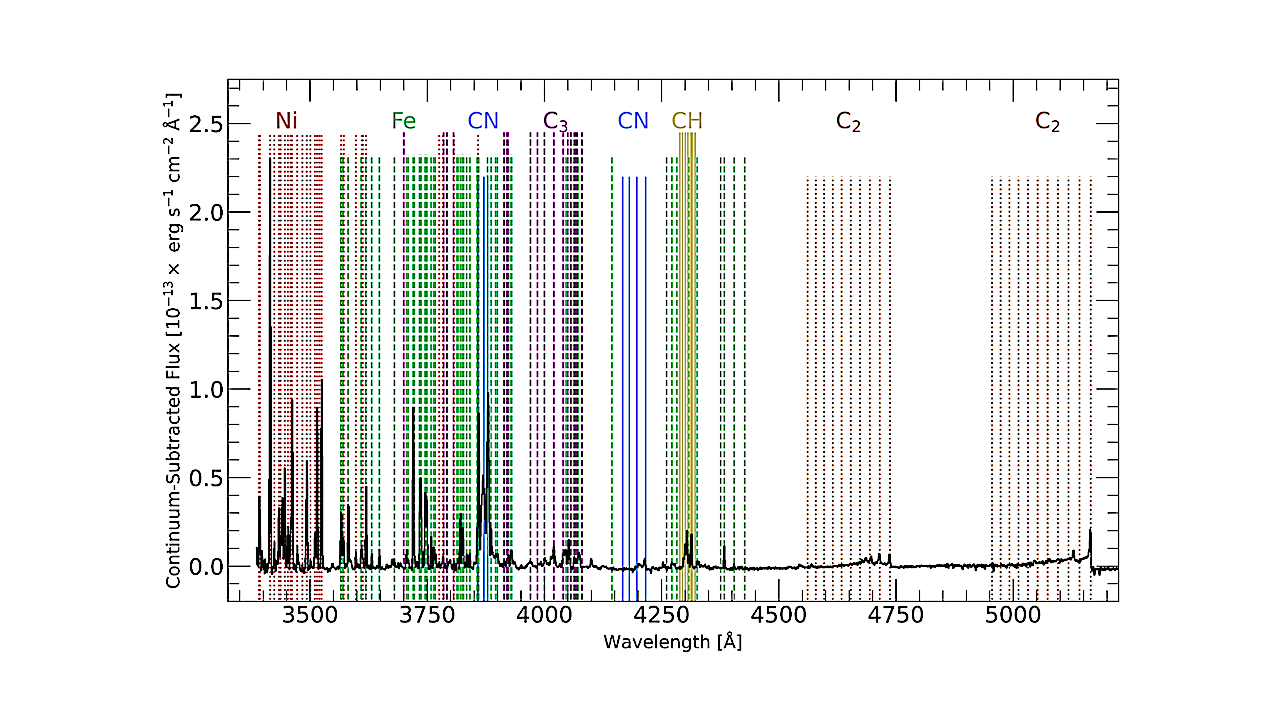
The environs of other stellar systems may be directly probed by analyzing the cometary activity of interstellar objects. The recently discovered interstellar object 3I/ATLAS was the subject of an intensive worldwide follow-up campaign in its pre-perihelion approach. Now, 3I/ATLAS has begun its post-perihelion departure from the Solar System.
In this letter, we report the first post-perihelion blue-sensitive integral-field unit spectroscopy of 3I/ATLAS using the Keck Cosmic Web Imager on November 16, 2025. We confirm previously reported CN, Fe, and Ni outgassing along with detections of carbon chain molecules C2 and C3.
We calculate production rates for each species. We find Fe and Ni production rates of QFe=(9.55±3.96)×1025 atoms s−1, and QNi=(6.61±2.74)×1025 atoms s−1, resulting in a ratio of log(QNi/QFe)=−0.16±0.03, which matches Solar System comets well and continues the pre-perihelion trend of declining log(QNi/QFe) with rh.
We investigate the radial distributions of these elemental species and find characteristic e-folding radii of 3880±39 km for Ni, 6053±68 km for CN, 4194±45 km for C2, and 3833±45 km for C3. Compared to pre-perihelion measurements, these radii have increased by a factor of ∼6.5–7. Our post-perihelion observations reveal that 3I/ATLAS continues to exhibit cometary behavior broadly consistent with Solar System comets.
Willem B. Hoogendam, David O. Jones, Bin Yang, Benjamin J. Shappee, James J. Wray, Karen J. Meech, Christopher Ashall, Dhvanil D. Desai, Jason T. Hinkle, Andrew M. Hoffman, Kyle Medler, Cameron Pfeffer, Ruining Zhao
Comments: 11 pages, 8 figures, to be submitted AAS Journals. Comet Comments Welcome!
Subjects: Earth and Planetary Astrophysics (astro-ph.EP); Astrophysics of Galaxies (astro-ph.GA)
Cite as: arXiv:2601.16983 [astro-ph.EP] (or arXiv:2601.16983v1 [astro-ph.EP] for this version)
https://doi.org/10.48550/arXiv.2601.16983
Focus to learn more
Submission history
From: Willem Hoogendam
[v1] Fri, 23 Jan 2026 18:59:59 UTC (372 KB)
https://arxiv.org/abs/2601.16983
Astrobiology, Astrochemistry,