The RoPES Project With HARPS and HARPS-N II. A Third Planet In The Multi-planet System HD 176986
Context. Earth-like planets orbiting in the habitable zone of K- to G-type stars create an RV effect in amplitude of less than 1 m s−1 and have orbital periods of hundreds of days. Only long-term RV surveys with sub-meter per second precision instruments can explore the outer regions of Sun-like stars and look for Earth-like planets and super-Earths.
Detecting Earth-like or super-Earth planets in the habitable zone of Sun-like stars is crucial to provide targets to the next generation of direct imaging facilities. Aims. We present the analysis of the K-type star HD 176986. It has a brightness of V=8.45 mag and a distance from the Sun of d = 27.88 pc. This star hosts a known planetary system of two super-Earths. We utilize historical and recently collected RV measurements to investigate the presence of Earth- and super-Earth-like planets in the habitable zone of HD 176986.
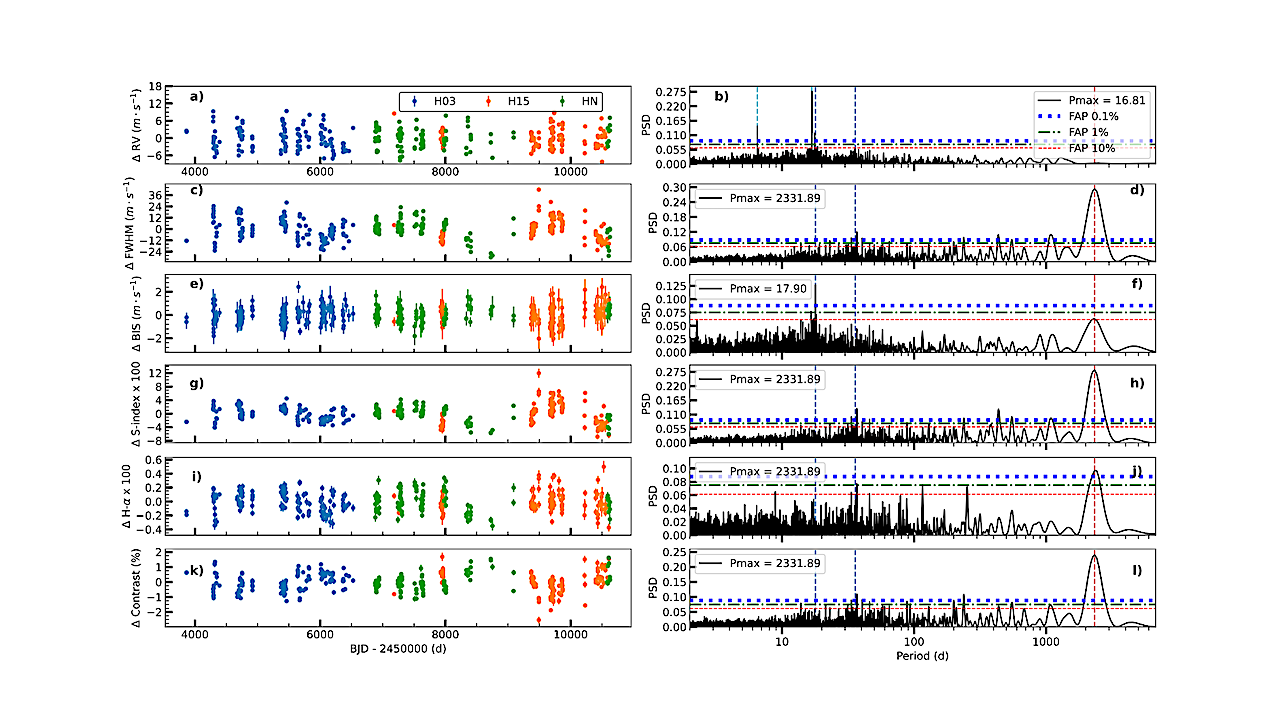
Methods. We monitored the system with HARPS and HARPS-N. We joined historical datasets with new data collected in an ongoing blind search program. We took advantage of recently developed tools for RV extraction and stellar activity filtering. The analysis of activity indicators permits us to determine the period of the magnetic cycle of the star alongside its rotation period. We performed a joint analysis of RVs and activity indicators through multidimensional GPs to better constrain the activity model in RVs and avoid overfitting.
Results. We de tected a new planet orbiting the star and retrieved the two known planets. HD 176986 b has an orbital period of 6.49164+0.00030 −0.00029 d and a minimum mass of 5.36 ± 0.44 M⊕. HD 176986 c has an orbital period of Pc = 16.8124 ± 0.0015 d and a minimum mass of 9.75+0.65 −0.64 M⊕. HD 176986 d has an orbital period of 61.376+0.051 −0.049 d and a minimum mass of 6.76+0.91 −0.92 M⊕. From the analysis of activity indicators, we find evidence of a magnetic cycle with a period of 2432+64 −59 d, along with a rotation period of 36.05 +0.67 −0.71d.
Conclusions. We discover a new planet in the multi-planet system orbiting the K-type star HD 176986. All the planets have minimum masses compatible with super-Earths or mini-Neptunes.
N. Nari, A. Suárez Mascareño, J. I. González Hernández, A. K. Stefanov, R. Rebolo, J. M. Mestre, X. Dumusque, M. Cretignier, V. M. Passegger, L. Mignon
Subjects: Earth and Planetary Astrophysics (astro-ph.EP); Solar and Stellar Astrophysics (astro-ph.SR)
Cite as: arXiv:2601.20559 [astro-ph.EP](or arXiv:2601.20559v1 [astro-ph.EP] for this version)
https://doi.org/10.48550/arXiv.2601.20559
Focus to learn more
Related DOI:
https://doi.org/10.1051/0004-6361/202557287
Focus to learn more
Submission history
From: Nicola Nari
[v1] Wed, 28 Jan 2026 12:53:04 UTC (5,881 KB)
https://arxiv.org/abs/2601.20559
Astrobiology