Climates Of Terrestrial Exoplanets And Biosignatures
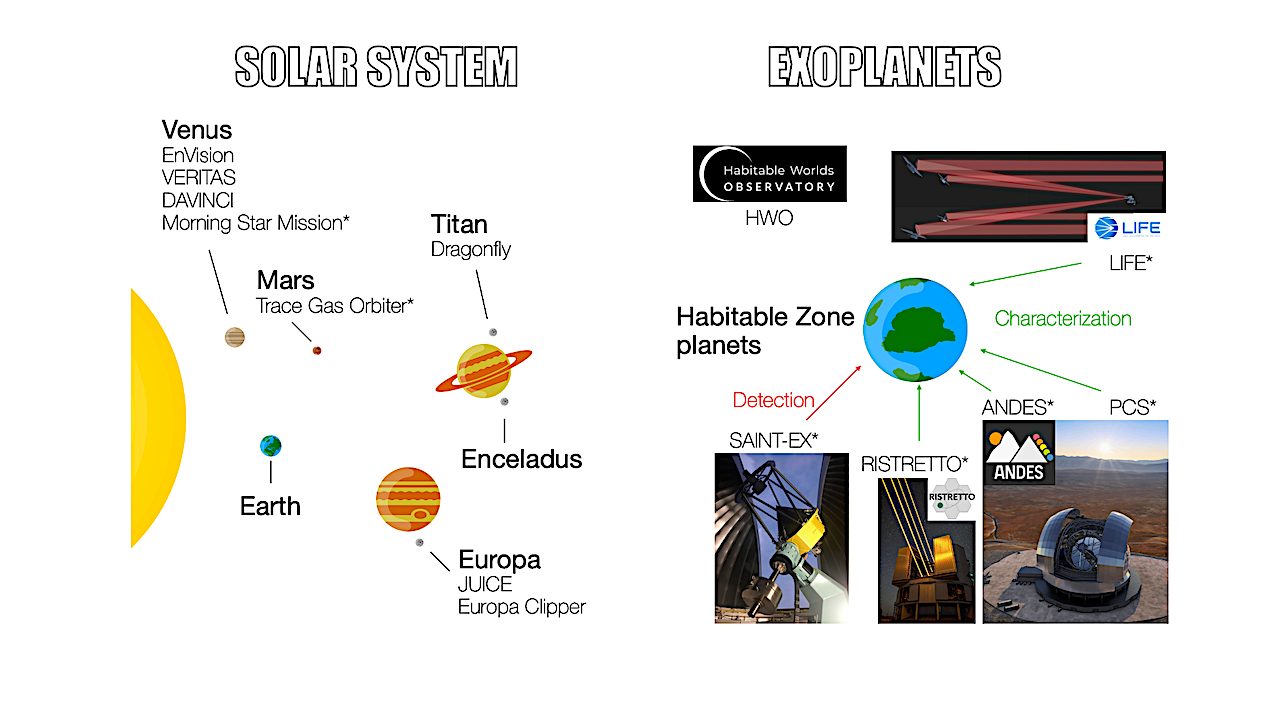
Understanding the climates of terrestrial exoplanets and the detectability of biosignatures is an inherently interdisciplinary challenge, requiring the integration of insights from Solar System exploration, exoplanet observations and climate science. Building from Earth as the only known inhabited planet, NCCR PlanetS has developed models, tools and observational strategies to assess planetary environments far beyond direct reach.
Between 2018 and 2025, PlanetS made major contributions across theory, modelling, instrumentation and mission preparation. On the modelling side, the Generic Planetary Climate Model enabled climate studies across a wide range of planetary regimes, from early Venus to temperate terrestrial exoplanets including Proxima b, incorporating advanced developments such as a dynamical slab ocean. In parallel, the THOR global climate model was developed to avoid Earth-centric assumptions and to stably simulate diverse atmospheric regimes.
PlanetS has also advanced atmospheric retrieval techniques combining forward modelling, Bayesian inference and machine learning, applied to targets ranging from Solar System bodies to exoplanet phase curves and directly imaged spectra. These efforts have helped assess the scientific return of future missions, notably the Large Interferometer for Exoplanets (LIFE) and to define instrumental requirements for detecting Earth-like atmospheres and biosignatures.
Within the Solar System, PlanetS contributed key technologies for biosignature detection, including ORIGIN and SenseLife, enabling in-situ and remote detection of organics, isotopic ratios and microstructures.
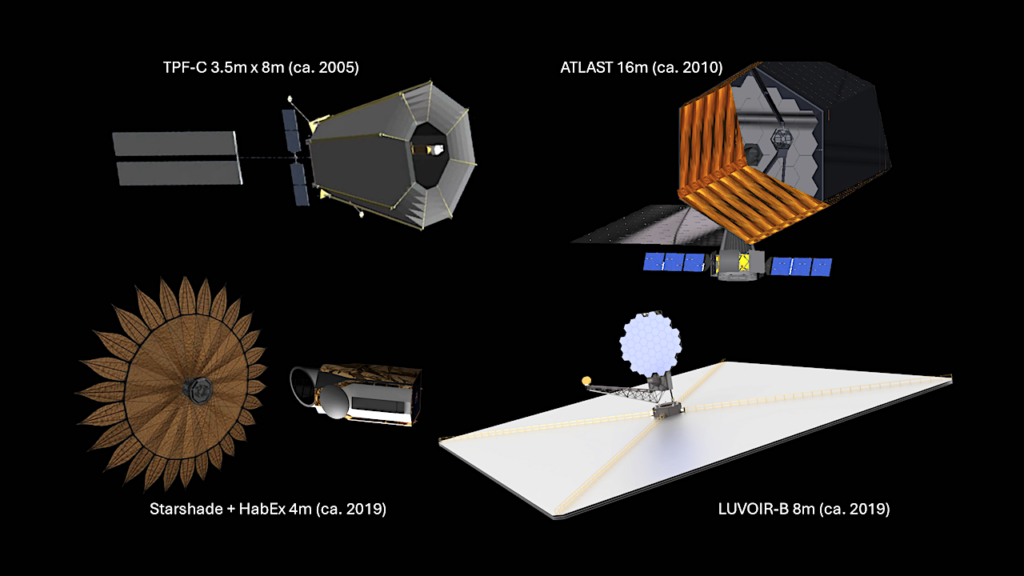
Finally, PlanetS has played a major role in preparing the next generation of observatories, from JWST, VLT and ELT instruments to LIFE and the Habitable Worlds Observatory. Together, these contributions form an integrated framework advancing the search for life beyond Earth.
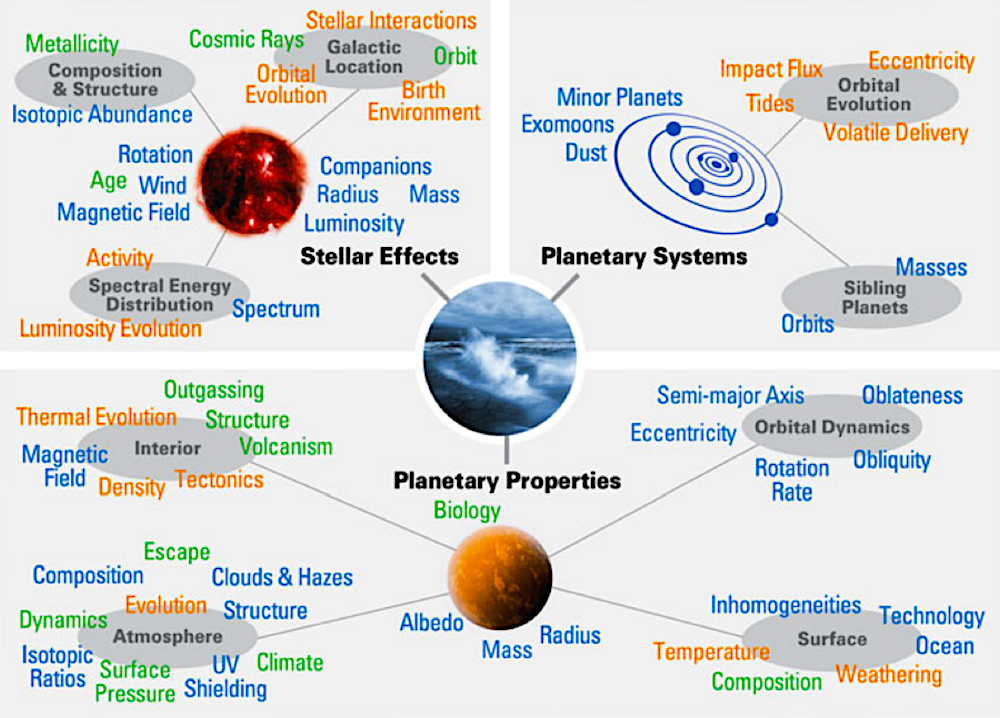
The various factors affecting planetary evolution and habitability. Font colors indicate observability: blue for directly detectable features with sufficiently powerful telescopes, green for those requiring model-based interpretation and orange for properties accessible mainly through theory. Credits: (Meadows and Barnes, 2018) — astro-ph.EP
Siddharth Bhatnagar, Emeline Bolmont, Nikita J. Boeren, Janina Hansen, Björn Konrad, Leander Schlarmann, Eleonora Alei, Marie Azevedo, Marrick Braam, Guillaume Chaverot, Jonathan Grone, Kaustubh Hakim, Mathilde Houelle, Daniel Kitzmann, Christophe Lovis, Antoine Pommerol, Sascha P. Quanz, Martin Turbet, Audrey Vorburger, Susanne F. Wampfler, Francis Zong Lang
Comments: This publication is a chapter in the PlanetS book, a book which will celebrate 12 years of planetary science related research in Switzerland (between 2014 and 2026). The two first authors contributed equally to this manuscript
Subjects: Earth and Planetary Astrophysics (astro-ph.EP)
Cite as: arXiv:2601.20620 [astro-ph.EP] (or arXiv:2601.20620v1 [astro-ph.EP] for this version)
https://doi.org/10.48550/arXiv.2601.20620
Focus to learn more
Submission history
From: Emeline Bolmont
[v1] Wed, 28 Jan 2026 13:52:51 UTC (26,897 KB)
https://arxiv.org/abs/2601.20620
Astrobiology