The Radius Cliff is a Waterfall: Explaining Sub-Neptune Exoplanets With Steam Worlds
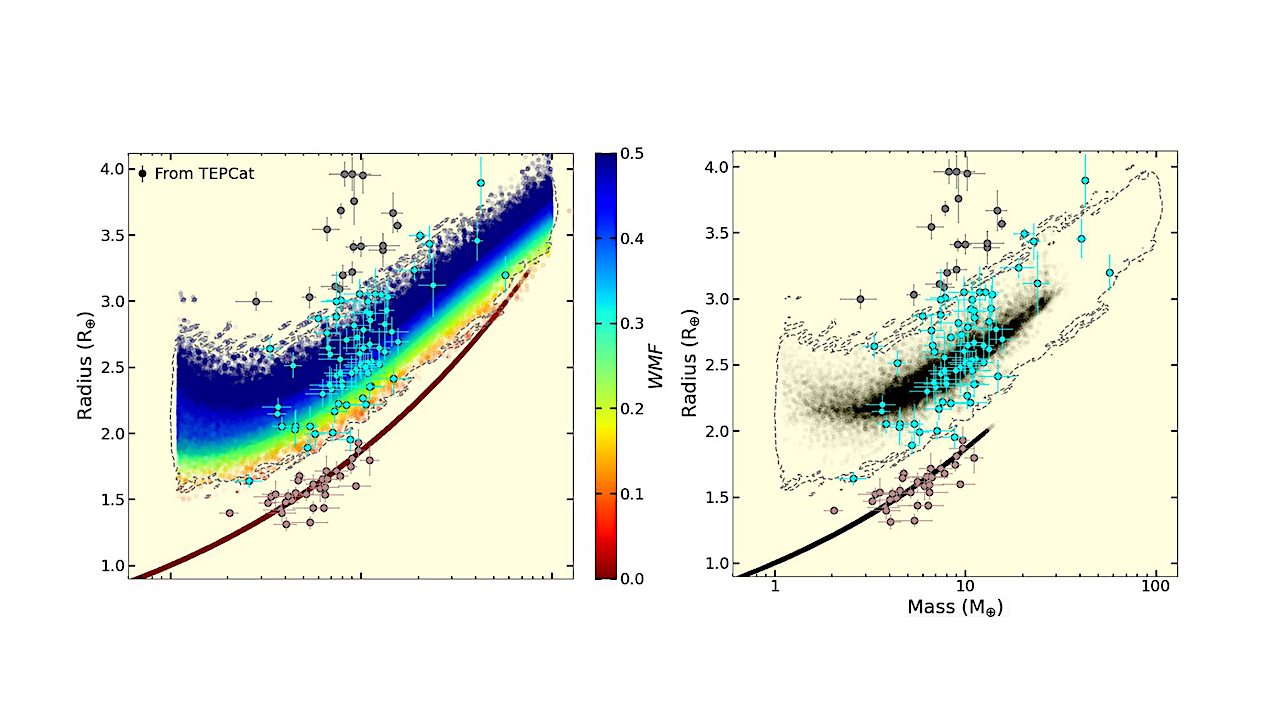
The demographics of Kepler planets provide a key testbed for models of planet formation and evolution, particularly for explaining the radius valley separating super-Earths and sub-Neptunes.
A primordial interpretation based on differences in bulk densities — where rocky and water-rich planets form via migration pathways — offers an alternative to atmospheric loss scenarios. Updated interior structure models of water worlds with adiabatic steam atmospheres reproduce the observed valley near ∼2 R⊕ more accurately.
Furthermore, migration models from our Genesis library suggest that these formation pathways can also account for the distinct period distributions of super-Earths and sub-Neptunes, as well as the emergence of the hot Neptune desert. Motivated by this, we develop a Bayesian hierarchical mixture model for close-in Kepler planets (P<100 days), combining rocky planets and water worlds without H/He envelopes.
The inferred mass distributions of rocky and water-rich planets peak at ∼2.6 M⊕ and ∼7 M⊕, respectively, with the water mass fraction of water worlds peaking at ∼41%. Water worlds provide a good representation of the Kepler sub-Neptune population, with the radius cliff emerging as a “waterfall” — a sharp decline in their occurrence. However, our mass-radius analysis shows that water worlds alone cannot explain planets with R≳3 R⊕, implying that at least ∼20% of sub-Neptunes in the sample are enriched in H/He gas.
Aritra Chakrabarty, Gijs D. Mulders, Artyom Aguichine, Natalie Batalha
Comments: 22 pages, 9 figures, accepted for publication in ApJ
Subjects: Earth and Planetary Astrophysics (astro-ph.EP); Solar and Stellar Astrophysics (astro-ph.SR)
Cite as: arXiv:2602.11923 [astro-ph.EP] (or arXiv:2602.11923v1 [astro-ph.EP] for this version)
https://doi.org/10.48550/arXiv.2602.11923
Focus to learn more
Submission history
From: Aritra Chakrabarty
[v1] Thu, 12 Feb 2026 13:23:00 UTC (1,276 KB)
https://arxiv.org/abs/2602.11923
Astrobiology, exoplanet,