Predictions Of The Nancy Grace Roman Space Telescope Galactic Exoplanet Survey. V. Detection Rates of Multiplanetary Systems In High Magnification Microlensing Events
The Nancy Grace Roman Space Telescope will expand the reach of gravitational microlensing surveys by increasing the number of events monitored and the precision of their light curves.
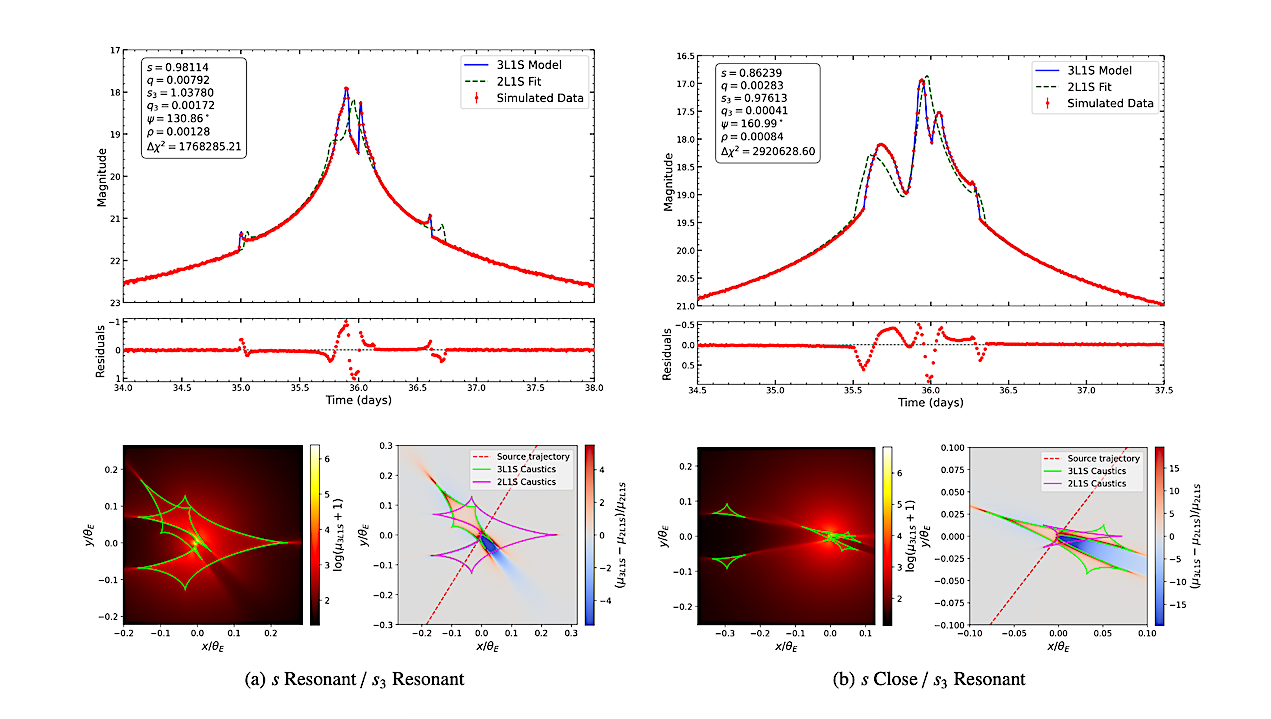
We investigate Roman’s ability to detect triple-lens microlensing systems, cases where a foreground star with two bound exoplanets produces detectable anomalies in a microlensing event, using its planned high-cadence observations toward the Galactic bulge. We simulate a large set of high-magnification microlensing light curves based on Roman’s expected survey characteristics.
A detection criterion, based on a required χ2 improvement for a two-planet model, is applied to determine whether the second planet can be reliably distinguished from a single-planet (binary-lens) model. Our simulations show that the majority of two-planet microlensing events would be detectable with Roman.
Events in which both planets are relatively massive (planet-star mass ratios of order 10−3), or in which the more massive planet occupies a favorable resonant configuration, produce strong central perturbations, resulting in detection efficiencies of roughly 90%. By contrast, systems with only low-mass planets (q∼10−4) or with less favorable alignments generate much weaker signals, which often fall below the detection threshold.
In general, the planetary mass ratios and the resulting caustic geometry (e.g., central caustic size in resonant versus wide/close orbits) are the dominant factors governing detectability. Taking into account the expected frequency of planetary systems and the fraction of high-magnification events, we estimate that Roman will detect a high-magnification triple-lens event in approximately 4.5% of multi-planet microlensing events, corresponding to about 64 events over the course of the full survey.
Vito Saggese, Étienne Bachelet, Sebastiano Calchi Novati, Valerio Bozza, Giovanni Covone, Farzaneh Zohrabi, Michael D. Albrow, Jay Anderson, Charles Beichman, David P. Bennett, Aparna Bhattacharya, Christopher Brandon, Sean Carey, Jessie Christiansen, Alison Crisp, William DeRocco, B. Scott Gaudi, Jon Hulberg, Macy J. Huston, Stela Ishitani Silva, Eamonn Kerins, Somayeh Khakpash, Katarzyna Kruszyńska, Casey Lam, Jessica R. Lu, Amber Malpas, Arjun Murlidhar, Marz Newman, Greg Olmschenk, Matthew Penny, Keivan G. Stassun, Alexander P. Stephan, Rachel A. Street, Takahiro Sumi, Sean K. Terry, Himanshu Verma, Weicheng Zang
Comments: 14 pages, 8 figures, 2 tables, Submitted to A&A
Subjects: Earth and Planetary Astrophysics (astro-ph.EP); Astrophysics of Galaxies (astro-ph.GA); Instrumentation and Methods for Astrophysics (astro-ph.IM)
Cite as: arXiv:2512.05182 [astro-ph.EP](or arXiv:2512.05182v1 [astro-ph.EP] for this version)
https://doi.org/10.48550/arXiv.2512.05182
Focus to learn more
Submission history
From: Vito Saggese
[v1] Thu, 4 Dec 2025 19:00:01 UTC (6,941 KB)
https://arxiv.org/abs/2512.05182
Astrobiology, Astronomy, Exoplanet,