Orbital Stability Of Moons Around The TRAPPIST-1 Planets
We investigate the dynamical stability of potential satellites orbiting the seven planets of the TRAPPIST-1 system using a suite of N-body simulations.
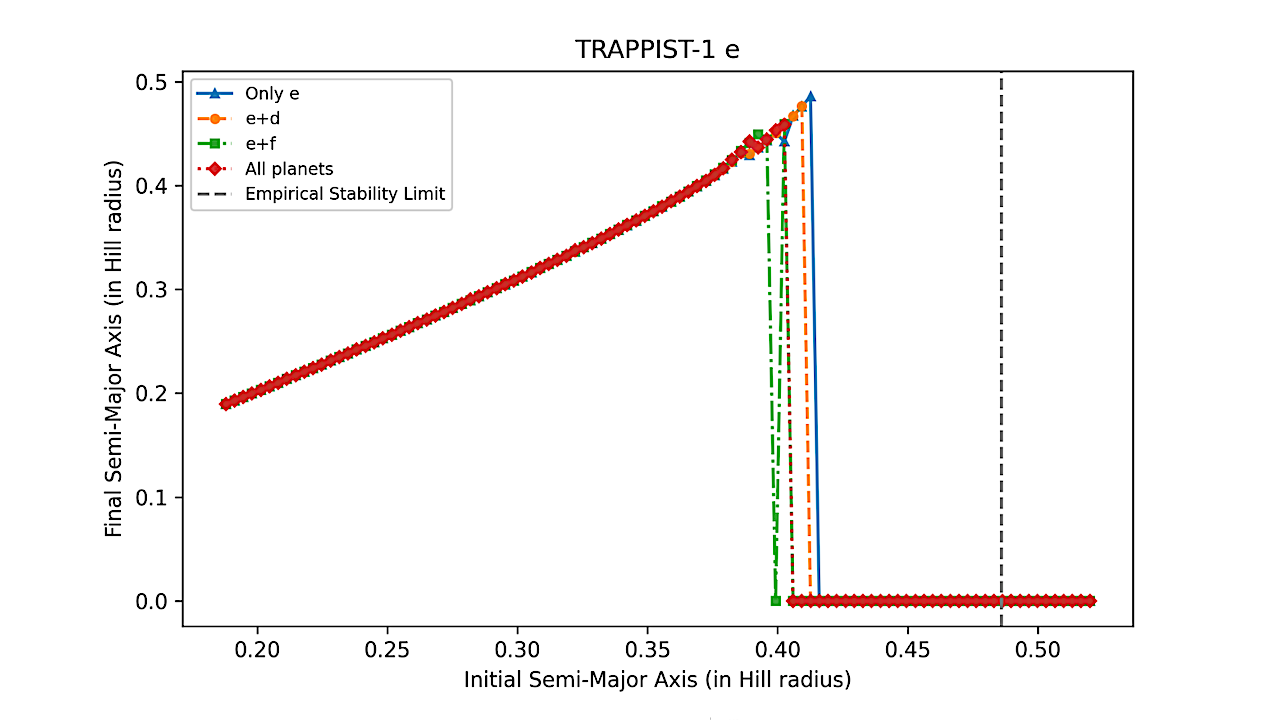
For each planet, we show that moons can remain stable from the Roche limit out to near the theoretical prograde stability boundary at roughly 0.5 Hill Radii. We quantify how perturbations from neighbouring planets modify these stability limits.
Although the overall effect of individual perturbers is generally weak, the combined gravitational influence of the full multi-planet configuration produces a modest contraction of the outer stable radius, notably for TRAPPIST-1 b and TRAPPIST-1 e. For each of the seven planets, the outer stability limit for satellites is at 40-45% of the Hill radius, consistent with previous work.
Using simple long-term tidal decay calculations, we show that the most massive satellites that could survive over Gyr timescales are 10−(7−9)M⊕ (with higher possible masses for the outer planets).
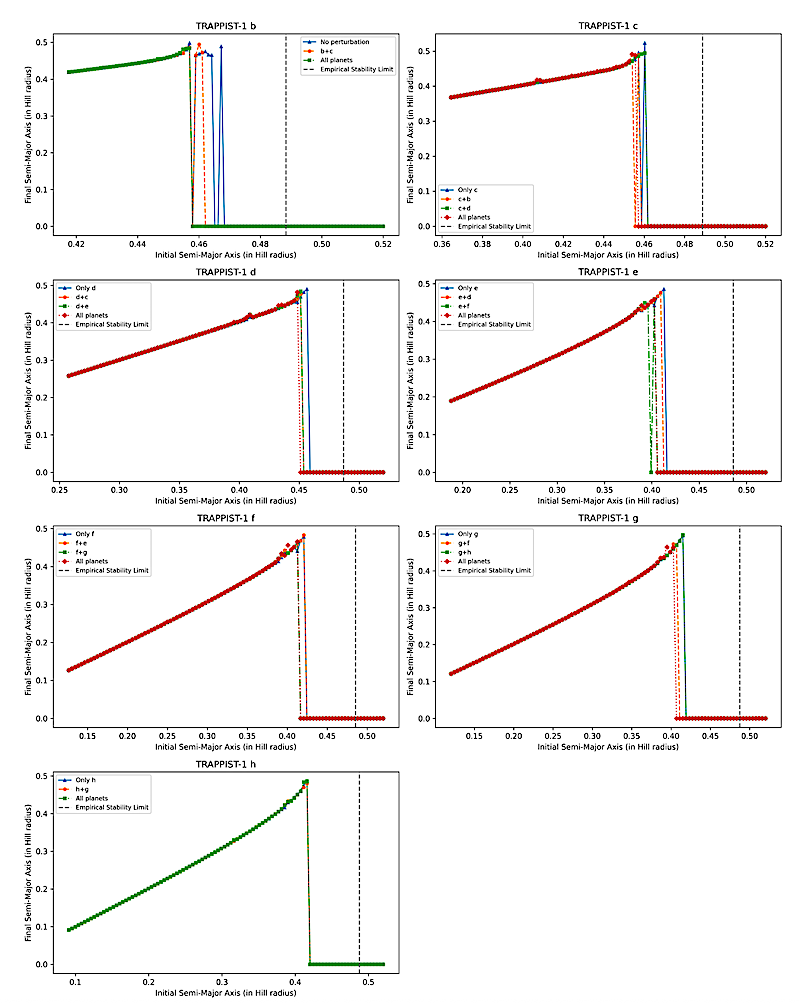
Final semi-major axes of satellites versus their initial orbital distance (in Hill radii) for each TRAPPIST-1 planet. Each panel compares stability outcomes under different perturbations: none, individual neighbouring planets, and the full multi-planet system. A drop to zero marks unstable orbits. The vertical dashed line indicates the empirical stability limit. In all cases, the full system shifts the stability boundary inward compared to isolated or single-perturber configurations. — astro-ph.EP
Shubham Dey, Sean N. Raymond
Comments: 5 pages, 1 figure
Subjects: Earth and Planetary Astrophysics (astro-ph.EP)
Cite as: arXiv:2512.19226 [astro-ph.EP] (or arXiv:2512.19226v1 [astro-ph.EP] for this version)
https://doi.org/10.48550/arXiv.2512.19226
Focus to learn more
Submission history
From: Shubham Dey Mr.
[v1] Mon, 22 Dec 2025 10:06:45 UTC (957 KB)
https://arxiv.org/abs/2512.19226
Astrobiology, exoplanet,