Evidence Of 1:1 Slope Between Rocky Super-Earths And Their Host Stars
The relationship between the composition of rocky exoplanets and their host stars is fundamental to understanding planetary formation and evolution.
However, previous studies have been limited by inconsistent datasets, observational biases and methodological differences. This study investigates the compositional relationship between rocky exoplanets and their host stars, utilizing a self-consistent and homogeneous dataset of 21 exoplanets and their 20 host stars.
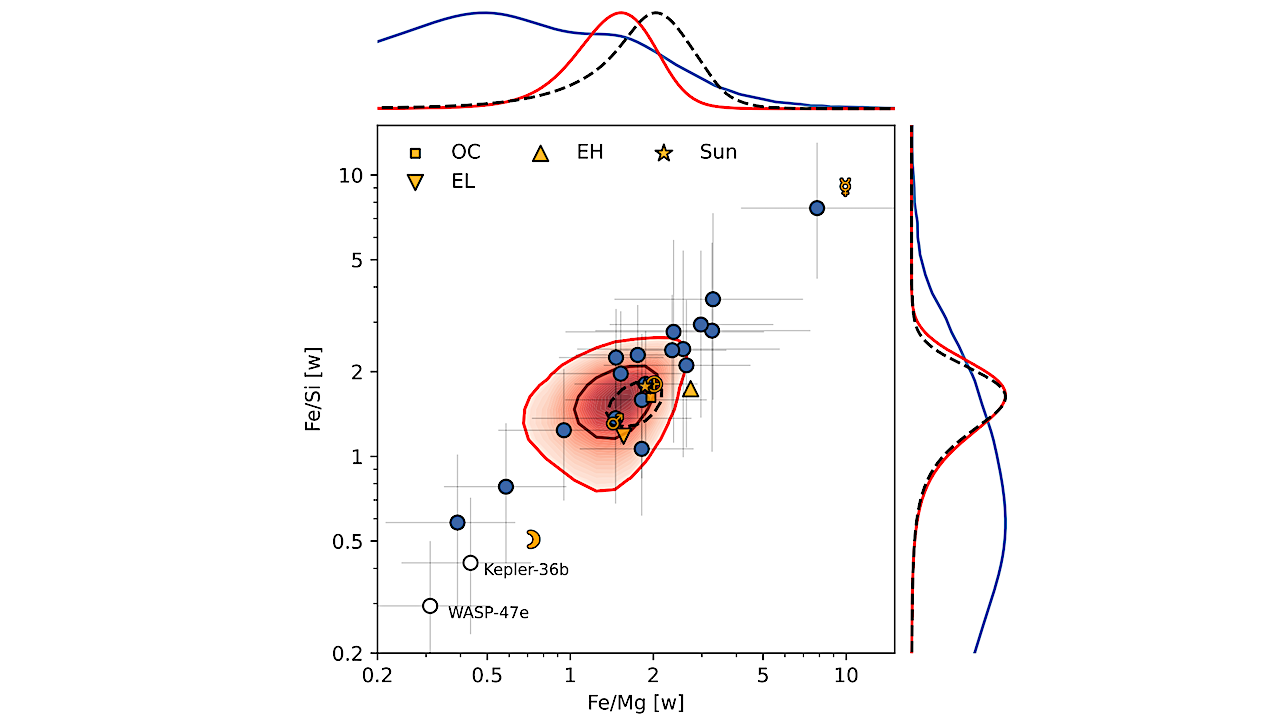
By applying sophisticated interior structure modeling and comprehensive chemical analysis, we identify a potential 1:1 best-fit line between the iron-mass fraction of planets and their host stars equivalent with a slope of m=0.94+1.02−1.07 and intercept of c=−0.02+0.31−0.29.
This results are consistent at the 1σ level with other homogeneous studies, but not with heterogeneous samples that suggest much steeper best-fit lines. Although, our results remain tentative due to sample size and data uncertainties, the updated dataset significantly reduces the number of super-Mercuries from four to one, but it remains that several high-density planets are beyond what a primordial origin would suggest.
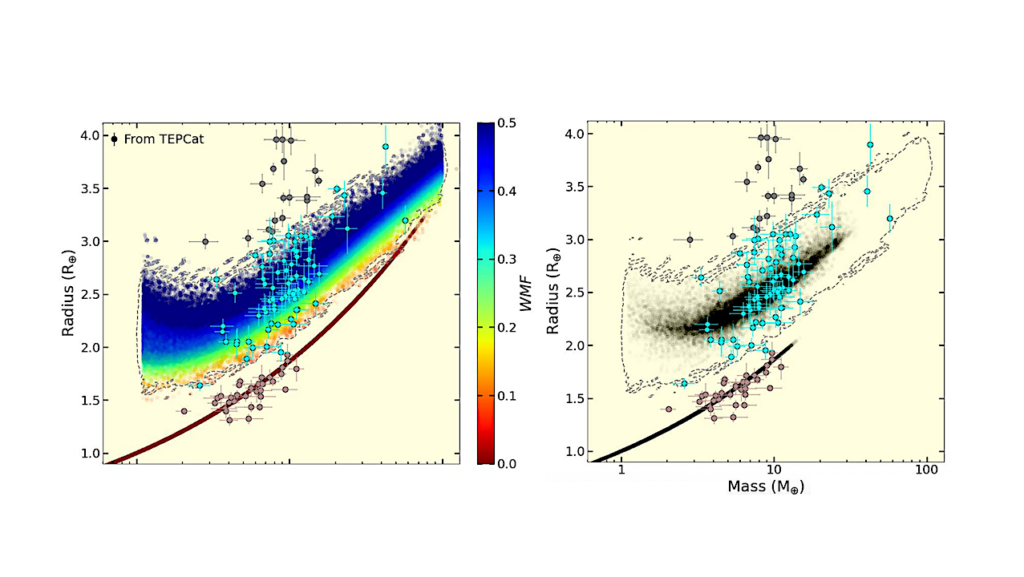
The planets in our sample have a wider range of compositions compared to stellar equivalent values, that could indicate formation pathways away from primordial or be the result of random scattering owing to current mass-radius uncertainties as we recover the observed outliers in mock population analysis ∼15% of the time.
To truly determine whether the origin is primordial with a 1:1 true relation, we find that sample of at least 150 planets is needed and that stars that are iron enrich or depleted are high value targets.
Mykhaylo Plotnykov, Diana Valencia, Alejandra Ross, Henrique Reggiani, Kevin C. Schlaufman
Comments: 24 pages, 13 figures, accepted in ApJ
Subjects: Earth and Planetary Astrophysics (astro-ph.EP); Solar and Stellar Astrophysics (astro-ph.SR)
Cite as: arXiv:2511.17717 [astro-ph.EP] (or arXiv:2511.17717v1 [astro-ph.EP] for this version)
https://doi.org/10.48550/arXiv.2511.17717
Focus to learn more
Related DOI:
https://doi.org/10.3847/1538-4357/ae200b
Focus to learn more
Submission history
From: Mykhaylo Plotnykov
[v1] Fri, 21 Nov 2025 19:13:11 UTC (894 KB)
https://arxiv.org/abs/2511.17717
Astrobiology,