What Cold-water Geysers On Earth Reveal About The Habitability Of Ocean Worlds
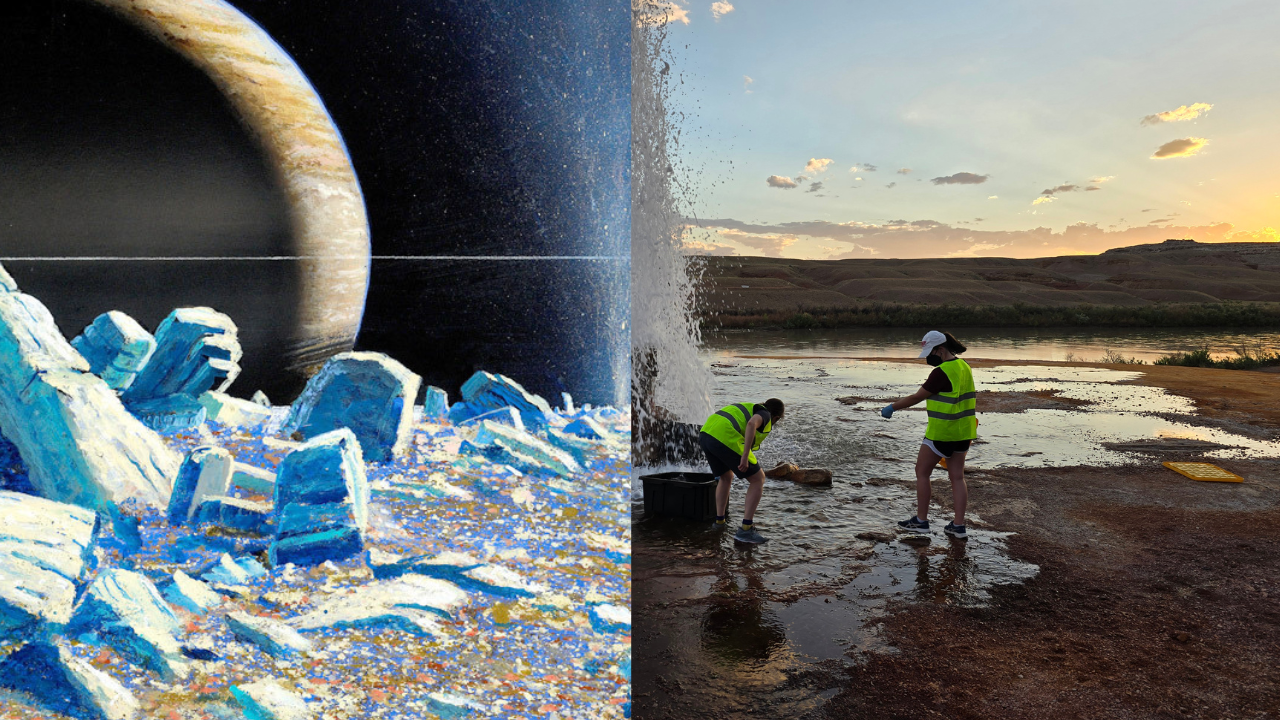
In the eastern Utah desert, carbon-dioxide-saturated water bubbles, sprays and foams from the ground. These cold-water geysers, sometimes called ‘soda pop geysers,’ are a new and reliable Earth-based analog for scientists studying plume eruptions of ocean worlds in the outer Solar System, according to new research led by Planetary Science Institute Senior Scientist Morgan Cable and published in Astrobiology.
“The same mechanics driving the cold-water geysers in Utah may also be occurring at the south pole of Saturn’s moon Enceladus, and at Jupiter’s moon Europa, where recent carbon dioxide-rich deposits have been identified on its surface,” Cable said. Such plumes are scientifically interesting targets because their composition can potentially reveal the habitability of the oceans below the surfaces of these icy moons.
Europa alone has two missions slated for arrival in 2030 and 2031: NASA’s Europa Clipper and the European Space Agency’s Jupiter Icy Moons Explorer, respectively. But before scientists can make sense of data returned from these missions – which will include measurements of the gas and grains within plume ejecta, if present – they must first understand how the journey from a moon’s briny bowels to the harsh environment of space can modify the spray’s composition compared to their host reservoirs, and in turn, potentially obscure the reality beneath the ice.
So, Cable and her team, which also includes PSI Senior Scientist Alex Patthoff, ventured into the desert to do just that. In Green River, Utah, they identified two carbon dioxide-driven cold-water geysers – Crystal Geyser and the smaller Champagne Geyser, and in 2024, they collected the effluent from both for chemical and biological analysis.
They found that the geysers’ discharge volume, eruptive energy and proximity to a subsurface host reservoir may all play a role in the composition of plume ejecta and surface deposits.
“While there’s no perfect Earth-based analog for the plumes on other worlds, this study did provide important constraints and lessons learned about the abundance and detectability of habitability indicators,” Cable said.
For example, it appears that plumes eject material that was drawn up from deep within an underground reservoir, when compared with the unerupted waters.
“If we extrapolate these findings to ocean worlds, missions should consider targeting large vents or areas of output to ensure access to materials from depth,” Cable said. “And, if possible, analysis of material from multiple sources of varied flux might provide a ‘depth profile’ of the host underground reservoir.”
What’s more, the team found compositional discrepancies between ejecta and reservoir measurements, such as pH, a measure of a substance’s acidity or alkalinity.
“This means that future research will benefit from combining measurements of plume ejecta by spacecraft, Earth-based telescope observations and geochemical computer models to fully characterize plume deposits and make robust inferences of ocean composition,” Cable said.
This work was funded with support from NASA’s Europa Inspiring Clipper: Opportunities for Next-generation Scientists Program.
Cold-Water CO2 Geysers as Ocean World Plume Analogs: Investigation of Habitability Indicators in Crystal and Champagne Geysers Pre- and Posteruption, Astrobiology via Sage journals
astrobiology