On The Synergetic Use Of Ariel And JWST For Exoplanet Atmospheric Science
This white paper explores the potential for strategic synergies between the JWST and the Ariel telescopes, two flagship observatories poised to revolutionise the study of exoplanet atmospheres.
Both telescopes have the potential to address common fundamental questions about exoplanets-especially concerning their nature and origins-and serve a growing scientific community. With their operations now anticipated to overlap, starting from 2030, there is a unique opportunity to enhance the scientific outputs of both observatories through coordinated efforts.
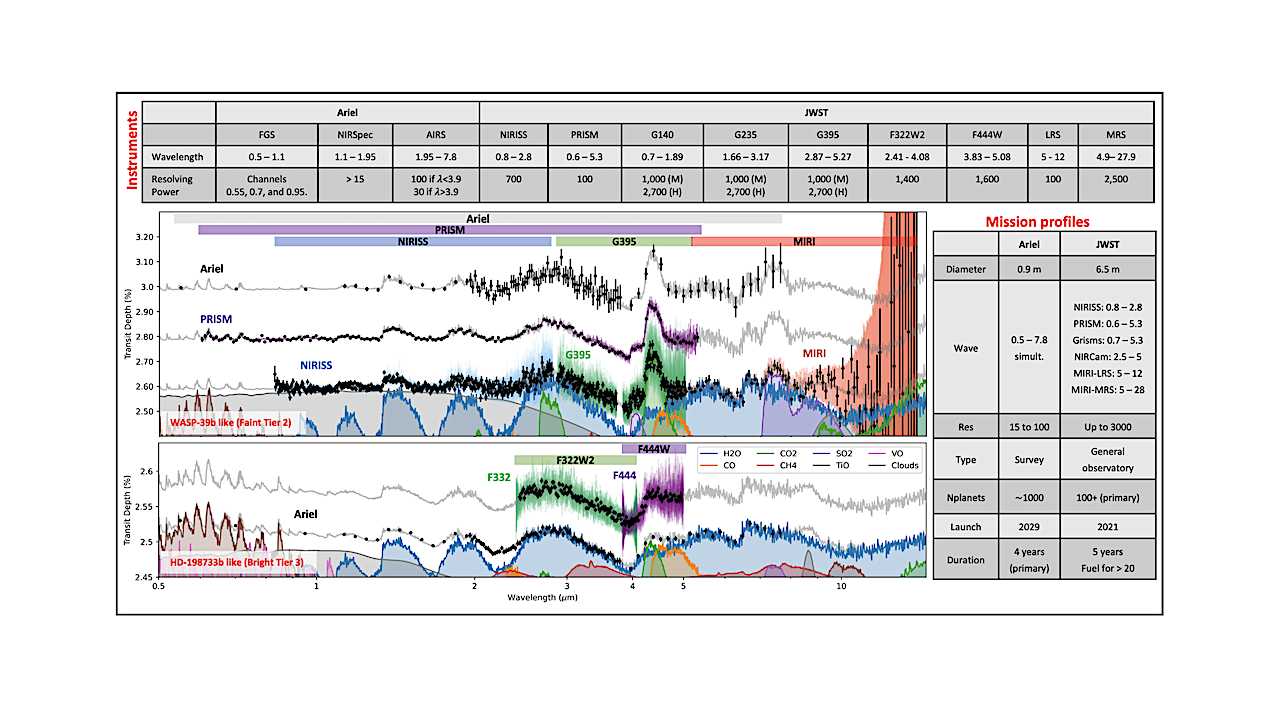
In this report, authored by the Ariel-JWST Synergy Working Group, part of the Ariel Consortium Science Team, we summarise the capabilities of JWST and Ariel; we highlight their key differences, similarities, synergies, and distinctive strengths. Ariel is designed to conduct a broad survey of exoplanet atmospheres but remains highly flexible, allowing the mission to integrate insights from JWST’s discoveries.
Findings from JWST, including data from initiatives shaped by NASA’s decadal survey priorities and community-driven research themes, will inform the development of Ariel’s core survey strategy. Conversely, Ariel’s ability to perform broad-wavelength coverage observations for bright targets provides complementary avenues for exoplanet researchers, particularly those interested in time-domain observations and large-scale atmospheric studies.
This paper identifies key pathways for fostering JWST-Ariel synergies, many of which can be initiated even before Ariel’s launch. Leveraging their complementary designs and scopes, JWST and Ariel can jointly address fundamental questions about the nature, formation, and evolution of exoplanets. Such strategic collaboration has the potential to maximise the scientific returns of both observatories and lay the foundation for future facilities in the roadmap to exoplanet exploration.
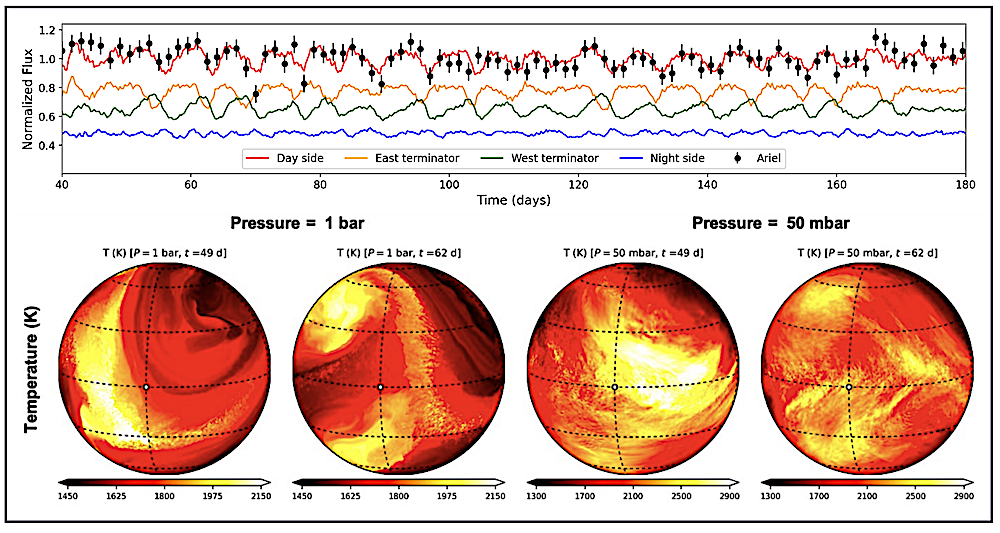
Blackbody emission at 104 Pa for a ultra-hot Jupiter like WASP-121 b (top) and example of temperature maps (bottom) from Changeat et al. (2024a). The planetary emission is integrated from 1 µm and 7.8µm and normalized by the mean of the day-side. Ariel’s observations and estimated error bars are shown in black. Variability patterns of the order of a few percent could be detected by Ariel (see also Kafle, Y-K. Cho, and Changeat, 2025). — astro-ph.IM
Quentin Changeat, Pierre-Olivier Lagage, Giovanna Tinetti, Benjamin Charnay, Nicolas B. Cowan, Camilla Danielski, Elsa Ducrot, Achrene Dyrek, Billy Edwards, Theresa Lueftinger, Giuseppina Micela, Giuseppe Morello, Enzo Pascale, Severine Robert, Olivia Venot, Joanna K. Barstow, Andrea Bocchieri, James Y-K. Cho, Ryan Cloutier, Athena Coustenis, Panayotis Lavvas, Yamila Miguel, Kay Hou Yip
Comments: White paper authored by the Ariel-JWST synergy working group, community feedback are welcomed, 18 pages
Subjects: Instrumentation and Methods for Astrophysics (astro-ph.IM); Earth and Planetary Astrophysics (astro-ph.EP)
Cite as: arXiv:2509.02657 [astro-ph.IM](or arXiv:2509.02657v1 [astro-ph.IM] for this version)
https://doi.org/10.48550/arXiv.2509.02657
Focus to learn more
Submission history
From: Quentin Changeat
[v1] Tue, 2 Sep 2025 16:34:13 UTC (9,143 KB)
[v2] Thu, 5 Feb 2026 11:26:49 UTC (11,333 KB)
https://arxiv.org/abs/2509.02657
Astrobiology,