Linking Planet Formation To Exoplanet Characteristics: C/O As A Diagnostic Of Planet Formation
Gas-giant exoplanets are test cases for theories of planet formation as their atmospheres are proposed to carry signatures of their formation within the protoplanetary disk.
The metallicity and C/O are key diagnostics, allowing to distinguish formation location within the disk (e.g., relative to snowlines), and mechanism (e.g., core accretion versus gravitational instability).
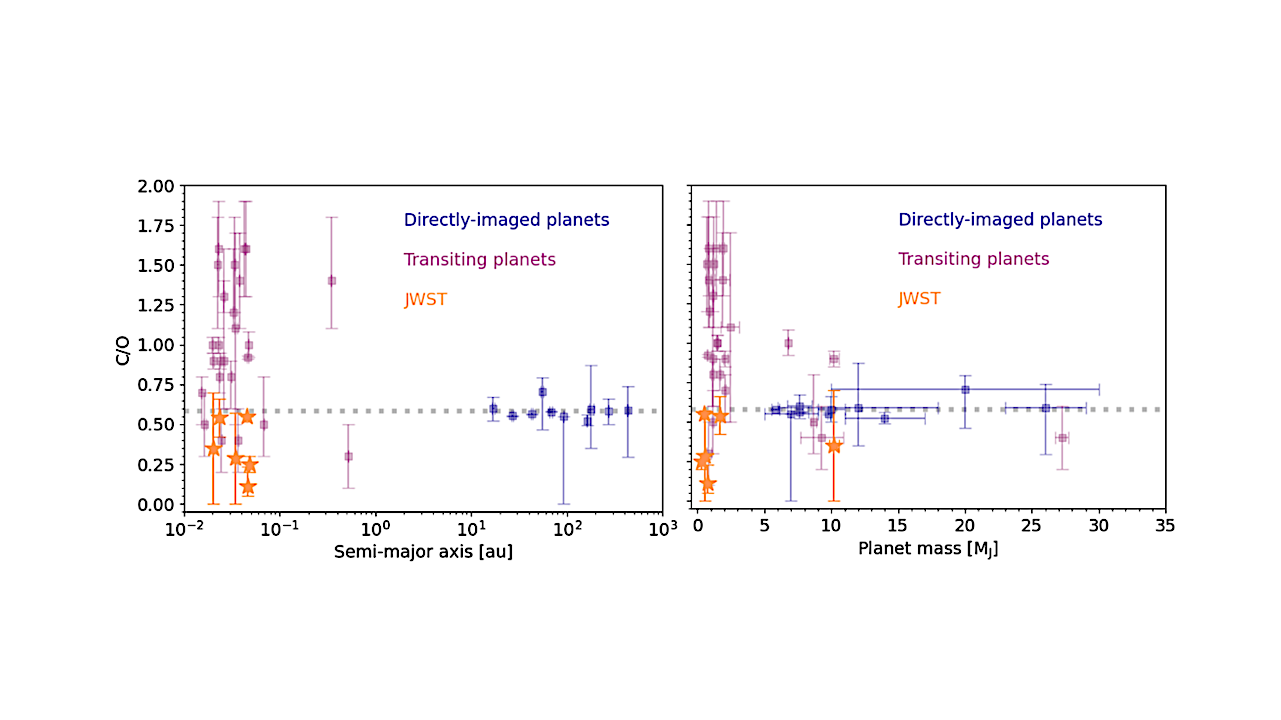
We can now probe the composition of the planet-forming regions of disks, and that in gas-giant exoplanets, to scrutinise these theories and diagnostics. So far, ALMA has revealed that the outer disk regions are typically metal-depleted and O-poor, whereas JWST is showing that the inner disk regions around Sun-like stars are mostly O-rich.
Further, JWST is showing that most transiting gas-giant planets are typically metal-enriched and O-rich, consistent with formation at/within the water snowline and pollution by icy bodies. There is emerging an arguably “conventional” picture of gas-giant planet formation for transiting planets, to be confirmed, of course, with future data.
Catherine Walsh (University of Leeds)
Comments: Accepted for publication in IAU Symposium 383 proceedings “Astrochemistry VIII: From the first galaxies to the formation of habitable worlds”. This short review was composed in January 2024 and all references/information are up to date until that time
Subjects: Earth and Planetary Astrophysics (astro-ph.EP); Astrophysics of Galaxies (astro-ph.GA)
Cite as: arXiv:2508.09587 [astro-ph.EP] (or arXiv:2508.09587v1 [astro-ph.EP] for this version)
https://doi.org/10.48550/arXiv.2508.09587
Focus to learn more
Submission history
From: Catherine Walsh
[v1] Wed, 13 Aug 2025 08:02:48 UTC (656 KB)
https://arxiv.org/abs/2508.09587
Astrobiology,