Efficient Reduction Of Stellar Contamination And Noise In Planetary Transmission Spectra Using Neural Networks
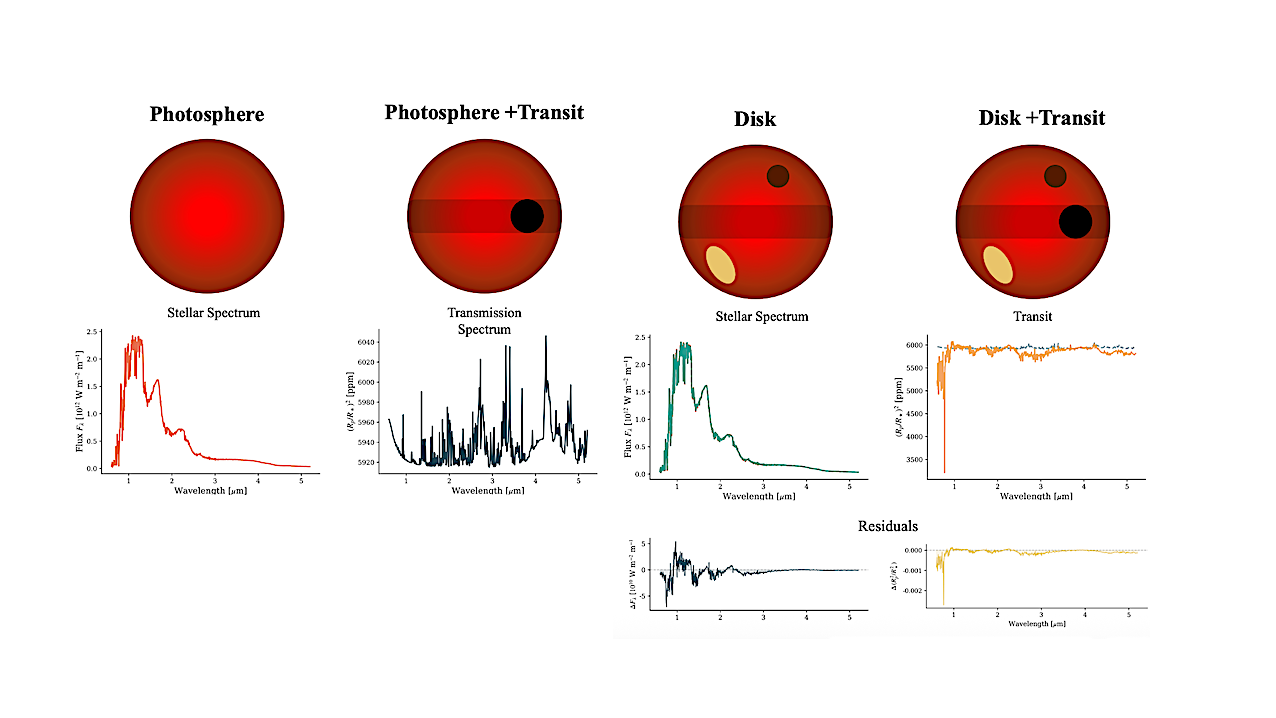
Context: JWST has enabled transmission spectroscopy at unprecedented precision, but stellar heterogeneities (spots and faculae) remain a dominant contamination source that can bias atmospheric retrievals if uncorrected.
Aims: We present a fast, unsupervised methodology to reduce stellar contamination and instrument-specific noise in exoplanet transmission spectra using denoising autoencoders, improving the reliability of retrieved atmospheric parameters.
Methods: We design and train denoising autoencoder architectures on large synthetic datasets of terrestrial (TRAPPIST-1e analogues) and sub-Neptune (K2-18b analogues) planets. Reconstruction quality is evaluated with the χ2 statistic over a wide range of signal-to-noise ratios, and atmospheric retrieval experiments on contaminated spectra are used to compare against standard correction approaches in accuracy and computational cost.
Results: The autoencoders reconstruct uncontaminated spectra while preserving key molecular features, even at low S/N. In retrieval tests, pre-processing with denoising autoencoders reduces bias in inferred abundances relative to uncorrected baselines and matches the accuracy of simultaneous stellar-contamination fitting while reducing computational time by a factor of three to six.
Conclusions: Denoising autoencoders provide an efficient alternative to conventional correction strategies and are promising components of future atmospheric characterization pipelines for both rocky and gaseous exoplanets.
David S. Duque-Castaño, Lauren Flor-Torres, Jorge I. Zuluaga
Comments: 16 pages, 11 figures. Submitted to Astronomy & Astrophysics. Unabridged version
Subjects: Earth and Planetary Astrophysics (astro-ph.EP); Instrumentation and Methods for Astrophysics (astro-ph.IM); Machine Learning (cs.LG)
Cite as: arXiv:2602.10330 [astro-ph.EP] (or arXiv:2602.10330v2 [astro-ph.EP] for this version)
https://doi.org/10.48550/arXiv.2602.10330
Focus to learn more
Submission history
From: David S. Duque-Castaño
[v1] Tue, 10 Feb 2026 22:07:18 UTC (7,569 KB)
[v2] Thu, 12 Feb 2026 02:25:40 UTC (7,419 KB)
https://arxiv.org/abs/2602.10330
Astrobiology,