Titan’s Organic World
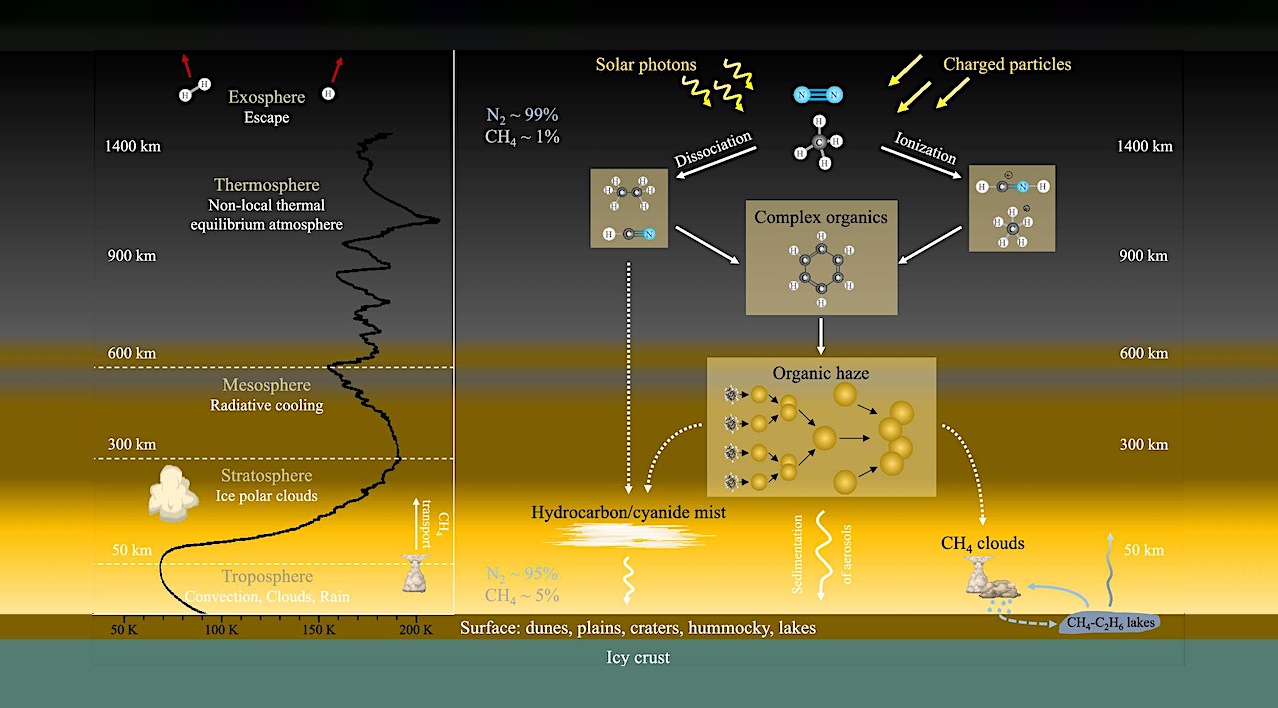
Titan, Saturn’s largest moon, possesses a dense N2–CH4 atmosphere driving complex organic chemistry. The interplay among photochemistry, aerosol formation, organic cloud condensation, and surface deposition makes Titan a natural laboratory for studying organic reaction networks and assessing the environmental conditions relevant to habitability on a cold, molecularly rich world.
Titan’s vertical atmospheric structure broadly resembles Earth’s, with a convective troposphere, a stratosphere, and a mesosphere transitioning into a tenuous thermosphere. Despite being colder, Titan’s atmosphere is more extended due to its lower gravity, with scale heights—the characteristic altitude over which atmospheric pressure or density decreases by a factor of e—of 15–50 km (compared to 5–8 km on Earth).
Two planetary boundary layers are present: a seasonal layer near 2 km and a diurnal layer that can reach ~800 m over a Titan day (15 d 22 h). Titan’s orbital period around Saturn is about 29.5 Earth years, driving long seasonal variability.
Located 1.4 billion km from the Sun, Titan receives only about one-thousandth of Earth’s solar flux. Its surface temperature is approximately 94 K, while surface pressure is close to 1.5 bar1. Under these conditions, methane exists near its triple point and plays a role analogous to water on Earth, forming clouds, precipitation, rivers, and seas. Titan is therefore the only known body, besides Earth, to host stable surface liquids.
- Titan’s organic world, Nature via PubMed (open access)
- Titan’s organic world, Nature (open access)
Astrobiology, Astrochemistry, Astrogeology,