High-resolution mid-IR Spectroscopy of SVS 13-A with EXES/SOFIA: The Surprisingly High CH3OH/H2O Ratio In The Planet-forming Zone Of A Solar Mass Protostar
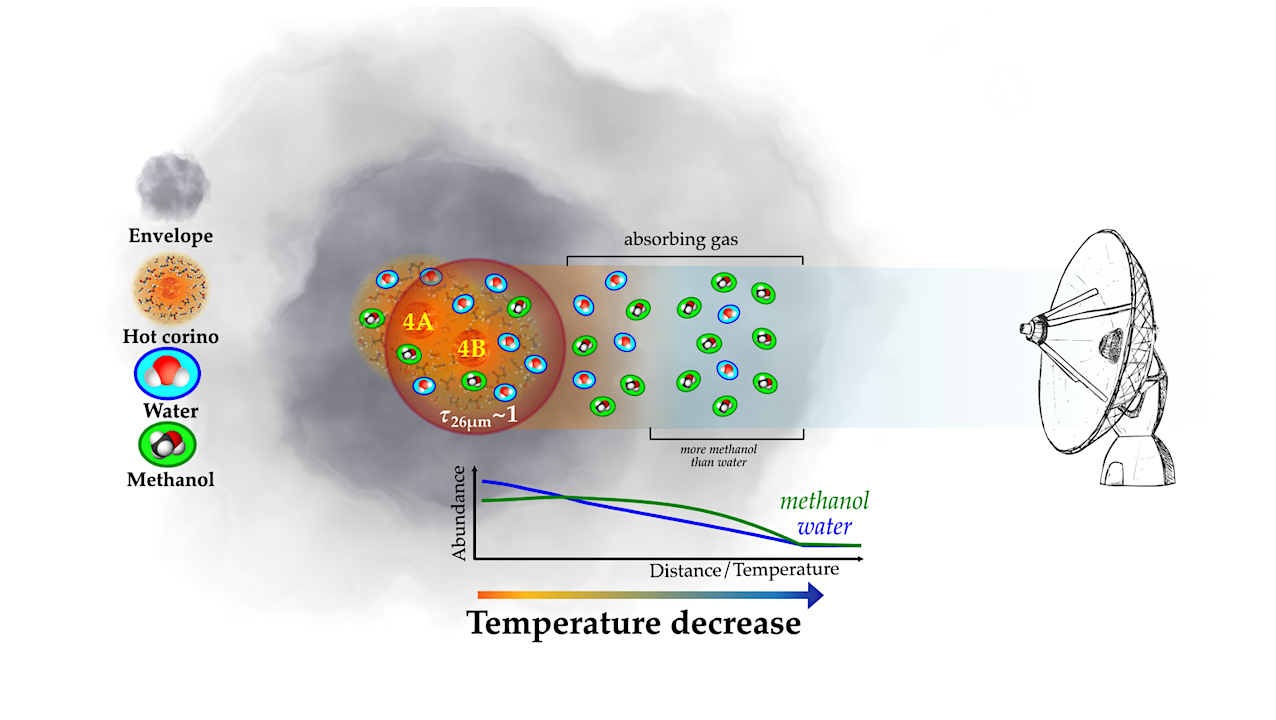
Water and methanol are key components of interstellar ices and gas in star- and planet-forming regions, but direct observations of water in low-mass protostars are challenging due to atmospheric absorption.
We present high-resolution (R = 70,500) mid-infrared spectroscopy of the Class I protostar SVS13-A with EXES on board SOFIA at 26 μm, targeting both H2O and CH3OH absorption lines. Several lines of each species are detected, tracing warm gas with rotational temperatures of ∼140–170 K.
Remarkably, the methanol column density is a factor of ∼4 higher than that of water, well above typical interstellar ice ratios (<10%). Comparison with previous millimeter observations indicates that absorption and emission probe distinct regions, with the mid-IR lines likely tracing cooler gas along the line of sight.
The surprising observed CH3OH/H2O ratio may reflect selective sublimation due to the distribution of binding energies or ice stratification in the inner envelope. These observations probe the inner regions of the protostar, where planets are expected to form and inherit the chemical composition of their natal environment, providing a direct link between ice sublimation and gas-phase chemistry.
Our results represent the first high-spectral-resolution mid-infrared view of both water and methanol toward a low-mass protostar, offering a unique window into the chemical composition of the innermost envelope and planet-forming region, and highlighting the diagnostic power of high-resolution mid-infrared spectroscopy to uncover hidden chemical layers and the ice-to-gas transition in embedded protostars.
Curtis DeWitt, Marta De Simone, Eleonora Bianchi, Cecilia Ceccarelli, Claudio Codella, Sarah Nickerson, Keeyoon Sung, Albert Rimola, Vittorio Bariosco, Piero Uliengo, Naseem Rangwala
Comments: 13 pages, 5 figures, accepted to ApJL
Subjects: Solar and Stellar Astrophysics (astro-ph.SR); Earth and Planetary Astrophysics (astro-ph.EP); Astrophysics of Galaxies (astro-ph.GA)
Cite as: arXiv:2603.19992 [astro-ph.SR] (or arXiv:2603.19992v1 [astro-ph.SR] for this version)
https://doi.org/10.48550/arXiv.2603.19992
Focus to learn more
Submission history
From: Curtis DeWitt
[v1] Fri, 20 Mar 2026 14:42:39 UTC (1,691 KB)
https://arxiv.org/abs/2603.19992
Astrobiology,