Distinguishing Life From Non-life Via Molecular Frontier Orbital Energy Gaps
Amino acids (AAs) are a key target in the search for life beyond Earth due to their extensive role in the machinery of all known life, persistence over geologic timescales, and analytical detectability.
However, AAs can also arise from abiotic processes on planets and in space. For example, material from asteroid Bennu contained 33 AAs, including 15 of the 20 proteinogenic AAs that are fundamental to life’s functions. Distinguishing life from non-life based on AAs in a sample remains an unsolved problem, particularly when their isotopic and structural signatures (e.g., chirality) could be altered via physicochemical processes.
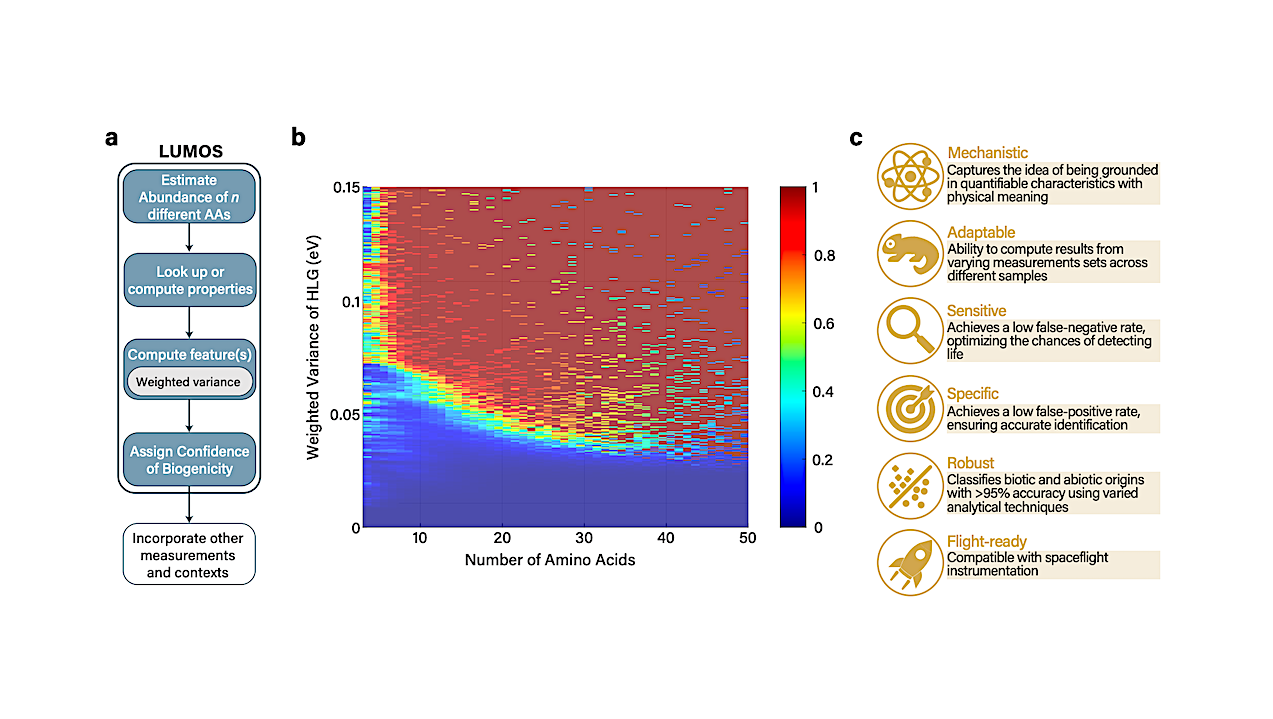
Here we introduce LUMOS (Life Unveiled via Molecular Orbital Signatures), a statistical framework that distinguishes life from non-life by analyzing the distribution of abundance-weighted HOMO-LUMO gap (HLG) values of AAs within a sample. Compilation of AAs datasets from diverse environments and provenances revealed that abiotic samples display highly uniform distributions of AAs HLGs.
In contrast, biotic samples show greater variance and preference towards AAs with lower HLG, likely reflecting the need for life to control when, where, and how chemical reactions occur. LUMOS achieves >95% accuracy in distinguishing biotic versus abiotic provenance across diverse environmental and extraterrestrial conditions.
These results suggest that varied molecular reactivity within biochemical systems may be a universal feature of life, representing an agnostic biosignature unlinked to the specific set of AAs used by life as we know it. LUMOS is compatible with existing analytical instrumentation, applicable to returned samples or in situ analyses. Broader characterization of abiotic and biotic environments will further refine the chemical boundaries separating biotic from abiotic chemical systems.
José L. Ramírez-Colón, Ziqin Ni, Christopher E. Carr
Comments: Keywords: Life detection, Biosignatures, Amino acids, Frontier Orbitals, HOMO-LUMO Gap, Agnostic. Code available at: https://github.com/jlramirezcolon/hlg-life-detection. AGPLv3 License
Subjects: Earth and Planetary Astrophysics (astro-ph.EP); Chemical Physics (physics.chem-ph); Biomolecules (q-bio.BM)
Cite as: arXiv:2602.18490 [astro-ph.EP] (or arXiv:2602.18490v1 [astro-ph.EP] for this version)
https://doi.org/10.48550/arXiv.2602.18490
Focus to learn more
Submission history
From: Christopher Carr
[v1] Wed, 11 Feb 2026 23:48:37 UTC (1,562 KB)
https://arxiv.org/abs/2602.18490
Astrobiology,