An Archival Summary: 15 Years Of ALMA Observations On Disks And Planet Formation

The Atacama Large (sub-)millimeter Array (ALMA) has been in scientific operations for almost 15 years.
We celebrate this achievement by providing a summary of the “Disks and planet formation” scientific category, with an emphasis on the disks located in the nearby star-forming regions.
As of the beginning of February 2026, ALMA had observed 3933 independent coordinates, which we analyzed by their location in the sky, frequency coverage, exposure time, spectral line coverage, and angular resolution.
We encourage the community to explore new scientific questions that are made possible through the archival datasets.
The Atacama Large Millimeter/submillimeter Array (ALMA) has been in operation since 2011. This timelapse shows the first observation date and total exposure time for all entries in the ALMA Archive within the scientific category “Disks and Planet Formation”. These observations are summarized in Kurtovic et al. (2026b): “An archival summary: 15 years of ALMA observations on disks and planet formation”. The star-forming regions are labeled following Delfini et al. (2025), based on the catalog of Avedisova (2002). The original bell sound used in the video was uploaded to Freesound.org by giddster and is licensed under Creative Commons 0 (https://freesound.org/s/437333/). Credit: Nicolas Kurtovic. via astro-ph.EP
A sequence of images from the ALMA telescope, with observations of the dust continuum emission from planet forming disks, after deprojecting by inclination and position angle. In the central image, all the disks are shown at the same spatial scale. The orbits of the planets in our Solar System are presented at the beginning for size reference. The insert on the bottom left shows the original image from ALMA, with the image extent changing from disk to disk to adjust for the disk size. All these images and their bibliographic references can be found in Kurtovic et al. (2026b): “An archival summary: 15 years of ALMA observations on disks and planet formation”. Song credit: “In the Hall of the Mountain King” by Edvard Grieg, performed by the Czech National Symphony Orchestra (as the Musopen Symphony Orchestra) for the Musopen Kickstarter Project. Downloaded from Wikimedia, available through Public Domain Licensing. — via astro-ph.EP
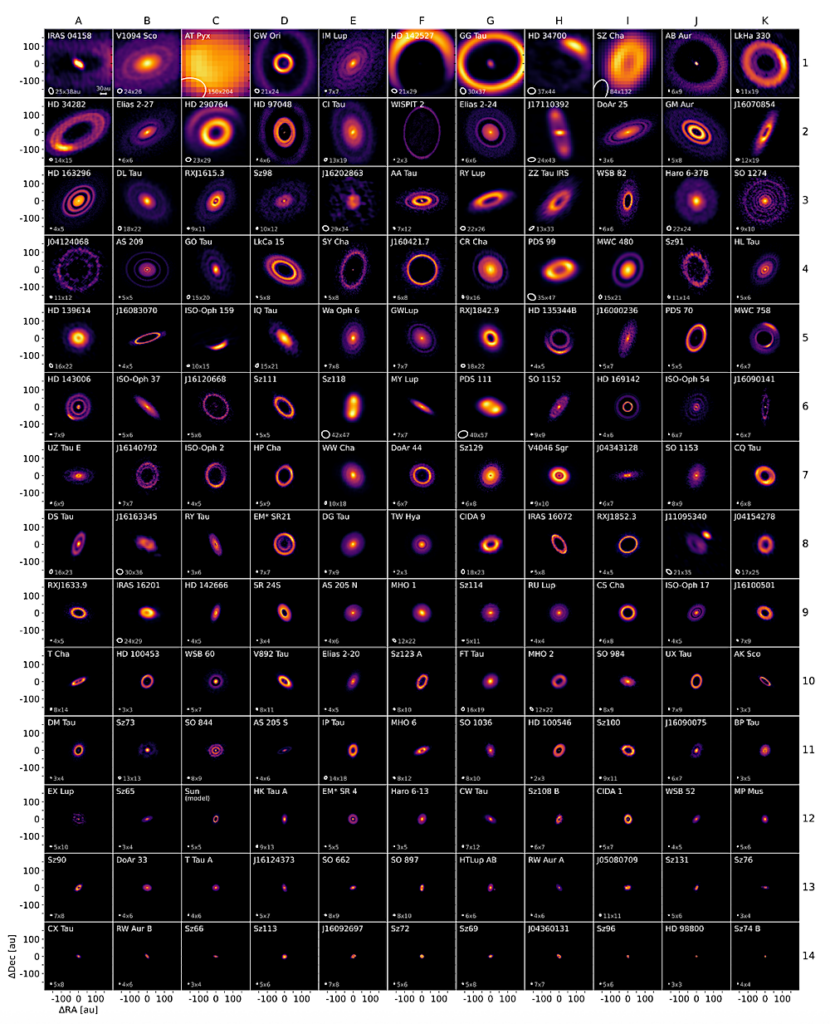
Collection of disks with substructures in dust continuum emission, available in the literature. Each panel is 400 au in size, and the disks are scaled based on the Gaia DR3 parallax, ranging from largest to smallest continuum disk from top to bottom. Further details and references in Sect. C. — astro-ph.EP
Nicolas T. Kurtovic, Lizxandra Flores-Rivera, Laura M. Perez, Miguel Vioque, Myriam Benisty, Felipe Alarcón, Marcelo Barraza-Alfaro, Pietro Curone, Kiyoaki Doi, Sierra Grant, Haochang Jiang, Akimasa Kataoka, Feng Long, Álvaro Ribas, Anibal Sierra, Lucas Stapper, Milou Temmink, Francesco Zagaría
Comments: The data of this draft is also shown here and here . The tables are available at https://github.com/nicokurtovic/Tables_archival-summary-2026. Article to be submitted to OJAp
Subjects: Earth and Planetary Astrophysics (astro-ph.EP)
Cite as: arXiv:2605.30023 [astro-ph.EP] (or arXiv:2605.30023v1 [astro-ph.EP] for this version)
https://doi.org/10.48550/arXiv.2605.30023
Focus to learn more
Submission history
From: Nicolás Kurtovic
[v1] Thu, 28 May 2026 14:42:40 UTC (4,194 KB)
https://arxiv.org/abs/2605.30023
Astrobiology, Astronomy, Exoplanet,