Assessing Ariel’s Capabilities To Observe Free-floating Brown Dwarfs

The primary goal of the Ariel space telescope is to conduct the biggest spectroscopic survey of transiting exoplanets to characterize their atmospheres and weather.
We propose to extend the Ariel survey to another domain of alien atmospheres – rogue planets and free-floating brown dwarfs.
Their isolated nature means the observations are uncontaminated by light from a host star, and their short rotation periods, often similar to hot Jupiter orbital periods, provide an opportunity to study time-varying meteorology.
Phase curve observations would especially help scientists understand atmospheric dynamics at the L/T transition, where multiple cloud species at different altitudes influence the time-varying spectra of brown dwarfs.
Inferring timescales and length scales of these atmospheric features is key to understanding the meteorology of sub-stellar objects. We quantify how many isolated cool objects that Ariel’s fine guidance sensor (FGS) is able to guide on.
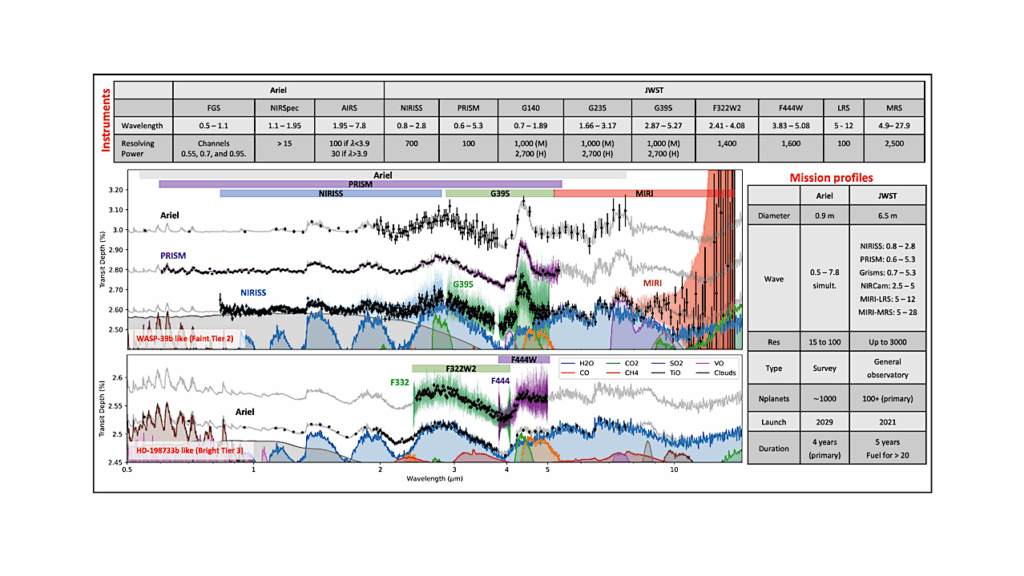
Among 2744 selected targets, none are bright enough under the planned 10 Hz FGS cadence; however, with a “slow” fine guidance mode of 1 Hz, Ariel could study 98 L0- to L5-type brown dwarfs. We simulate single-epoch and time-series spectroscopic observations of the brightest isolated brown dwarfs given currently known instrumental specifications.
We show that the resolution and sensitivity of Ariel instruments in the 1.1-7.8 micron regime can measure cloud-induced variability at the sub-percent level. A survey of brown dwarf phase curve observations, unavailable to ground-based telescopes, would be the perfect complement to Ariel’s survey of atmospheric variability in hot Jupiters.
Roman Akhmetshyn, Nicolas B Cowan, Sarah Casewell
Comments: Submitted to RASTI on May 22, 2026
Subjects: Earth and Planetary Astrophysics (astro-ph.EP); Instrumentation and Methods for Astrophysics (astro-ph.IM); Solar and Stellar Astrophysics (astro-ph.SR)
Cite as: arXiv:2605.28924 [astro-ph.EP] (or arXiv:2605.28924v1 [astro-ph.EP] for this version)
https://doi.org/10.48550/arXiv.2605.28924
Focus to learn more
Submission history
From: Roman Akhmetshyn
[v1] Wed, 27 May 2026 18:00:00 UTC (198 KB)
https://arxiv.org/abs/2605.28924
Astrobiology