On The Information Content of Ariel Transmission Spectra: Reassessing The Tier System
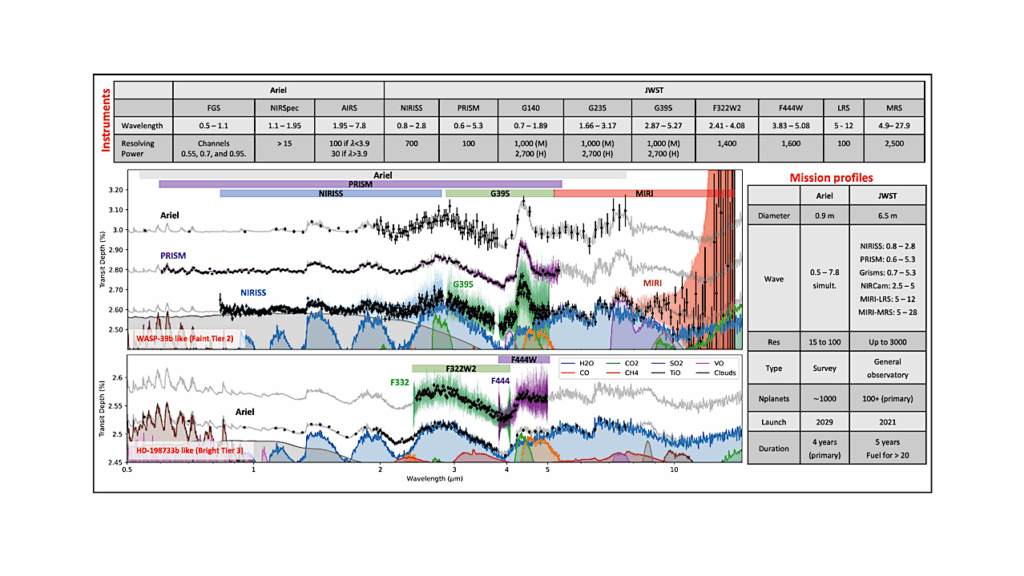
The European Space Agency’s Ariel mission will conduct a survey of the atmospheric properties of exoplanets around bright stars.
The mission is nominally divided into three Tiers. The Tier 1 survey will consist of low-precision observations of ~1000 planets, with a subset of these included in the higher-precision Tier 2 survey expected to be necessary for atmospheric characterization.
Tier 3 will be repeated observations of a small number of benchmark planets. Though previous studies have assessed the ability of Ariel to uncover population-level trends, they have generally presupposed a given Tier.
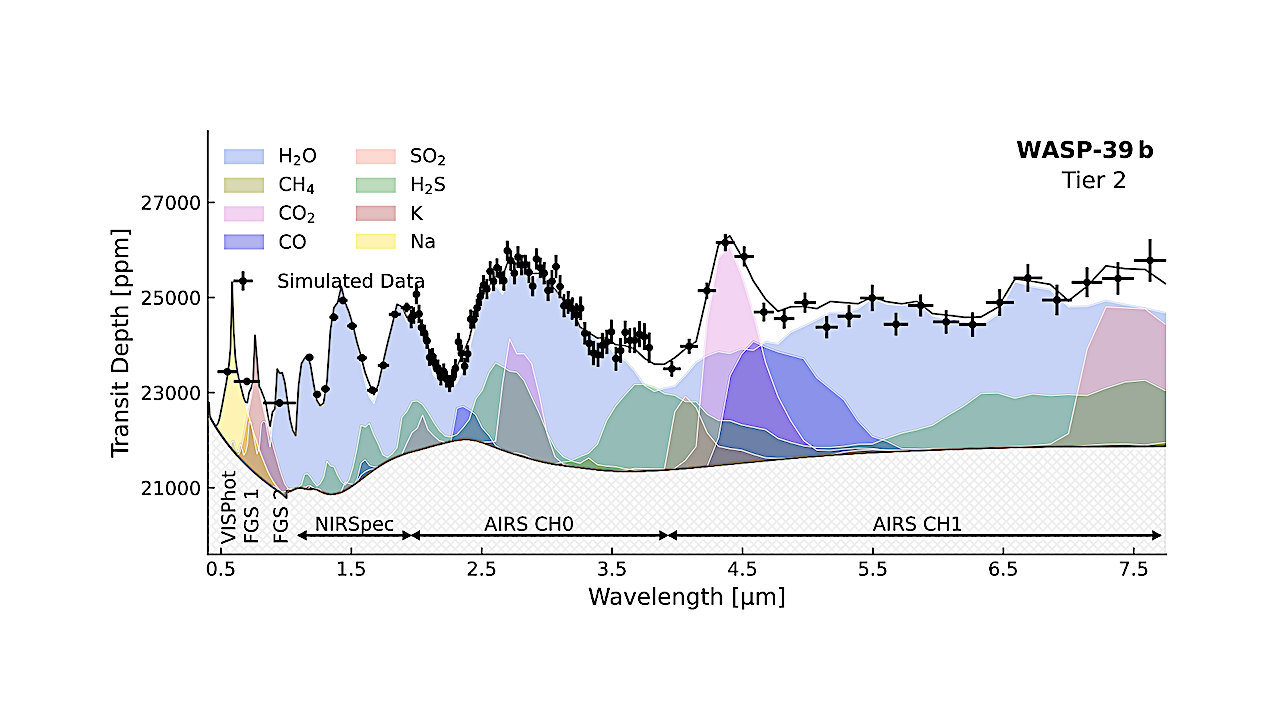
Here we interrogate this assumption and assess the information content of Ariel transmission spectra as a function of Tier for three benchmark planets: a hot-Saturn, warm-Neptune, and temperate sub-Neptune. We simulate a grid of Ariel transit spectra at different Tiers for each target and use retrievals to assess which chemical species are detectable.
We find that for giant planets like a hot-Saturn or warm-Neptune, Tier 1-quality observations are sufficient for <1.5dex constraints on H2O and CO2, irrespective of the presence of clouds — meaning important chemical insights are already obtainable in the Tier 1 survey. Moving to Tiers 2 and 3 result in an incremental increase in precision as well as other molecules becoming detectable in certain scenarios (e.g., H2S, CO).
Tier 1 observations are also sufficient to constrain CH4 in a cloud-free, temperate sub-Neptune, whereas observations with at least Tier 2 precision are necessary if the atmosphere is cloudy. The number of transits necessary to reach this precision, however, may be prohibitive for the inclusion of temperate sub-Neptunes in even the Tier 1 survey.
Michael Radica, Nicolas B. Cowan, Ryan Cloutier, Leo Yang Wang
Comments: 13 pages. Submitted to AAS Journals
Subjects: Earth and Planetary Astrophysics (astro-ph.EP); Instrumentation and Methods for Astrophysics (astro-ph.IM)
Cite as: arXiv:2604.07598 [astro-ph.EP] (or arXiv:2604.07598v1 [astro-ph.EP] for this version)
https://doi.org/10.48550/arXiv.2604.07598
Focus to learn more
Submission history
From: Michael Radica
[v1] Wed, 8 Apr 2026 21:08:18 UTC (270 KB)
https://arxiv.org/abs/2604.07598
Astrobiology, Astronomy, Exoplanet,