Ariel Stellar Characterisation IV. Fundamental Parameters Of 18 Hot Stars In The Ariel Mission Candidate Sample

The characterisation of exoplanetary systems depends on the accurate determination of host star parameters.
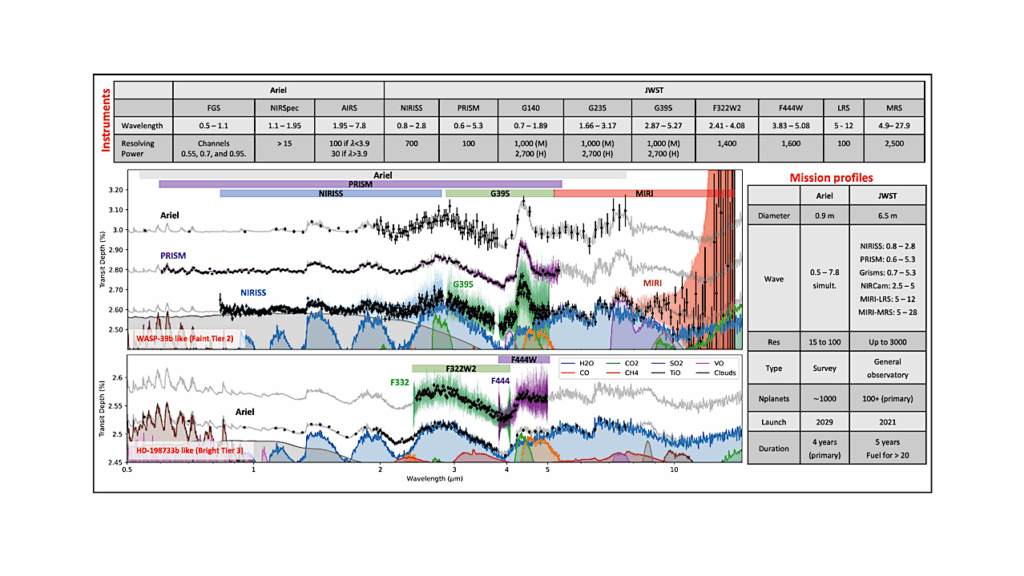
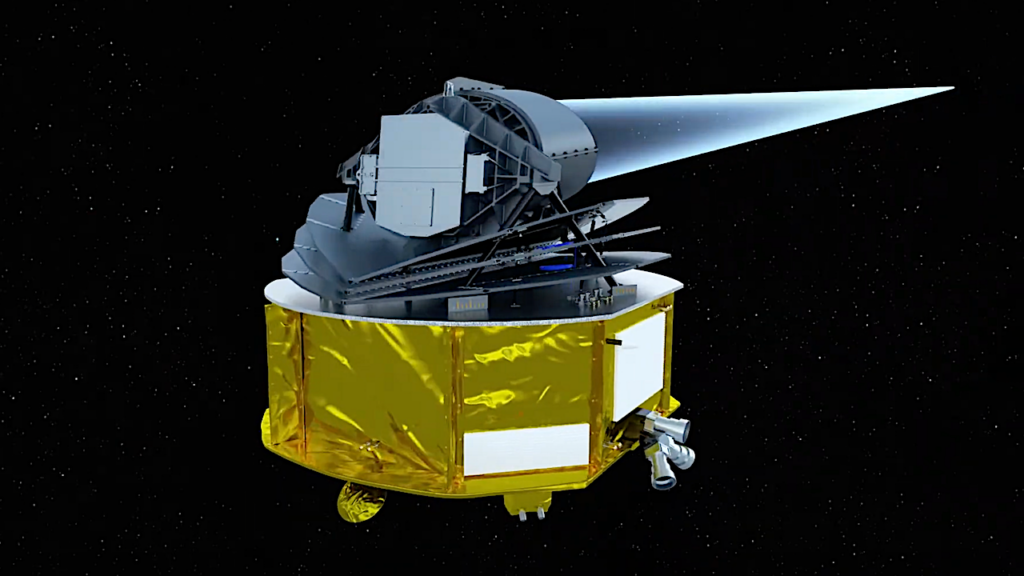
The Ariel mission will probe the atmospheres of a statistically significant sample of exoplanets, and so requires a precise characterisation of the stellar properties well before its launch in 2029. The homogeneous determination of stellar parameters for Ariel will enable both the optimisation of the final target list and set roots for a reliable interpretation of the formation and evolution of planetary systems.
Such a homogeneous characterisation has thus far only been carried out for the cool teff ≲7000K host stars among the Ariel target candidates. We present a uniform determination of fundamental stellar parameters for 18 hot stars in the Tier 1 candidate list of the Ariel mission candidate sample. We adopted an iterative spectro-trigonometric approach optimised for high-temperature stars.
High-resolution spectra were analysed using the zeeman code with χ2 minimisation, combining model fits to metal and Balmer lines. Surface gravity was refined using photometry-based radii and masses from stellar evolutionary tracks. We derived effective temperatures, surface gravities, projected rotational velocities, microturbulent velocities, overall metallicities, iron abundances, stellar masses, and radii for our sample of 18 hot stars.
Our results were validated against a set of benchmark stars previously presented in the literature. The derived parameters provide an internally consistent basis for studying the link between stellar properties and planetary characteristics in intermediate-mass stars. Building on our previous work on FGK host stars, we show that correlations between stellar mass, metallicity, and planetary radii also extend to early-type stars, and stellar properties influence the architecture of multi-planet systems.
H. Ramler, S. P. D. Borthakur, C. P. Folsom, D. Bossini, A. Lehtmets, C. Danielski, D. Turrini, M. Benito, M. Tsantaki, L. Magrini, N. Moedas, K. Biazzo, R. da Silva, M. Kama, E. Siimon, V. Mitrokhina, K. G. Hełminiak, S. Benatti, M. Rainer
Subjects: Solar and Stellar Astrophysics (astro-ph.SR); Earth and Planetary Astrophysics (astro-ph.EP)
Cite as: arXiv:2605.12644 [astro-ph.SR] (or arXiv:2605.12644v1 [astro-ph.SR] for this version)
https://doi.org/10.48550/arXiv.2605.12644
Focus to learn more
Submission history
From: Heleri Ramler
[v1] Tue, 12 May 2026 18:32:34 UTC (2,893 KB)
https://arxiv.org/abs/2605.12644
Astrobiology, exoplanet,