From Microbial Dark Matter To Living Library: New Biobank Decodes Survival Secrets Of Extreme Acid Mine Drainage Microbes
Editor’s note: If we aspire to mount expeditions to new worlds and then embrace the task of characterizing and quantifying whatever life forms we find, the ability to map and understand whatever metabolic and genomic systems are in operation is important. Not only do we need to know how alien biota function, but also how they evolved – what differences and similarities they may have with the origin and evolution of life on Earth. Increasing in situ capabilities like this can allow much more preliminary analysis to be done on site – or back on Earth.
Over the past several decades our definition of “life as we know it” on Earth has undergone a paradigm shift as we have discovered various “extremophiles” living in environments that orthodox biology would see as being “extreme”. These extreme environments may be more normal and common – and important – than we once thought. The environments that extremophiles inhabit may resemble the environments wherein life first originated and evolved on Earth. Of course, evolution is still ongoing.
The disposal of large amounts of toxic materials seems to have eliminated many life forms in the deepest reaches of the ocean while providing a novel albeit extreme environment. Organisms – perhaps nascent extremophiles already equipped with some adaptive traits can survive, adapt, and thrive. How these adaptations happen and morph during evolution will be instructive not only in understanding life’s origin but also the range of locations on this world – and on others – where life (as we mostly understand it) can exist. Of course dumping these poisons into our oceans is not a smart idea in the first place.
mbAMD (describe below) is a good start in collecting the various attributes of terrestrial extremophile characteristics and should inform the eventual development of similar astrobiology datasets – which are hopefully mutually intercompatible.
Acid mine drainage (AMD) – one of Earth’s most hostile habitats – forms when sulfide minerals are exposed to air, water and microbes, generating pH levels below 3 and high concentrations of heavy metals.
Despite this harshness, AMD hosts diverse and specialized microbial communities that drive iron and sulfur geocycling, accelerating mineral weathering and acid generation. These microorganisms have stringent physiological needs – including specific electron donors, pH homeostasis and sometimes symbiotic dependencies – make them notoriously difficult to isolate.
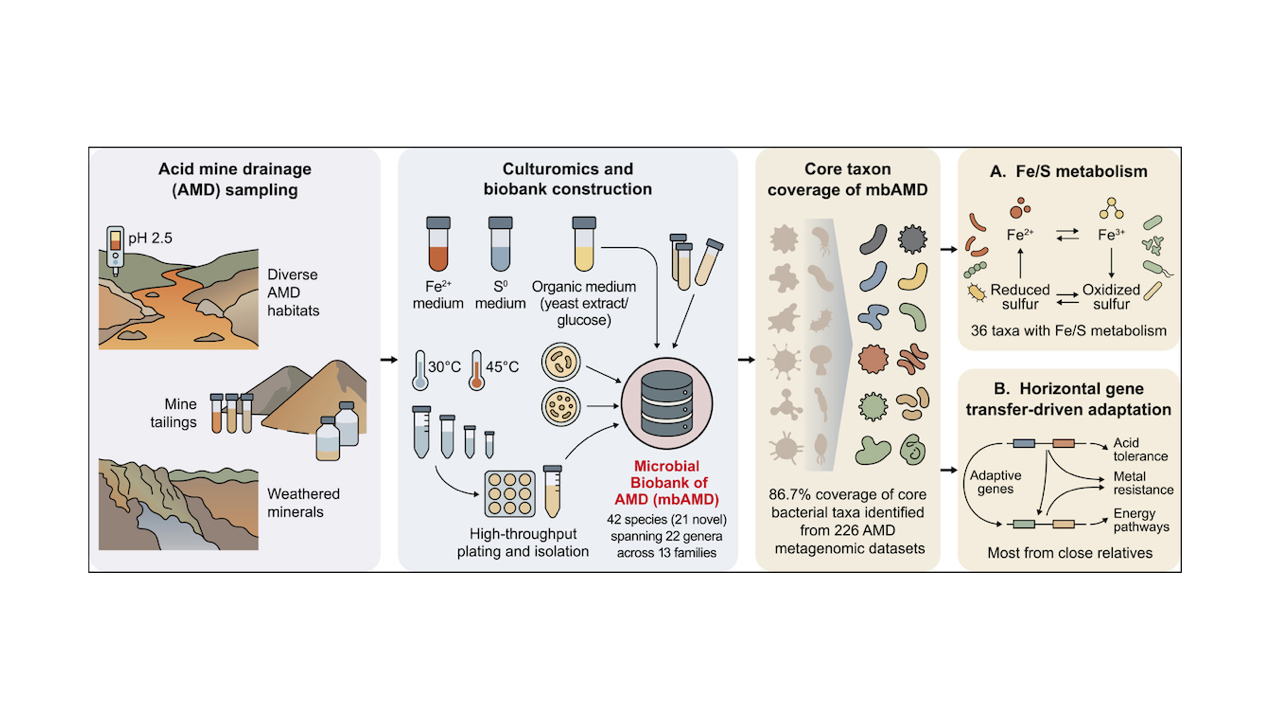
So far, over 97 percent of microorganisms in AMD have never been cultured, leaving their metabolism and adaptation strategies locked as “microbial dark matter.” Now, a new culturomics‑driven resource called the Microbial Biobank of AMD (mbAMD) changes that. The collection contains 652 isolates spanning 42 species, including 21 novel taxa, and covers 86.7 percent of the global AMD core microbiome.
Functional tests confirmed that 36 of these species actively metabolize iron or sulfur. Among them are the first pure cultures of acid‑tolerant sulfate reducers, organisms long sought for their potential to remediate AMD pollution.
A team led by scientists at the Institute of Microbiology, Chinese Academy of Sciences, publishing (DOI: 10.1016/j.ese.2026.100722) in Environmental Science and Ecotechnology on June 11, 2026, constructed the mbAMD – a culturomics-derived biobank from AMD samples collected at three mining sites in China. Using 12 tailored culture conditions, high-throughput plating and microfluidic technology, they recovered 652 phylogenetically distinct strains, including 11 formally described novel species, four new genera and one previously undescribed family.
The mbAMD’s power lies in its functional validation. Through culture-based assays and comparative genomics, the team showed that 36 taxa actively oxidize or reduce iron or sulfur. Among the most striking finds: three novel acid-tolerant sulfate reducers – Alicyclobacillus curvatus ALEF1T, Alicyclobacillus mengziensis S30H14T and Acidiferrimicrobium ferridurans MYW30-Hm14 – are the first pure cultures of their kind, holding promise for bioremediation of acidic, metal-laden waters.
Genomic analysis also uncovered surprises: several validated iron oxidizers lack all known iron-oxidation systems, hinting at entirely unknown electron transport pathways.
Meanwhile, horizontal gene transfer (HGT) emerged as a dominant evolutionary driver, contributing 3.5–39.6 percent of genome content across AMD taxa. Transferred genes are functionally enriched in acid tolerance (e.g., clcA, kdpC), metal resistance (e.g., merA, mntH, znuB) and energy metabolism.
The network analysis revealed that extremophiles preferentially acquire adaptive genes from phylogenetically close relatives rather than distant donors – a modular acquisition pattern that may accelerate niche specialization.
“For years, AMD’s microbial dark matter remained out of reach – we knew it was there, but we couldn’t identify their functions, let alone exploit them.” the authors said. “With mbAMD, we’ve turned sequence predictions into living resources. Seeing that 70 percent of our isolates actively metabolize iron or sulfur, and discovering the first pure acid-tolerant sulfate reducers, was incredibly rewarding.
Even more striking was the HGT pattern: these extremophiles don’t borrow genes randomly. They consistently trade stress-survival tools with their close relatives. That’s a very different picture of adaptation than what we see in many other environments.”
The mbAMD provides a functional foundation for biohydrometallurgy and environmental remediation. The newly isolated sulfate reducers could be developed into bioremediation agents that precipitate metals under low-pH conditions – a long-standing challenge for treating AMD. Similarly, the collection’s iron- and sulfur-oxidizing strains may help optimize bioleaching processes for metal recovery from low-grade ores.
Beyond applications, the resource enables a shift from metagenomic prediction to empirical testing, allowing researchers to validate metabolic pathways, dissect stress responses and explore evolutionary trade-offs in extreme environments. The study also offers a replicable culturomics framework that can be applied to other underexplored ecosystems – from deep-sea vents to alkaline soda lakes – to unlock their own microbial dark matter.
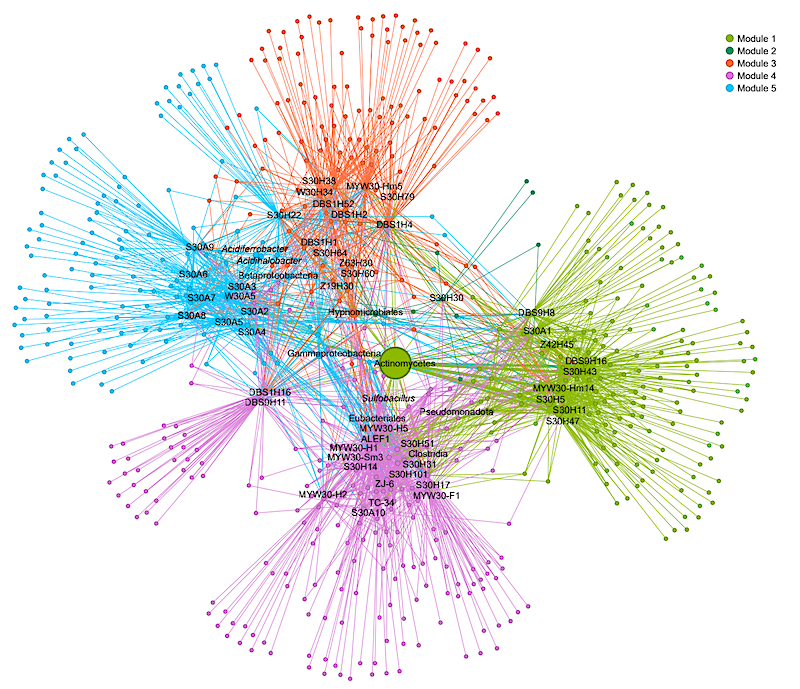
Transferred genes and donors of horizontal gene transfer (HGT) events. a, The plot presents the most prevalent (top 60) transferred genes in each genome. b, A directed network illustrating the relationships between donors and acid mine drainage recipients of HGTs. The size of the dots represents the weighted degree of each node, the arrowspoint to the recipients of HGTs, and the thickness of the edges represents the number of genes transferred between the respective HGT donors and recipients. — Environmental Science and Ecotechnology
A culturomics biobank decodes extremophile evolution and metabolism in acid mine drainage, Environmental Science and Ecotechnology (open access)
Astrobiology, Pollution, bioinformatics,