Mars Mission: A Stress Test For The Search For Life
Billions of years ago, environmental conditions on Mars were significantly more hospitable than they are today. Our neighbouring planet was likely warm, humid, and surrounded by a dense atmosphere.
Whether simple microorganisms could have evolved at that time, remains an open question. NASA rovers have found organic molecules in Martian rock, but none of them can unambiguously be linked to life. Rosalind Franklin is set to join the “search team” on Mars starting in 2030. The European rover specialises in detecting organic molecules, among other things.
Researchers from the Max Planck Institute for Solar System Research (MPS), the University of Göttingen, and Côte d’Azur University in Nice (France) have now subjected the measurement principle used for this purpose to a new stress test.
Proving that life once existed on Mars is a difficult task, even for ESA’s rover. How can organic molecules that were part of an organism billions of years ago be distinguished from those that formed by non-biological processes? And which molecules are particularly suited to revealing their past?
The researchers are pinning their hopes on pristane (C19H40) and phytane (C2OH42), two hydrocarbons that derive from living organisms and occur on Earth as components of petroleum. They are particularly stable. “If life once existed on Mars, then molecules like pristane and phytane represent important molecular biosignatures that could have survived to this day,” said MPS scientist Guillaume Leseigneur, lead author of the new study.
Mirrored molecules
Another property makes pristane and phytane promising indicators of life: like many other organic compounds, they are chiral, meaning that they can exist in different configurations, known as enantiomers. These differ only in the spatial, mirrored arrangement of their atoms within the molecule — a bit like the fingers of the left and right hands.
“Chirality is a valuable tool in the search for past extraterrestrial life,” said co-author Uwe Meierhenrich of Côte d’Azur University. In organisms, chiral organic molecules occur almost exclusively in one of the two possible mirror configurations. This is true on Earth — and, due to life’s self-replicative properties, must also apply to any potential extraterrestrial life. However, if the same molecules are of non-living origin, both mirror forms are expected to be present in equal parts.
Meteorite and Mars Substitute
The Rosalind Franklin rover is capable of distinguishing between organic molecules of different chirality. This task is performed by the Mars Organic Molecule Analyzer (MOMA), an instrument that combines a gas chromatograph, a mass spectrometer, small furnaces, and an excitation laser.
It was developed and built under the leadership of the MPS. Using the gas chromatograph and mass spectrometer, the instrument analyzes the volatile components of rock samples that have been heated in the furnaces. The resulting gas mixture then passes through various capillary tubes that have been coated on their inner surfaces. Since chiral variants of the same type of molecule react at different rates with the coatings, they can be separated in time.
In the current measurements, for which the team used identical MOMA tube replicas, this has now been achieved for pristane and phytane for the first time. Both substances are extremely unreactive. “Chiral separation of pristane and phytane requires high instrument sensitivity and measurement accuracy, both of which we show MOMA can achieve”, explained co-author and MOMA team member Fatma Yesil Sahan from the MPS.
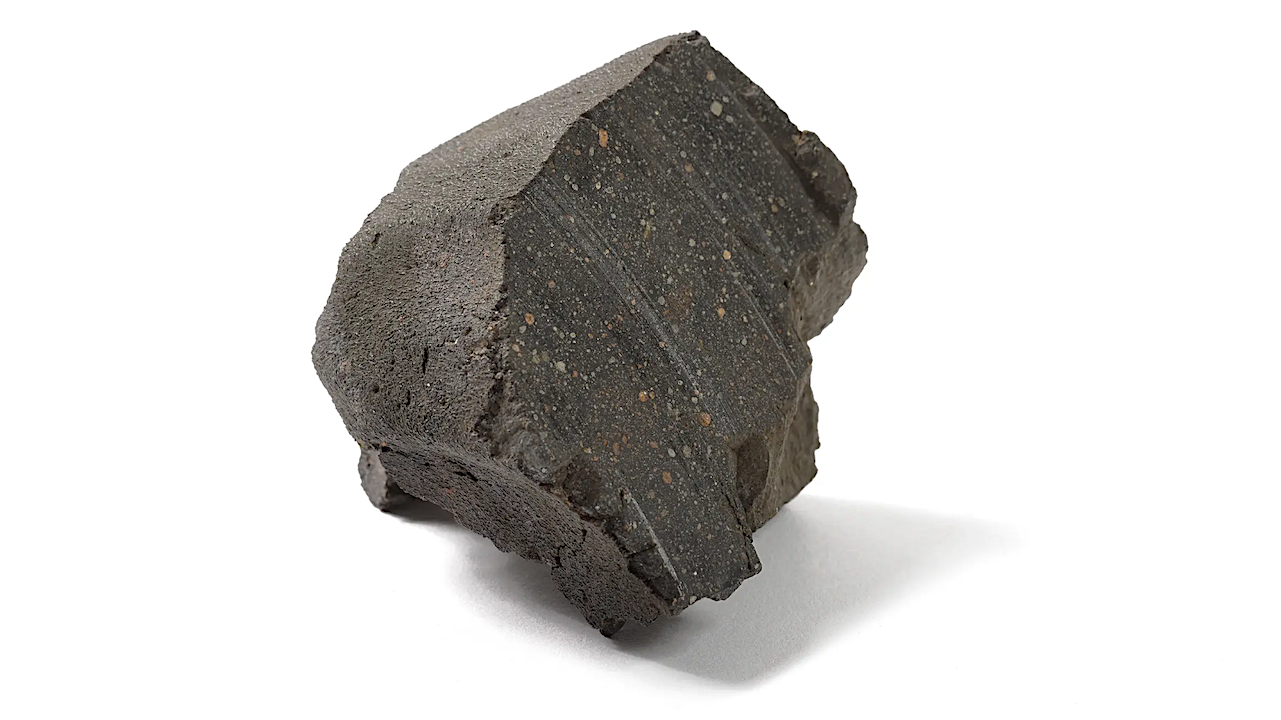
As a substitute for Martian rock, the researchers used samples from the Murchison meteorite, which fell in Australia in 1969. Like other space rocks, it contains a variety of organic molecules: some that are part of its original composition, and others that were added through biological contamination, for example at the site where it was found. The researchers assumed that pristane and phytane likely belong to the latter group.
Mysterious Contaminants
However, the results of the measurements were surprising: the Murchison meteorite contains all chiral variants of pristane and phytane in equal proportions — quite unlike any biomass it could have come into contact with at its discovery site. The researchers concluded that the contaminants must have been picked up during its descent through the atmosphere by contact with aerosols from fossil fuel burning.
This is suggested by comparative measurements of pristane and phytane preserved in oil shales, sedimentary rocks containing a petroleum precursor. “Petroleum forms in these rocks over millions of years at great depths under the influence of heat and pressure”, said co-author Manuel Reinhardt from the University of Göttingen. Under such conditions, the chiral imbalance is lost, which plausibly explains the equal proportions of all chiral variants of pristane and phytane in the Murchison meteorite.
The research team views the new measurements not only as a successful trial run for MOMA’s activities on Mars. Rather, the results also raise further questions about the origin of organic molecules found in meteorites, and about the increasing concentrations of petroleum contamination in our atmosphere.
The instrument MOMA is part of ESA’s ExoMars Mission to Mars. It was developed and built under a programme of, and funded by, the European Space Agency.
Racemic isoprenoids in the Murchison meteorite derive from petroleum-based aerosol pollutants, Earth and Planetary Science Letters (open access)
Astrobiology, Astrochemistry,