Visual Inspection Of Potential Exocomet Transits Identified Through Machine Learning And Statistical Methods
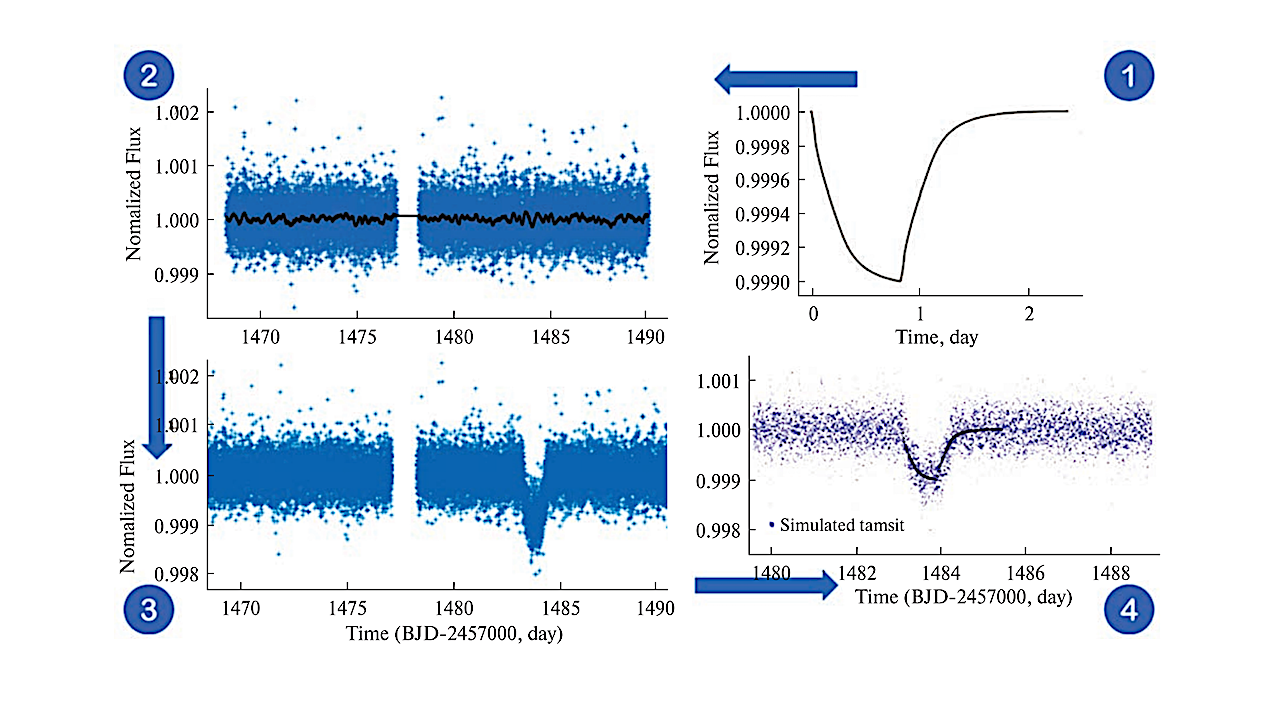
In this work, we explore several ways to detect possible exocomet transits in the TESS (The Transiting Exoplanet Survey Satellite) light curves. The first one has been presented in our previous work, a machine learning approach based on the Random Forest algorithm.
It was trained on asymmetric transit profiles calculated as a result of the modelling of a comet transit, and then applied to real star light curves from Sector 1 of TESS. This allowed us to detect 32 candidates with weak and non-periodic brightness dips that may correspond to comet-like events.
The aim of this work is to analyse the events identified by the visual inspection to make sure that the features detected were not caused by instrumental effects. The second approach to detect possible exocomet transits, which is proposed, is an independent statistical method to test the results of the machine learning algorithm and to look for asymmetric minima directly in the light curves.
This approach was applied to beta Pictoris light curves using TESS data from Sectors 5, 6, 32, and 33. The algorithm reproduced nearly all previously known events deeper than 0.03 % of the star flux, showing that it is efficient to detect shallow and irregular flux changes in the different sectors of the TESS data and at the different levels of noise.
The combination of machine learning, visual inspection, and statistical analysis facilitates the identification of faint and short-lived asymmetric transits in photometric data. Although the number of confirmed exocomet transits is still small, the growing amount of observations points to their likely presence in many young planetary systems.
D.V. Dobrycheva, I.V. Kulyk, D.R. Karakuts, M.Yu. Vasylenko, Ya.V. Pavlenko, O.S. Shubina, I.V. Luk’yanyk
Comments: 14 pages, 14 figures, 30 references
Subjects: Earth and Planetary Astrophysics (astro-ph.EP); Instrumentation and Methods for Astrophysics (astro-ph.IM)
MSC classes: 85A35, 85-08
ACM classes: I.2.6; J.2
Cite as: arXiv:2602.02701 [astro-ph.EP](or arXiv:2602.02701v1 [astro-ph.EP] for this version)
https://doi.org/10.48550/arXiv.2602.02701
Focus to learn more
Related DOI:
https://doi.org/10.15407/knit2025.06.080
Focus to learn more
Submission history
From: Daria Dobrycheva
[v1] Mon, 2 Feb 2026 19:12:44 UTC (1,167 KB)
https://arxiv.org/abs/2602.02701
Astrobiology, Interstellar,