Organic Carbon Detected In The Bright Angel Formation On Mars
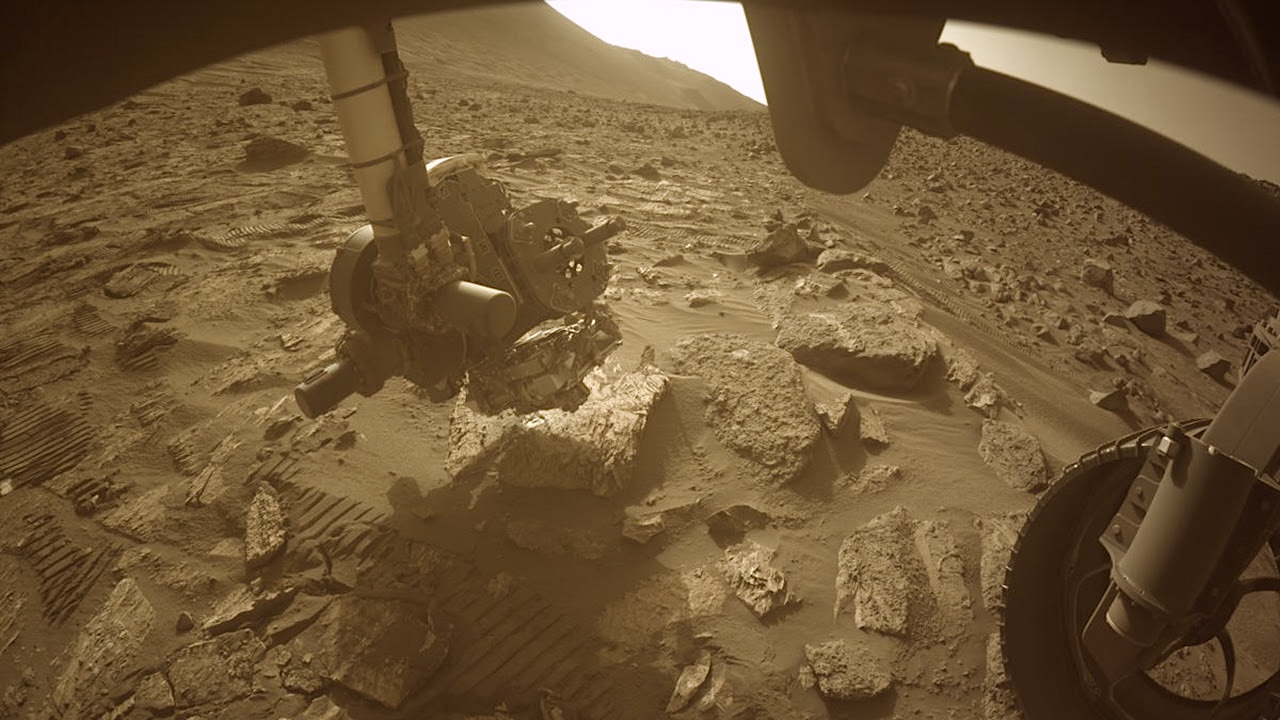
In September of last year, NASA announced that its Perseverance rover discovered a potential biosignature, which is a substance or structure that might have a biological origin.
A new paper, published in Science Advances, unambiguously confirms the detection of organic carbon, the building blocks of life, in the same two rocks from the Bright Angel formation, and describes in more detail exactly what we can say about that organic matter. Ashley Murphy, a Planetary Science Institute postdoctoral researcher, co-led the paper with the SHERLOC instrument’s Deputy Principal Investigator, Kyle Uckert.
Using the Scanning Habitable Environments with Raman & Luminescence for Organics & Chemicals (SHERLOC) instrument on the robotic arm of the Perseverance rover, the team performed Raman spectroscopy on multiple rocks and collected a sample from one rock dubbed “Cheyava Falls” in Jezero crater’s Bright Angel formation. Raman spectroscopy is a non-destructive way to detect and map minerals and organic compounds in rocks illuminated with laser light.
The team detected the presence of macromolecular carbon (MMC), which are large tangled networks of carbon atoms commonly found in rocks on Earth and meteorites. MMC can arise from biotic or abiotic sources.
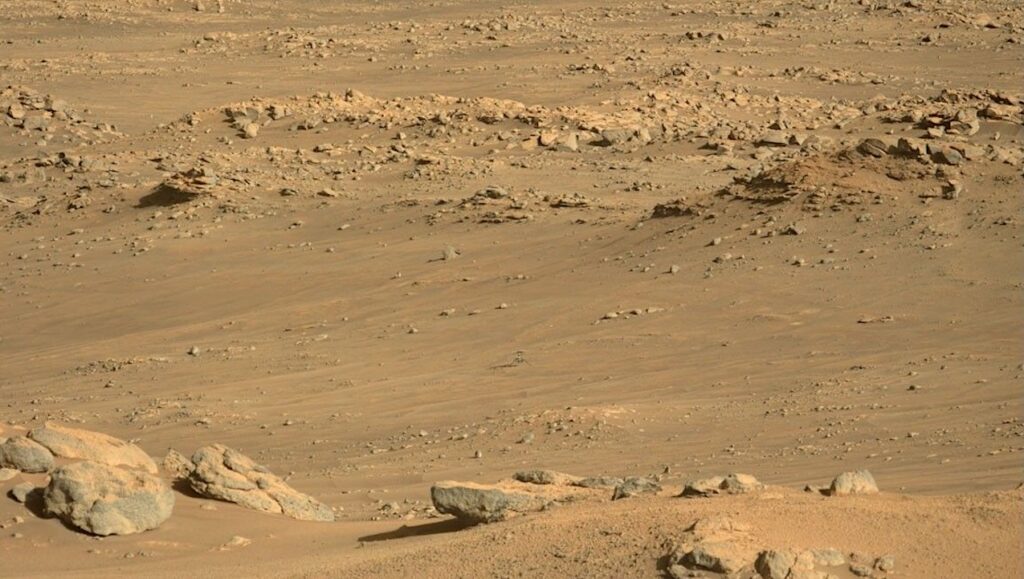
Billions of years ago, a river channel carried water and sediment into Jezero crater. Fine-grained sediment settled to the bottom before eventually hardening into the mudstone rocks the team analyzed. MMC was detected in association with these fine-grained sediments as well as carbonate and sulfate minerals that formed later during aqueous alteration, suggesting possible timing of organic emplacement at two or more events across geologic history.
“While the specific formation mechanism of the MMC detected in the Bright Angel mudstones remains unknown, this is still one of the most exciting findings to date,” Murphy said.
Analysis also determined that the MMC was preserved only microns beneath the Martian surface, which is less than the thickness of a piece of paper. This marks the shallowest detection of MMC on Mars. It is notable to find complex organic molecules this close to the surface in a harsh environment like Mars where sunlight and other environmental factors are known to destroy organics.
“The Martian surface environment includes radiation and chemical oxidants that are destructive to organics, and terrestrial laboratory simulations have shown that the survival time of organics in Martian-like conditions – especially at or near the surface – depends on factors such as the type of organic molecule and the surrounding minerals,” Murphy said. “The MMC detected in the Bright Angel mudstones is either resistant to degradation and/or has been sufficiently shielded by other minerals, such as clays, or iron-rich Martian soil.”
What’s more, the sample was collected more than 2,000 miles away from organic detections by NASA’s Curiosity rover in Gale crater.
“It is encouraging for Martian habitability,” Murphy said. “This indicates that billions of years ago, organics may have been more than just locally present and may have been more widely available in ancient lakes and rivers on Mars.”
Neither Curiosity rover in Gale crater nor Perseverance rover in Jezero crater have the large and power-consuming equipment necessary to determine if Bright Angel contains fossilized microbial life. Perseverance was built with the goal of detecting potential biosignatures such as those found in the Cheyava Falls rock, making this a “resounding win for Mars science,” Murphy said. However, more powerful tools in laboratories on Earth are needed to confirm if life or geology is behind this discovery.
If one day the team gets their hands on samples returned from this location on Mars, they hope to conduct mineral and organic analysis at higher resolution and with higher sensitivity instruments to better understand the origin of the MMC and what it can tell us about organics on Mars.
Murphy continues to work with the SHERLOC science team to explore the surface of Mars and use Mars analog and Raman spectroscopic studies to improve the interpretation of rover-derived data.
Murphy’s work on SHERLOC Instrument Mars 2020 was funded by JPL Subcontract No. 1641753 to PSI.
Spatially distributed complex organic matter detected in an ancient river valley in Jezero crater, Mars, Science (open access)
Astrobiology,