Tidal Rock Grinding As A Source Of H2 On Enceladus
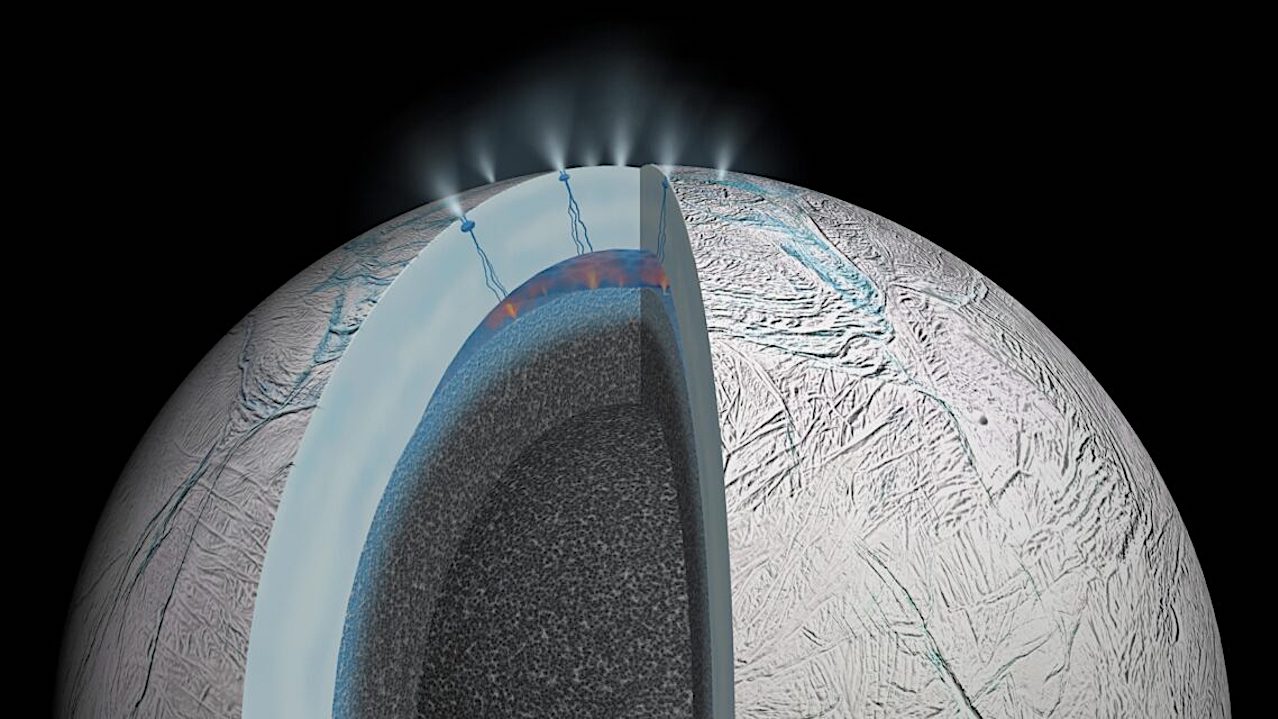
The Solar System hosts multiple potentially habitable environments, including the subsurface ocean beneath the icy crust of Saturn’s moon Enceladus.
This ocean’s composition is unusually well constrained thanks to Cassini’s observations of Enceladus’s south polar plume during multiple flybys.
Among the plume’s more surprising components is molecular hydrogen (H2), detected in trace amounts. The presence of observable amounts of H2 is intriguing not only because it is difficult to explain through conventional geochemical processes, but also because it could serve as both an energy source for life and a driver of prebiotic organic chemistry.
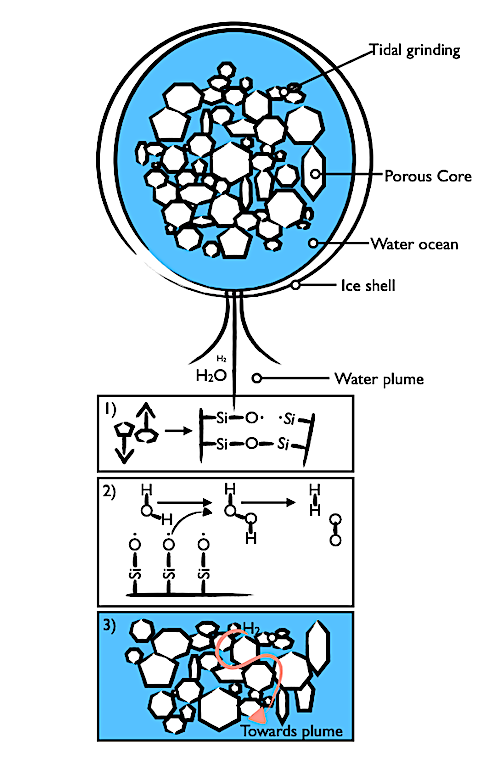
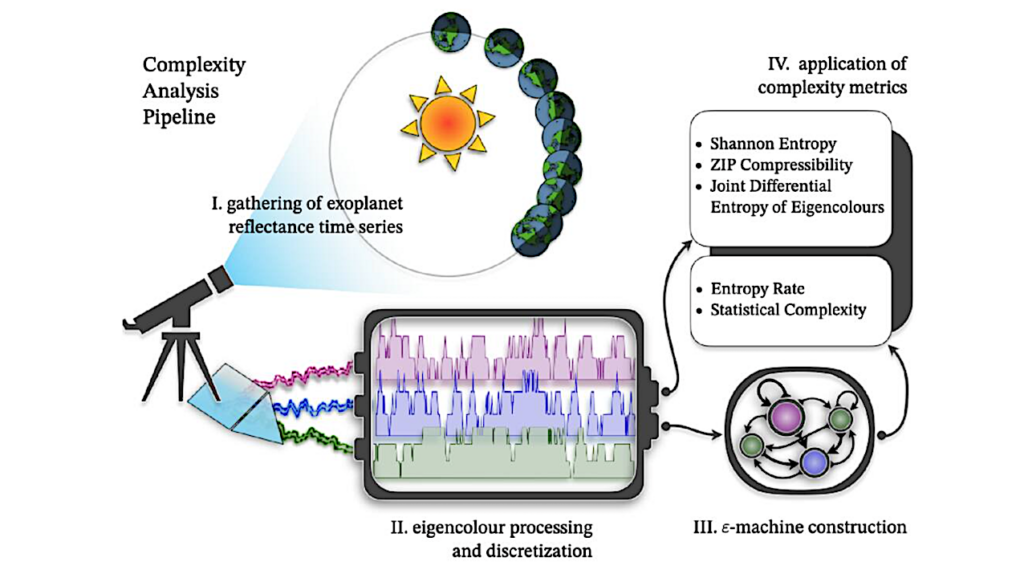
A cartoon representation of the structure and relevant processes of Enceladus, showcasing its icy surface, internal ocean and rocky core as well as the three steps required for tidally induced rock grinding in the core to explain H2 observations in the plume. — astro-ph.EP
In this study, we explore whether tidally induced rock grinding within Enceladus’s core could account for the observed H2. Laboratory experiments show that H2 can be efficiently produced when freshly fractured rock reacts with water.
Using these experimentally determined production efficiencies, we estimate H2 generation rates as a function of the fraction of tidal energy dissipated through rock grinding. Our results suggest that tidal grinding could plausibly produce the observed levels of H2, with instantaneous production rates potentially exceeding those from radiolysis or serpentinization.
However, sustaining such production over geological timescales would require efficient healing of silicate surfaces in the core to allow repeated grinding. Without such healing, tidally induced rock grinding may instead lead to episodic bursts of chemical activity lasting up to millions of years–potentially sufficient to initiate new prebiotic pathways.
This transient mechanism would complement the longer-term, lower-energy contributions from serpentinization (over hundreds of millions of years) and radiolysis (over billions of years).
Karin I. Oberg, Cara Magnabosco, Nicholas J. Tosca
Comments: Accepted for publication in Earth and Planetary Science Letters
Subjects: Earth and Planetary Astrophysics (astro-ph.EP)
Cite as: arXiv:2606.16860 [astro-ph.EP](or arXiv:2606.16860v1 [astro-ph.EP] for this version)
https://doi.org/10.48550/arXiv.2606.16860
Focus to learn more
Related DOI:
https://doi.org/10.1016/j.epsl.2026.120167
Focus to learn more
Submission history
From: Karin Oberg
[v1] Mon, 15 Jun 2026 15:35:39 UTC (927 KB)
https://arxiv.org/abs/2606.16860
Astrobiology