COUNTESS I: A Uniformly Vetted Catalog of Known and New Transiting Exoplanets in the TESS Northern Continuous Viewing Zone
The Transiting Exoplanet Survey Satellite (TESS) has transformed the study of nearby exoplanetary systems; however, its nominal observing strategy limits sensitivity to planets with orbital periods shorter than ∼10 days for most parts of the sky.
The two TESS Continuous Viewing Zones (CVZs) provide extended temporal baselines that help overcome this limitation, enabling the detection of longer-period (>10 days) transiting planets around nearby stars.
Here, we present COUNTESS, a transit-search pipeline optimized for long-baseline TESS observations that combines multi-sector light curves with heterogeneous cadences, and implements fast-folding BLS period detection, vetting, and statistical validation. As a first application of the pipeline, we conducted a search on the primary and first extended mission photometry in the TESS northern CVZ.
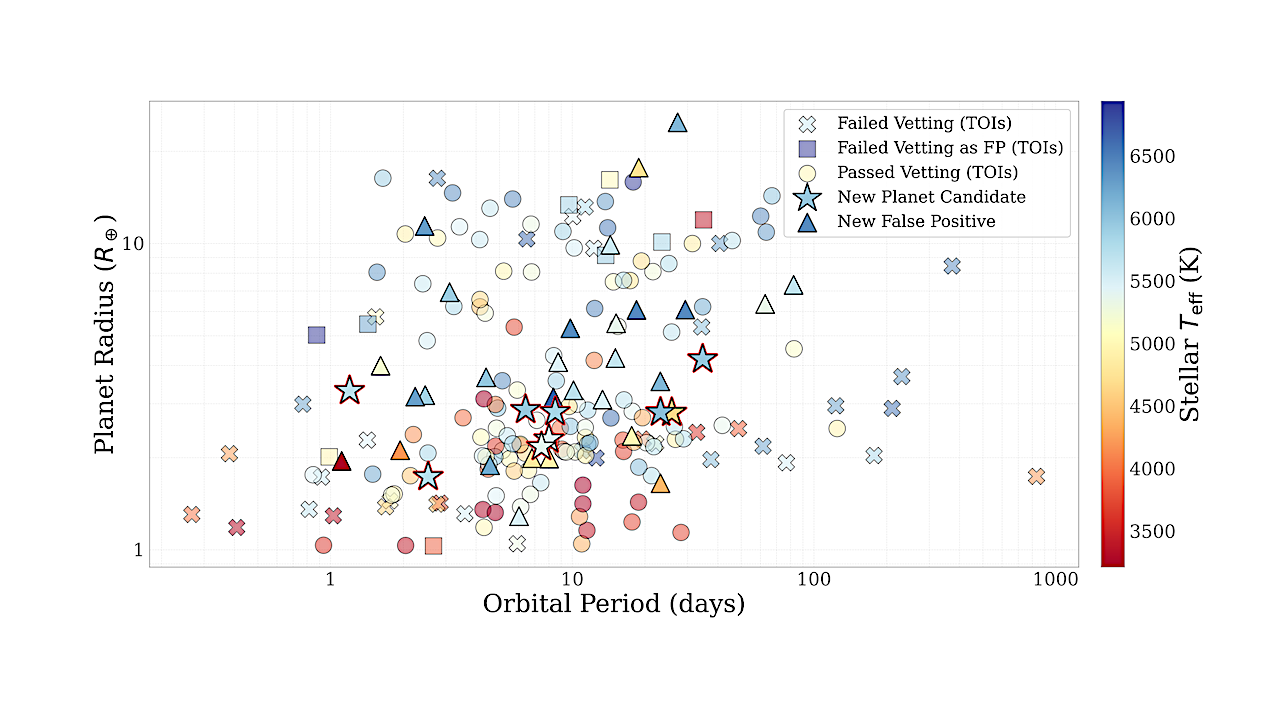
For this analysis, we used Gaia DR3 and 2MASS photometry to homogeneously derive a stellar catalog of FGKM stars for the TESS northern CVZ, resulting in a sample of 391,059 stars. We used COUNTESS to search for transiting planets around 26,114 of these stars with TESS-SPOC light curves and assessed its performance, recovering 115 out of 159 known TESS Objects of Interest (TOIs; 0.85 days<P<124.72 days; 1.03 R⊕<Rp<16.35 R⊕).
Additionally, we identified 10 new exoplanet candidates (1.20 days<P<34.62 days; 1.73 R⊕<Rp<4.19 R⊕) that passed vetting tests, including two new statistically validated sub-Neptunes, TIC 219893931b and TIC 237254473b. COUNTESS enables extended-baseline TESS analyses and identification of longer-period planets, establishing a foundation for future exoplanet demographic studies, including comparisons with Kepler and K2.
Andrew Hotnisky, Rachel B. Fernandes, Kevin K. Hardegree-Ullman, Steven Giacalone, Kiersten M. Boley, Kristo Ment, Michelle Kunimoto, Galen J. Bergsten, Sakhee Bhure, Jessie L. Christiansen, Brandon Radzom, Suvrath Mahadevan
Comments: 26 pages, 10 figures, 6 tables; resubmitted to AAS Journals after addressing referee comments
Subjects: Earth and Planetary Astrophysics (astro-ph.EP); Instrumentation and Methods for Astrophysics (astro-ph.IM); Solar and Stellar Astrophysics (astro-ph.SR)
Cite as: arXiv:2606.13789 [astro-ph.EP] (or arXiv:2606.13789v1 [astro-ph.EP] for this version)
https://doi.org/10.48550/arXiv.2606.13789
Focus to learn more
Submission history
From: Andrew Hotnisky
[v1] Thu, 11 Jun 2026 18:01:13 UTC (14,312 KB)
https://arxiv.org/abs/2606.13789
Astrobiology, Astronomy, Exoplanet,