The Capability Of CSST In Characterizing Planetary Atmospheres. I. Transmission Spectroscopy Of Hot Jupiters
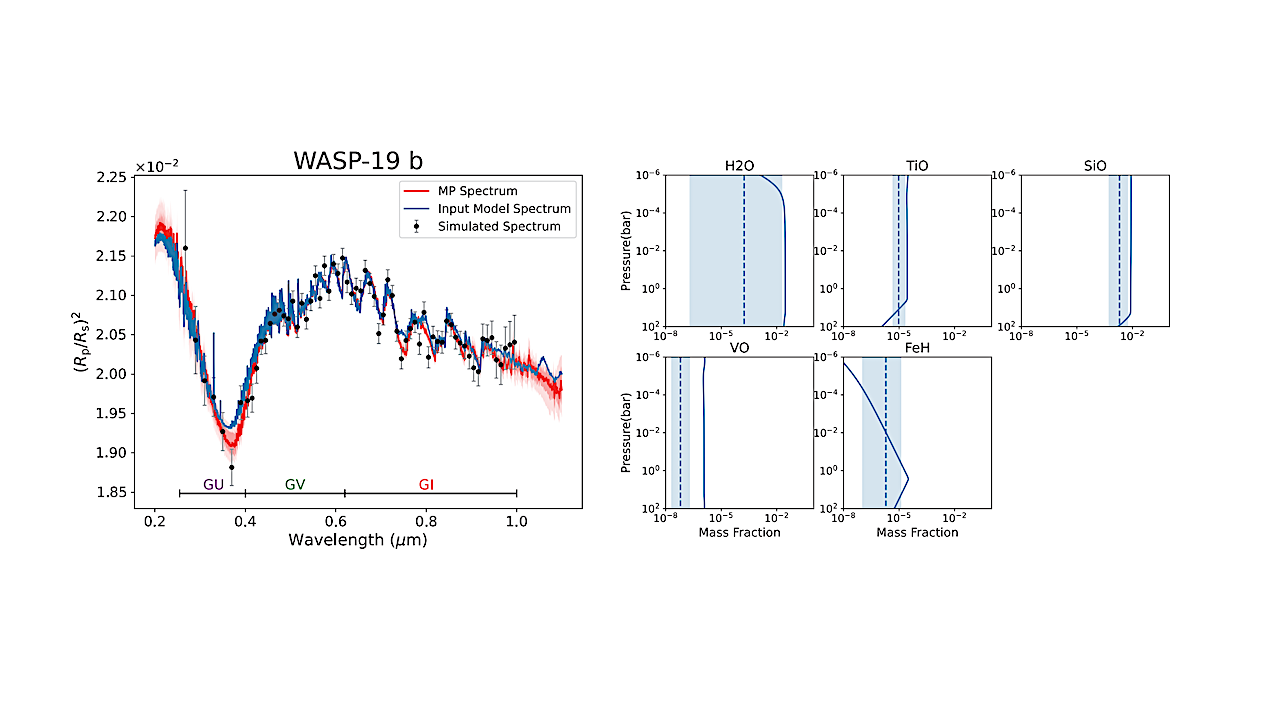
Transmission spectroscopy has become a primary tool for probing exoplanetary atmospheres, enabling constraints on their chemical compositions and providing limited information on their thermal properties.
We assess the potential of the upcoming Chinese Space Station Telescope (CSST) for exoplanet atmospheric characterization through transmission spectroscopy. Theoretical spectra of hot gas planets are generated and used to simulate slitless spectroscopic observations with the CSST across the ultraviolet-to-near-infrared range. Atmospheric retrievals performed on the simulated data are compared with the input models to assess the robustness and accuracy of parameter determinations.
We find that multi-band observations across three wavelength channels, each with two transits can place meaningful constraints on key atmospheric parameters. For multi-band observations that account for correlated (red) noise, future CSST observations are expected to achieve constraints that are comparable to, or in some cases slightly weaker than, those of the Hubble Space Telescope (HST), depending on the noise level and observing strategy.
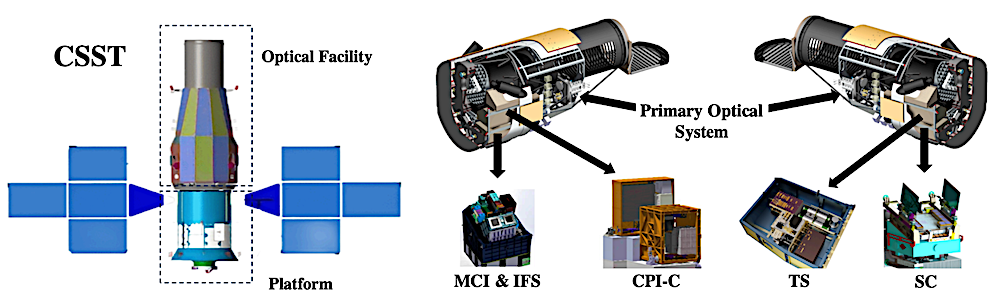
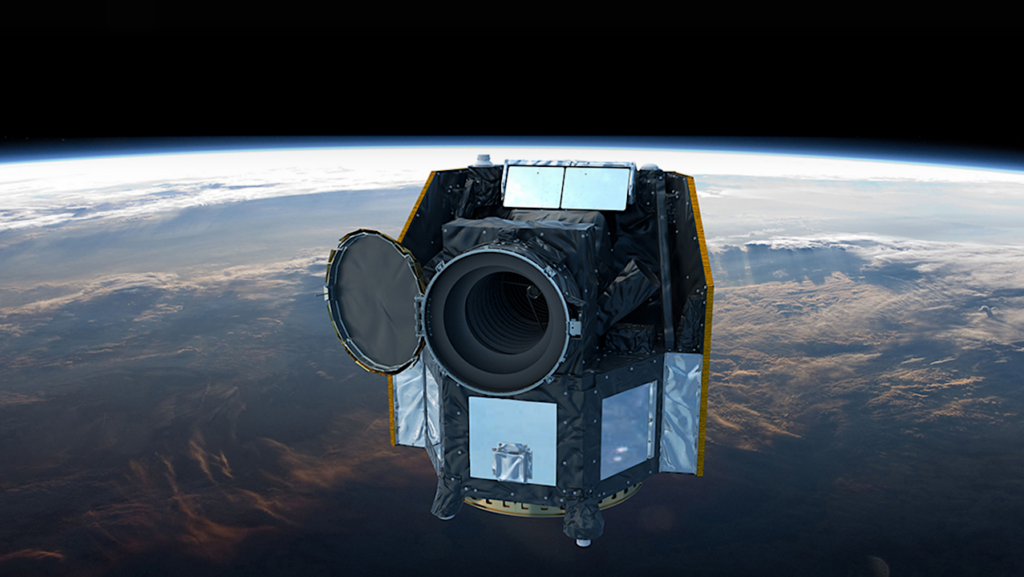
The CSST is composed of the platform and optical facility (left panel). The CSST platform can rendezvous and dock with the CSS for on-orbit servicing. The optical facility includes the primary optical system (or OTA) and five scientific instruments, i.e. SC, MCI, IFS, CPI-C, and TS (right panel). — astro-ph.EP
We conclude that CSST will provide unique and complementary constraints on the chemical compositions and physical properties of exoplanetary atmospheres, particularly for atomic species, metal-bearing molecules, and scattering processes accessible in the UV and optical, thereby complementing JWST’s infrared sensitivity to molecular species.
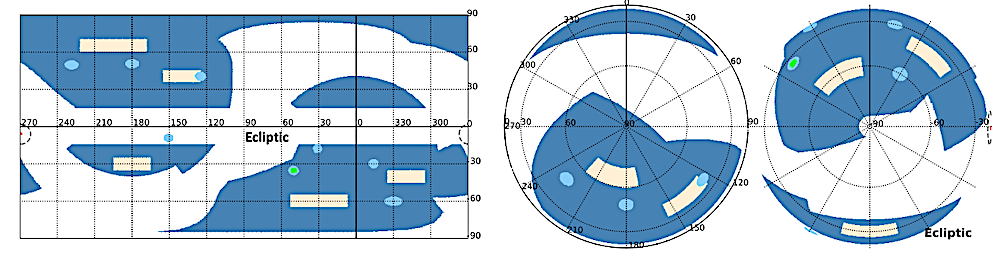
The preliminary planned survey fields of the CSST-SC (ecliptic coordinates). The deep and light blue regions are the survey areas of the CSST 17,500 deg2 wide-field and 400 deg2 deep-field surveys, respectively. The yellow regions show the selected sky areas that Euclid has completed as CSST priority observations. The 9 deg2 UDF and microlensing observations of Galactic bulge area are shown in green and red regions, respectively. — astro-ph.EP
Zibo Liu, Wei Wang, Meng Zhai, Jinpeng Wang, Qinglin Ouyang, Fei Yan, Guo Chen, Dongdong Ni, Yong Zhao, Yujuan Liu, Fei Zhao, Gang Zhao
Comments: 40 pages, 24 figures, accepted for publication in ApJ
Subjects: Earth and Planetary Astrophysics (astro-ph.EP); Instrumentation and Methods for Astrophysics (astro-ph.IM)
Cite as: arXiv:2606.16452 [astro-ph.EP] (or arXiv:2606.16452v1 [astro-ph.EP] for this version)
https://doi.org/10.48550/arXiv.2606.16452
Focus to learn more
Submission history
From: Zibo Liu
[v1] Mon, 15 Jun 2026 09:23:39 UTC (2,872 KB)
https://arxiv.org/abs/2606.16452
Astrobiology,