A Decade Of Monitoring The HIP 41378’s Planetary System
Multi-planetary systems provide key constraints on planet formation and evolution, as their architecture encodes the dynamical history of planets formed within a common protoplanetary disk.
However, the current population remains strongly biased toward compact, short-period systems, and only a limited number of such systems with measured masses and radii are known.
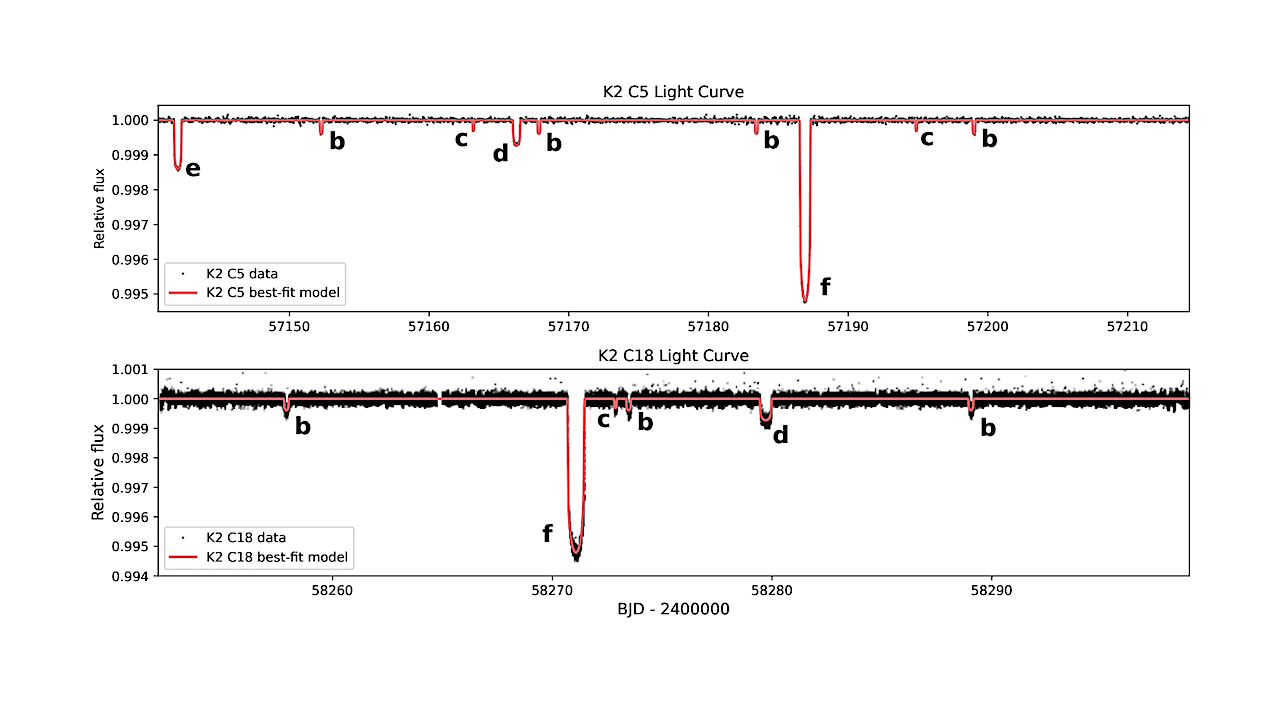
HIP 41378 is an exceptional system hosting five transiting planets with orbital periods up to 1.5 years, including an ultra-low density planet HIP 41378 f. The outer transiting planets d and e remained poorly constrained with unknown periods and masses, leaving the system architecture only partially characterised. We present long-term monitoring of this target with high-precision radial-velocity (RV) instruments (HARPS, HARPS-N, HIRES, and ESPRESSO) and space-based photometry spanning 2015-2024.
We detect RV signals for all the planets, confirming their orbital periods and constraining their masses. In particular, the RV data strongly favour an orbital period of Pd = 278 days for planet d and refine the orbital period of planet e to Pe = 393+3-5 days. We measure a new mass of Mf = 25pm 5 earth masses for HIP 41378 f, confirming its super-puff nature with a bulk density of 0.166+0.033-0.036 g cm3.
We also confirm the planetary nature of HIP 41378 g, a non-transiting planet with a 63-day period, and determine its minimum mass. In addition, the RVs reveal a long-period signal, with P = 2602+468-433 days, which we attribute to the candidate planet HIP 41378 h, although a stellar magnetic cycle cannot be excluded.
Finally, we investigate the system’s dynamical architecture and resonant structure, assess its completeness by constraining additional undetected planets, and discuss the implications for the origin and internal structure of the remarkable planet HIP 41378 f.
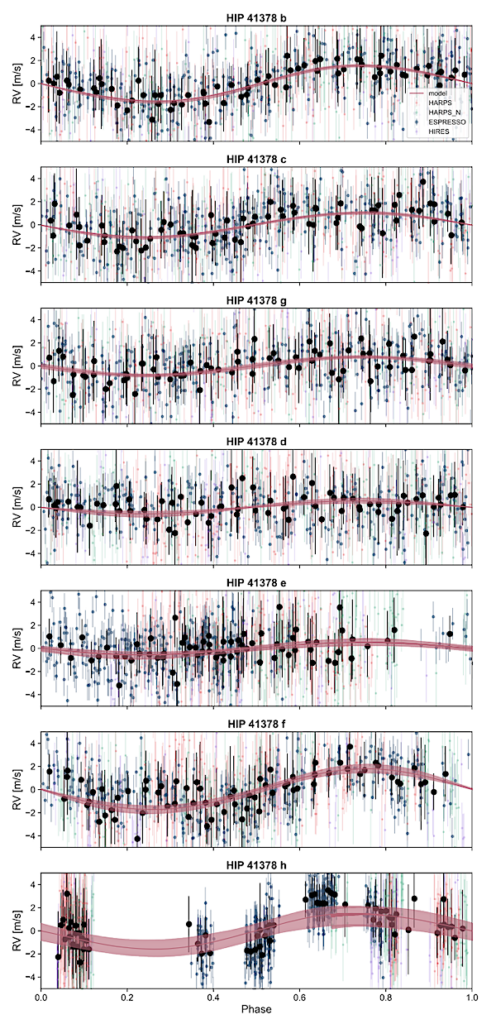
HARPS-N, HARPS, HIRES, and ESPRESSO RV phasefolded on the results of the joint RV+transit fit for the seven planets in the system. The pink line represents the median of the best-fit model RV curve with its 68% HDI in the shaded area. — astro-ph.EP
S. Grouffal, A. Santerne, X. Dumusque, B. Akinsanmi, T. Guillot, N. C. Hara, A. Leleu, L. Malavolta, M. Saillenfest, D. J. Armstrong, S. C. C. Barros, D. Bayliss, A. S. Bonomo, D. J. A. Brown, A. Collier Cameron, M. Cretignier, I. J. M. Crossfield, F. Dai, M. Damasso, O. Demangeon, P. Figueira, P. Leonardi, A. F. Martinez Fiorenzano, M. Lopez-Morales, E. Molinari, A. Mortier, L. D. Nielsen, H. P. Osborn, E. Petigura, K. Rice, N. C. Santos, A. Sozzetti, S. Sulis, S. Udry, C. Watson
Comments: Accepted in A&A. 25 pages, 22 figures. This work has a companion paper: Leonardi et al. 2026
Subjects: Earth and Planetary Astrophysics (astro-ph.EP)
Cite as: arXiv:2606.23103 [astro-ph.EP] (or arXiv:2606.23103v1 [astro-ph.EP] for this version)
https://doi.org/10.48550/arXiv.2606.23103
Focus to learn more
Submission history
From: Salomé Grouffal
[v1] Mon, 22 Jun 2026 09:46:20 UTC (9,054 KB)
https://arxiv.org/abs/2606.23103
Astrobiology, exoplanet,