Bipolar Investigation Of Near-surface Glacial Ice Reveals An Active Microbial Ecosystem Driven By Photosynthesis And Chemolithoautotrophy
Despite extreme conditions including freezing temperatures, low water activity, and few nutrients, active microorganisms are thought to inhabit glacial ice, yet little is known about their identities and methods of survival.
We used flow cytometry, cultivation, metagenomics, and metatranscriptomics to characterize viable and active microbial communities from near-surface englacial ice from White Glacier in the Canadian High Arctic and Johnsons Glacier on Livingston Island, Antarctica.
The ice, though low in microbial biomass (104 cells/ml), harbors communities capable of growth at subzero temperatures (-5°C), high salinity (12% NaCl), and low pH (pH 3). The communities of both poles were different, with metagenome-assembled genomes (MAGs) from White Glacier belonging to Cyanobacteriota and novel phyla and MAGs from Johnsons Glacier belonging to Pseudomonadota and Actinomycetota.
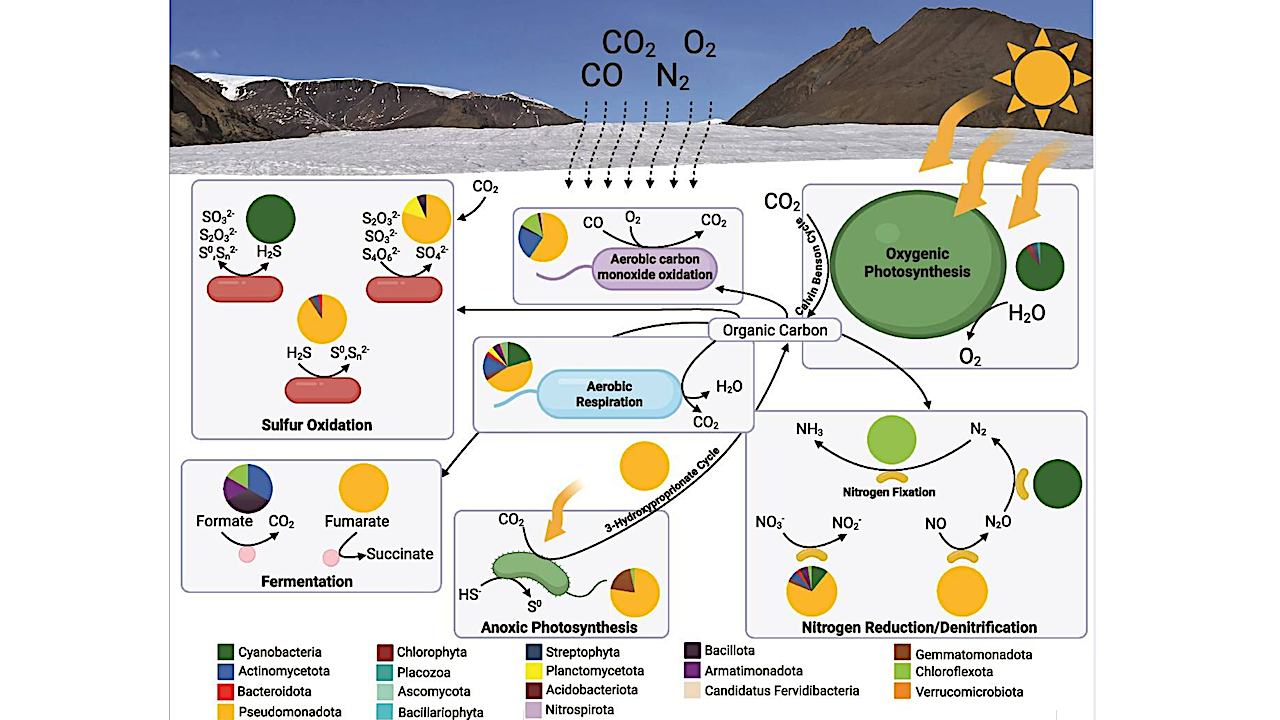
Despite this, both glacial communities shared key metabolic functions, including aerobic respiration, aerobic carbon monoxide oxidation, sulfide oxidation, and denitrification. Metatranscriptomics from White Glacier revealed dominant Cyanobacteriota, performing oxygenic photosynthesis and carbon fixation and accompanied by active lithoautotrophs performing metabolisms such as carbon fixation via the 3-hydroxyproprionate cycle, anoxygenic photosynthesis, sulfide oxidation, and nitrate reduction/denitrification.
These metabolisms appear to support an active heterotrophic community performing aerobic respiration and aerobic carbon monoxide oxidation. This study highlights the distinct but functionally similar microbial communities in Arctic and Antarctic glaciers, hinting that there may be a core set of metabolisms required for surviving in englacial ice and suggesting that similar communities could persist in glacial ice on Mars or the icy outer moons, Europa and Enceladus.
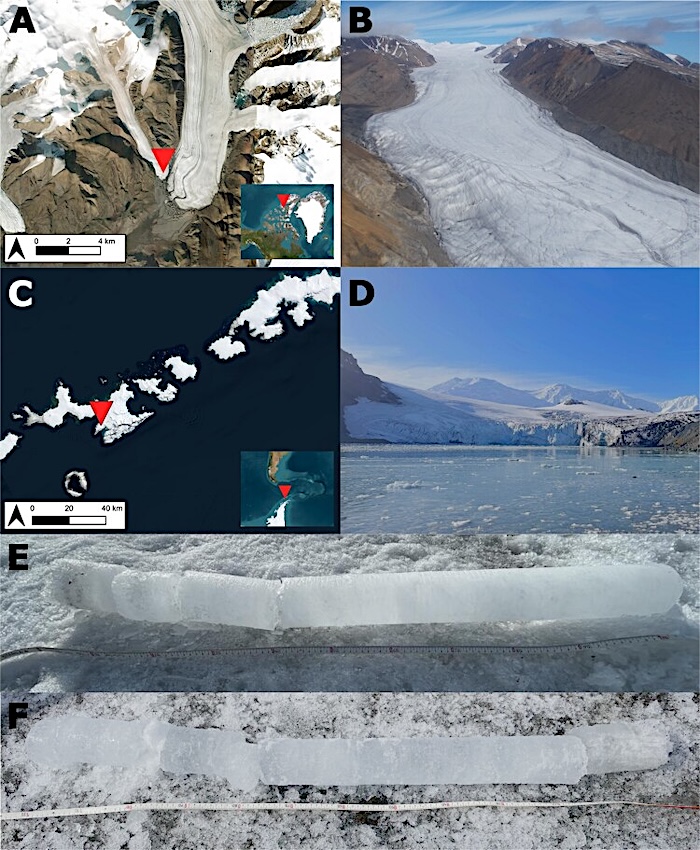
(A) Location of White Glacier on Axel Heiberg Island in Nunavut, Canada (Photo credit: Environmental Systems Research Institute); (B) arial view of White Glacier (Photo credit: Scott Sugden); (C) location of Johnsons Glacier on Livingston Island, Antarctica (Photo credit: Environmental Systems Research Institute); (D) photo of Johnsons Glacier; (E) one of the White Glacier cores used in this study; (F) one of the Johnsons Glacier cores used in this study. — ISME Communications via PubMed
O’Connor BRW, Allen D, Quinn M, Kozey M, Léveillé RJ, Whyte LG.
ISME Commun. 2026 Apr 22;6(1):ycag105. doi: 10.1093/ismeco/ycag105. eCollection 2026 Jan.
PMID: 42164315
Bipolar investigation of near-surface glacial ice reveals an active microbial ecosystem driven by photosynthesis and chemolithoautotrophy, ISME Communications via PubMed
Astrobiology