Ca-bearing Cyanopolyynes in IRC+10216
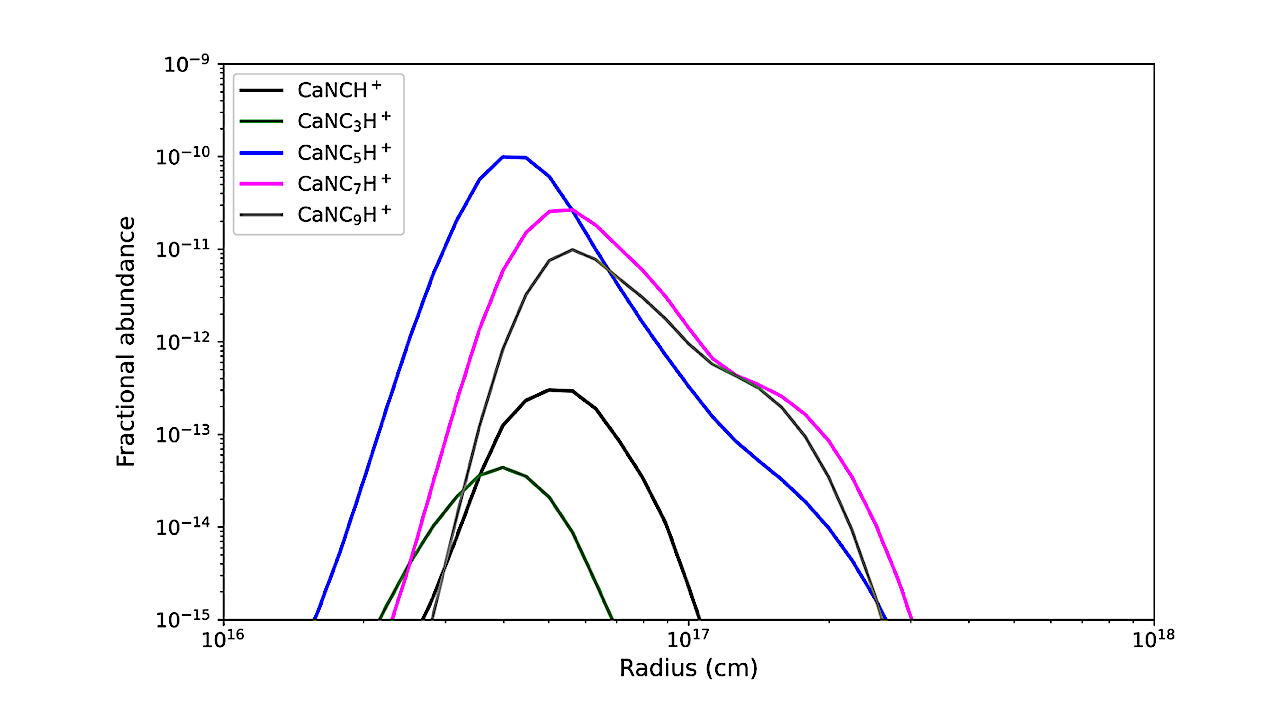
In recent years, a number of metal-containing, carbon-chain species have been detected in the external circumstellar envelope of the carbon-rich AGB star IRC+10216.
The most common metal detected in such species is Mg, for which molecules as large as MgC5N, MgC5N+ MgC6H and MgC6H+ have been observed.
In this paper, we calculate the likely abundances of the Ca-bearing cyanopolyynes, CaC2n+1N for n = 1-4, drawing the conclusion that the observed abundance of CaNC must be made from much larger Ca-terminated cyanopolyyne ions, which requires considerable rearrangement in their dissociative recombination.
We pay particular attention to the detectability of CaC3N whose rotational spectrum has recently been measured.
T. J. Millar
Comments: 5 pages, 4 figures, in press at MNRAS
Subjects: Solar and Stellar Astrophysics (astro-ph.SR); Astrophysics of Galaxies (astro-ph.GA)
Cite as: arXiv:2606.00631 [astro-ph.SR] (or arXiv:2606.00631v1 [astro-ph.SR] for this version)
https://doi.org/10.48550/arXiv.2606.00631
Focus to learn more
Related DOI:
https://doi.org/10.1093/mnras/stag1002
Focus to learn more
Submission history
From: Tom Millar
[v1] Sat, 30 May 2026 09:06:59 UTC (46 KB)
https://arxiv.org/abs/2606.00631
Astrobiology, Astrochemistry,