Isotopic Signature of Organic Molecules from Beyond the Solar System: An Enriched Methane D/H Ratio in the Interstellar Object 3I/ATLAS
Interstellar objects are interlopers from other planetary systems, and their volatile compositions provide a glimpse into planet formation around their host star. We present near-infrared spectra of the coma of interstellar object 3I/ATLAS measured with the James Webb Space Telescope.
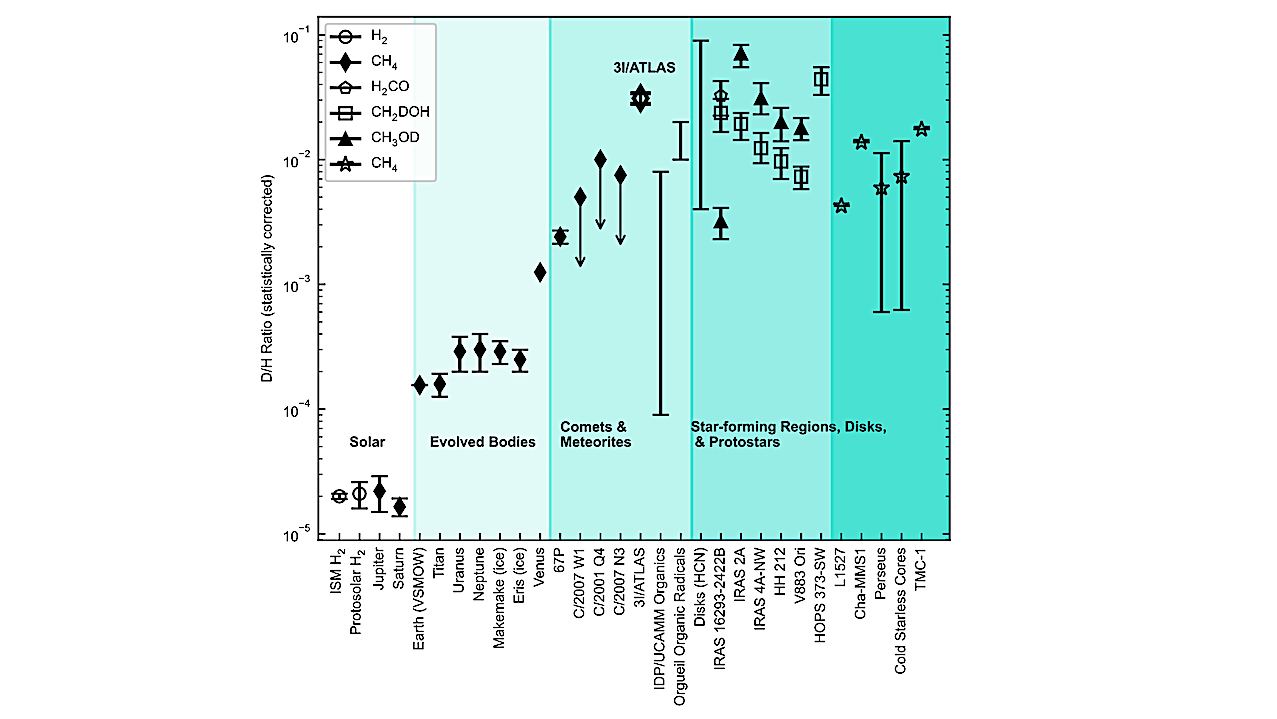
Our results demonstrate an unexpectedly high D/H=(3.31±0.34)% for methane and represent an exceedingly rare detection of deuterated organic molecules in an interstellar object. This D/H ratio is a factor of 14±2 higher than that measured in comet 67P/Churyumov-Gerasimenko by the Rosetta spacecraft, the only other comet for which CH3D has been detected, yet the ratio of deuteration in methane compared with water is consistent for both comets within 1.2σ.
The D/H ratio in methane is observationally unconstrained in extrasolar sources to date, but the enriched ratio in 3I/ATLAS is most similar to those measured in other organic molecules toward primitive environments.
The high D/H ratios of water and methane in 3I/ATLAS are a natural consequence of formation in a high D/H elemental ratio environment as a result of locally cold conditions in the protoplanetary disk and prior interstellar cloud. Thus, 3I/ATLAS formed in an environment very different from that in which our Sun and planets originated.
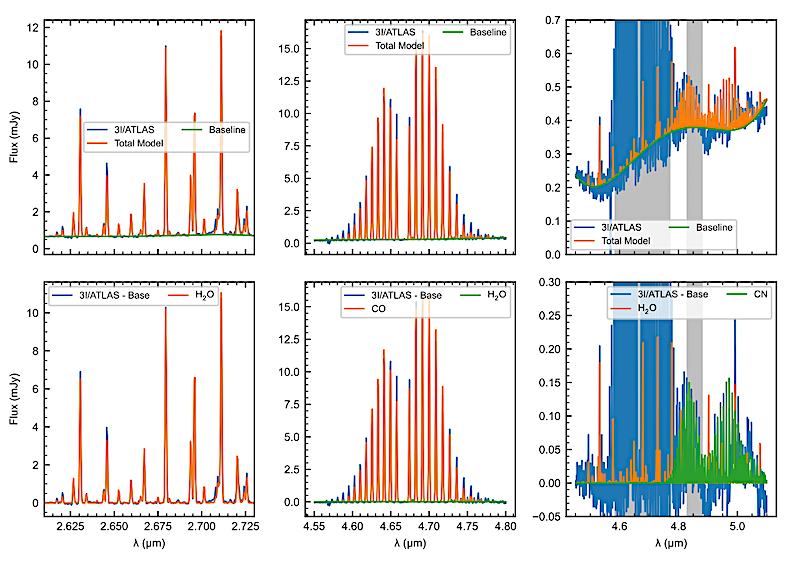
Left Panels. Upper. 3I/ATLAS 2.7 µm H2O spectrum on 2025 December 22 with best-fit model and spectral baseline overplotted. Lower. Baseline-subtracted 3I/ATLAS spectrum with best-fit individual molecular emission model(s) shown. Middle Panels. As in the left panels, but for CO on 2025 December 23. Right Panels. As in the left panels, but for H2O and CN on 2025 December 23. The gray shaded regions show the strong CO and OCS emission masked when retrieving Q(H2O).– astro-ph.EP
Nathan X. Roth, Martin Cordiner, Stefanie Milam, Geronimo Villanueva, Steven Charnley, Nicolas Biver, Dominique Bockelee-Morvan, Dennis Bodewits, Jacques Crovisier, Maria N. Drozdovskaya, Davide Farnocchia, Kenji Furuya, Michael S.P. Kelley, Marco Micheli, John W. Noonan, Cyrielle Opitom, Megan E. Schwamb, Cristina A. Thomas
Subjects: Earth and Planetary Astrophysics (astro-ph.EP); Astrophysics of Galaxies (astro-ph.GA)
Cite as: arXiv:2603.20445 [astro-ph.EP] (or arXiv:2603.20445v1 [astro-ph.EP] for this version)
https://doi.org/10.48550/arXiv.2603.20445
Focus to learn more
Submission history
From: Nathan Roth
[v1] Fri, 20 Mar 2026 19:20:31 UTC (287 KB)
https://arxiv.org/abs/2603.20445
Astrobiology, Astrochemistry,