Three Outstanding Physical Questions For K2-18 b And Other Temperate sub-Neptunes
Recent transmission spectra of the temperate sub-Neptune K2-18 b obtained with JWST have attracted significant attention. Debates have quickly arisen over the interpretation of the spectral data, particularly the recent MIRI observation where dimethyl sulfide (DMS) and dimethyl disulfide (DMDS) are claimed.
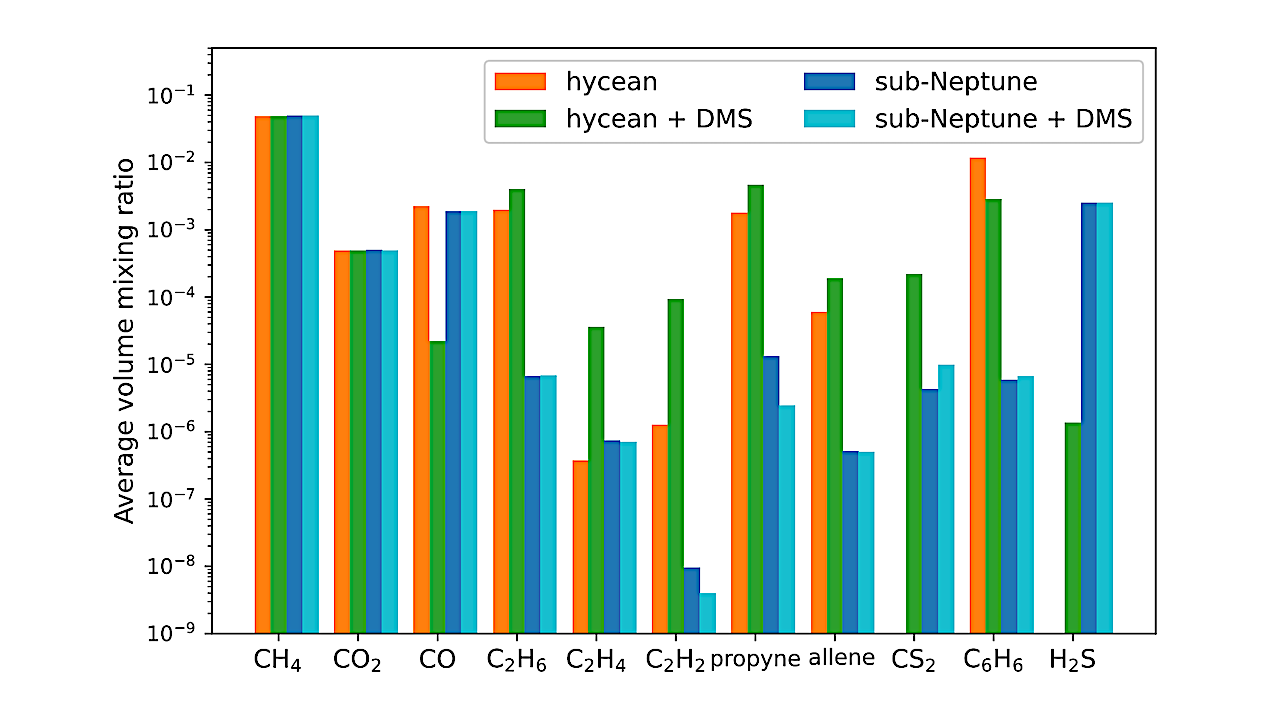
Here we revisit K2-18 b as a case study to examine several key questions that are also broadly relevant to the temperate sub-Neptune population: i) Can the low water abundance be reconciled with water clouds driven by orbital eccentricity? ii) Are the observed and non-observed atmospheric compositions mutually consistent? iii) Is it kinetically possible to produce DMS under sub-Neptune conditions?
To address these questions, we couple climate and photochemical models to obtain self-consistent climate-photochemistry states for K2-18 b with a moderate orbital eccentricity of 0.2, as suggested by radial-velocity measurements.
In addition, we present new laboratory measurements of DMS and DMDS infrared opacities by HFML-FELIX and compile updated C2H6 (ethane) opacities that include weak overtone bands. Our results support the interpretation of a sub-Neptune scenario without invoking DMS, and we do not find strong evidence for a water-rich interior.
Shang-Min Tsai, Piero Ferrari, Mats Kuipers, Jacob Lustig-Yaeger, Arnav Agrawal, Sean Jordan, Bart Oostenrijk, Laura Pille, Edward W. Schwieterman, Laurens B. F. M. Waters
Comments: Submitted to AAS Journals
Subjects: Earth and Planetary Astrophysics (astro-ph.EP)
Cite as: arXiv:2603.19803 [astro-ph.EP] (or arXiv:2603.19803v1 [astro-ph.EP] for this version)
https://doi.org/10.48550/arXiv.2603.19803
Focus to learn more
Submission history
From: Shang-Min Tsai
[v1] Fri, 20 Mar 2026 09:41:01 UTC (1,032 KB)
https://arxiv.org/abs/2603.19803
Astrobiology,