SPHEREx Re-Observation of Interstellar Object 3I/ATLAS in December 2025: Detection of Increased Post-Perihelion Activity, Refractory Coma Dust, and New Coma Gas Species
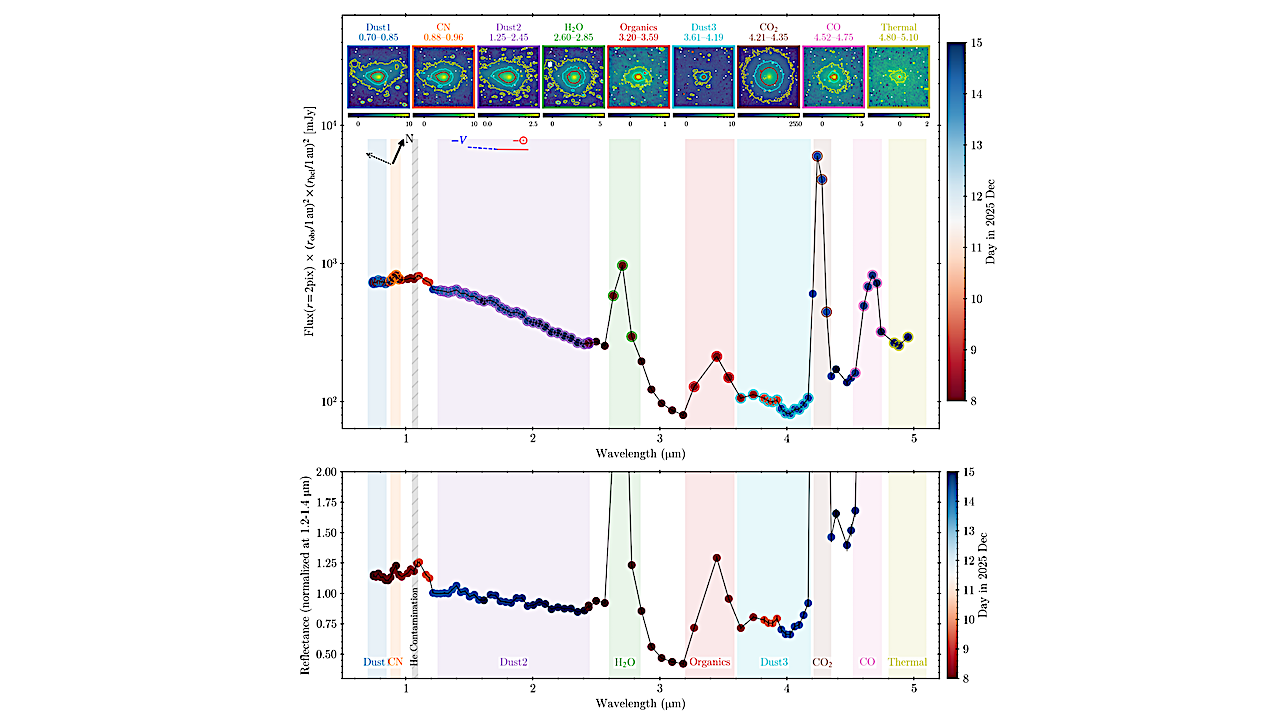
In December-2025, the NASA SPHEREx spacecraft re-observed ISO 3I/ATLAS post-perihelion, finding a much more active object compared to August-2025 SPHEREx pre-perihelion observations, with marked evidence for development into an cometary body fully sublimating all its ices.
The new imaging spectrophotometry is dominated by spatially resolved features due to dust scattered-light and thermal emission plus gas-emissions from CN (0.93 um), H2O (2.7 um), organic C-H (3.2 to 3.6 um), CO2 (4.25 to 4.27 um), and CO (4.6 to 4.8 um). The CO2 gas-coma continues to be extended out to a 3 arcmin radius.
The continuum spectral signature of H2O-ice absorption has mostly disappeared, replaced by scattered-light plus thermal-emission from organo-silicaceous dust grains while the H2O gas-emission is 20 times brighter.
All but the organics-gas comae are circularly symmetric, while a weak pear-shaped solar-pointing dust tail consistent with large dust grains is now present. The new appearance of CN and C-H features suggests that these species are contained either in H2O phases or were trapped under them.
C.M. Lisse, YP. Bach, S.A. Bryan, P. M. Korngut, B.P. Crill, A.J. Cukierman, O. Doré, A. Cooray, B. Fabinsky, A.L. Faisst, H. Hui, G.J. Melnick, C.H. Nguyen, Z. Rustamkulov, V. Tolls, M.W. Werner
Comments: 6 pages, 1 figure, submitted to RNAAS
Subjects: Earth and Planetary Astrophysics (astro-ph.EP); Astrophysics of Galaxies (astro-ph.GA); Solar and Stellar Astrophysics (astro-ph.SR)
Cite as: arXiv:2601.06759 [astro-ph.EP](or arXiv:2601.06759v1 [astro-ph.EP] for this version)
https://doi.org/10.48550/arXiv.2601.06759
Focus to learn more
Submission history
From: Carey Lisse
[v1] Sun, 11 Jan 2026 03:31:54 UTC (1,070 KB)
https://arxiv.org/abs/2601.06759
astrobiology, Astrochemistry, Astronomy, Interstellar,