Interstellar Ices as Carriers of Supernova Material to the Early Solar System
Planetary materials show systematic variations in their nucleosynthetic isotope compositions that resonate with orbital distance. The origin of this pattern remains debated, limiting how these isotopic signatures can be used to trace the precursors of terrestrial planets.
Here we test the hypothesis that interstellar ices carried supernova-produced nuclides by searching for a supernova nucleosynthetic fingerprint in aqueous alteration minerals from carbonaceous and non-carbonaceous chondrite meteorites.
We focus on zirconium, a refractory element that includes the neutron-rich isotope 96Zr formed in core-collapse supernovae. Leaching experiments reveal extreme 96Zr enrichments in alteration minerals, showing that they incorporated supernova material hosted in interstellar ices.
We show that the Solar System’s zirconium isotope variability reflects mixing between these ices and an ice-free rocky component. Finally, the presence of supernova nuclides in a volatile carrier supports models where the Solar System’s nucleosynthetic variability was imparted by thermal processing of material in the protoplanetary disk and during planetary accretion.
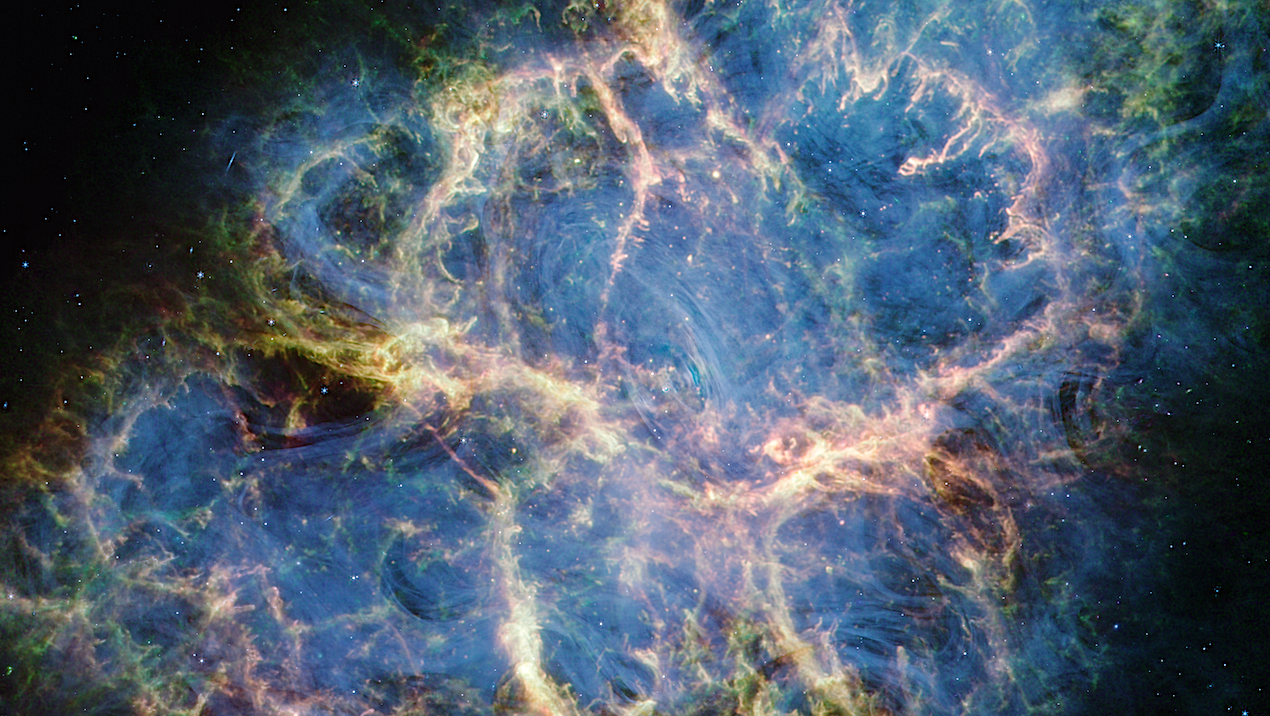
This illustration demonstrates how a massive star fuses heavier and heavier elements until exploding as a supernova and spreading those elements throughout space. Credit: NASA, ESA, and L. Hustak (STScI)
Martin Bizzarro, Martin Schiller, Jesper Holst, Laura Bouvier, Mirek Groen, Frédéric Moynier, Elishevah van Kooten, Maria Schönbächler, Troels Haugbølle, Darach Watson, Anders Johansen, James Connelly, Emil Bizzarro
Comments: Published in Nature Communications on November 27, 2025
Subjects: Earth and Planetary Astrophysics (astro-ph.EP); Astrophysics of Galaxies (astro-ph.GA); High Energy Astrophysical Phenomena (astro-ph.HE)
Cite as: arXiv:2512.00522 [astro-ph.EP] (or arXiv:2512.00522v1 [astro-ph.EP] for this version)
https://doi.org/10.48550/arXiv.2512.00522
Focus to learn more
Journal reference: Nature Communications volume 16, Article number: 10657 (2025)
Related DOI:
https://doi.org/10.1038/s41467-025-65672-5
Focus to learn more
Submission history
From: Anders Johansen
[v1] Sat, 29 Nov 2025 15:40:18 UTC (2,068 KB)
https://arxiv.org/abs/2512.00522
Astrobiology, Astrochemistry, Astronomy,