A Gene-Free Minimal System for Synthetic Quorum Sensing in Protocell Communities
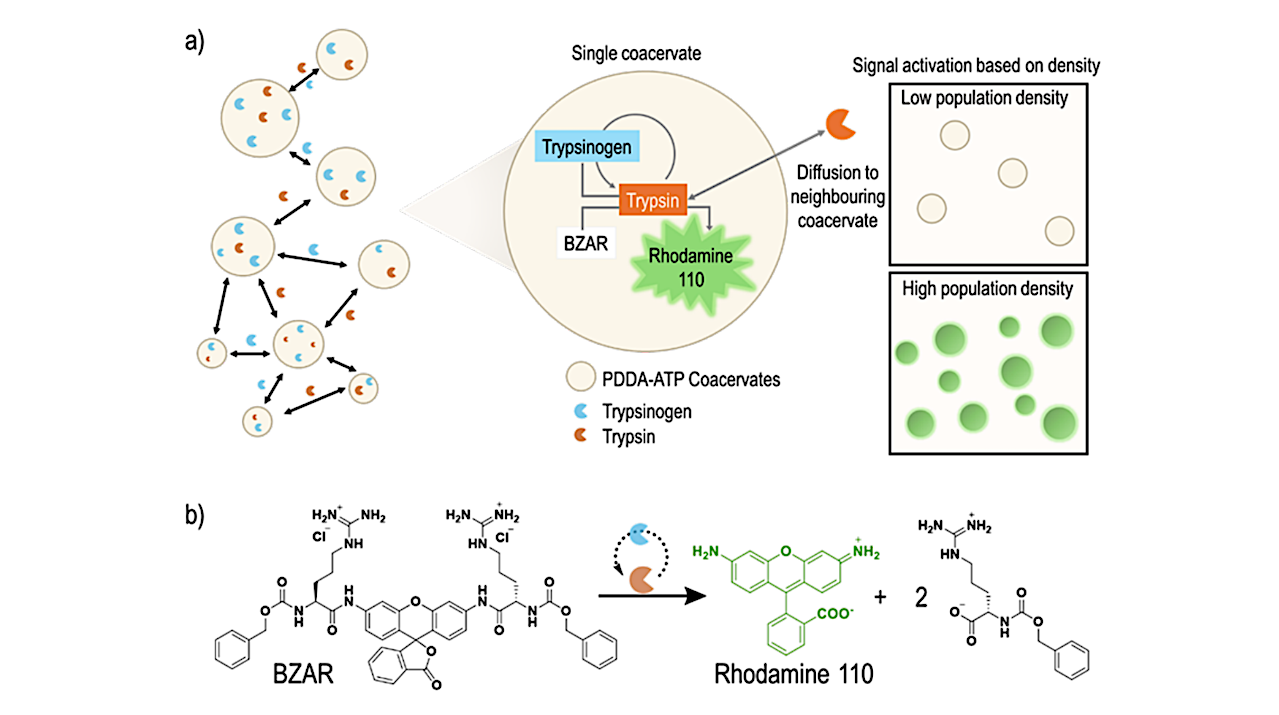
Synthetic communication networks are key to engineering life-like behaviors in artificial cells. Inspired by natural quorum sensing, we developed a coacervate-based system that exhibits quorum-sensing-like communication, driven by an autocatalytic trypsin–trypsinogen feedback loop.
These membraneless compartments enable diffusion and amplification of signaling molecules, resulting in population density–dependent collective activation analogous to natural quorum responses. At high population density, signal accumulation triggers a system-wide fluorescent response, whereas at low population density, signaling remains off.
By varying trypsin, trypsinogen, and population density, the activation threshold shifted over nearly an order of magnitude, with a fourfold acceleration in signal amplification at high population density. This gene-free platform establishes a minimal route to programmable, collective dynamics in synthetic protocell community.
A Gene-Free Minimal System for Synthetic Quorum Sensing in Protocell Communities, chemrxiv.org (open access)
Astrobiology, Genomics,