TESS Planets In Known Radial Velocity Cold Jupiter Systems: Hot Super Earth Occurrence Is Enhanced By Cold Jupiters
The correlation between inner super-Earths (SEs) and outer cold Jupiters (CJs) provides an important constraint on the formation and dynamical evolution of planetary systems. Previous studies have suggested a positive connection between these two populations, particularly around metal-rich stars, and proposed that nearly all CJ-hosting stars may also harbor inner SEs.
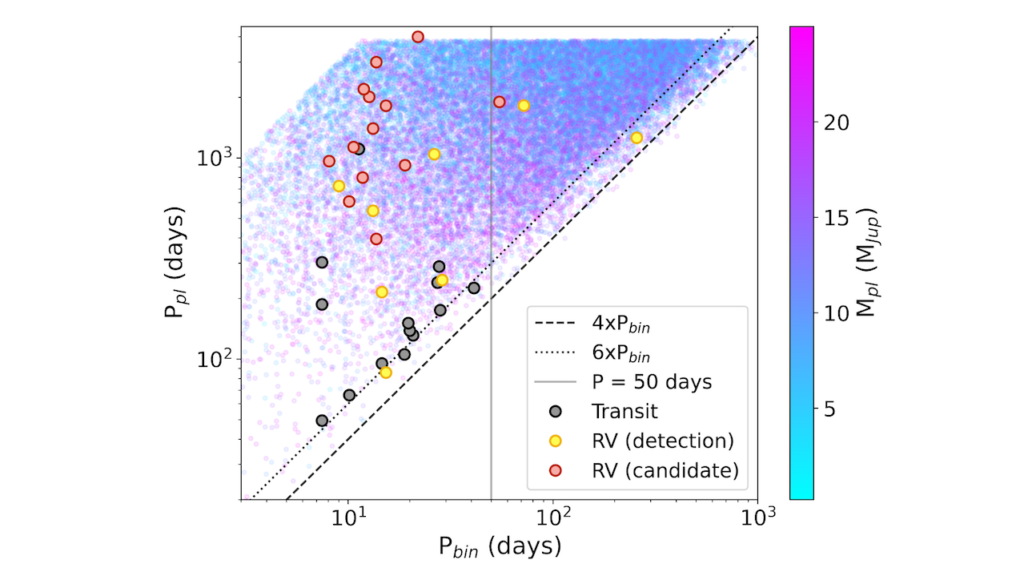
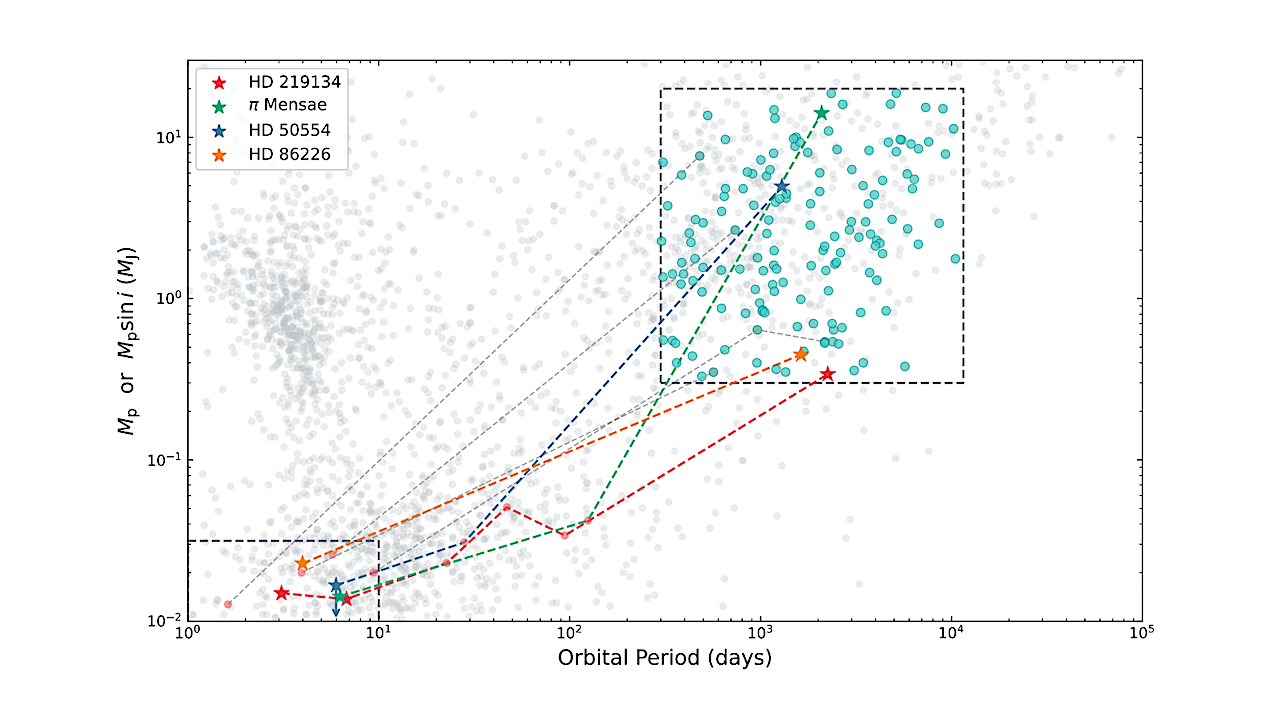
In this work, we use TESS transits to investigate the occurrence of hot SEs in systems with known CJs detected by radial velocity (RV). Out of a statistical sample of 132 CJ systems, we identify five transiting hot super-Earths (1-4R⊕, P<10d) around four stars, including one new candidate (TOI-6965.01) around HD 50554. To enable statistical analysis, we first validate the two candidates around HD 50554 using TESS photometry, archival RV measurements, and Gaia astrometry.
After accounting for detection sensitivity and geometric transit probability, we find that the presence of CJs enhances the occurrence rate of hot super-Earths by a factor of 8.1+4.3−3.2 relative to field stars, with the case of no enhancement ruled out at the 99.9% confidence level.
Taking into account the average multiplicity of hot SEs, we find that about 87% of CJ systems host at least one hot SE. Our results provide strong supporting evidence for a positive SE-CJ correlation. We also briefly explore the correlation around metal-poor hosts and for specific sub-populations (e.g., warm super-Earths or cold super-Jupiters).
Quanyi Liu, Wei Zhu, Tianjun Gan, Fei Dai
Comments: 15 pages, 8 figures, 4 tables; Submitted to AJ
Subjects: Earth and Planetary Astrophysics (astro-ph.EP)
Cite as: arXiv:2602.11017 [astro-ph.EP] (or arXiv:2602.11017v1 [astro-ph.EP] for this version)
https://doi.org/10.48550/arXiv.2602.11017
Focus to learn more
Submission history
From: Quanyi Liu
[v1] Wed, 11 Feb 2026 16:41:01 UTC (1,440 KB)
https://arxiv.org/abs/2602.11017
Astrobiology,