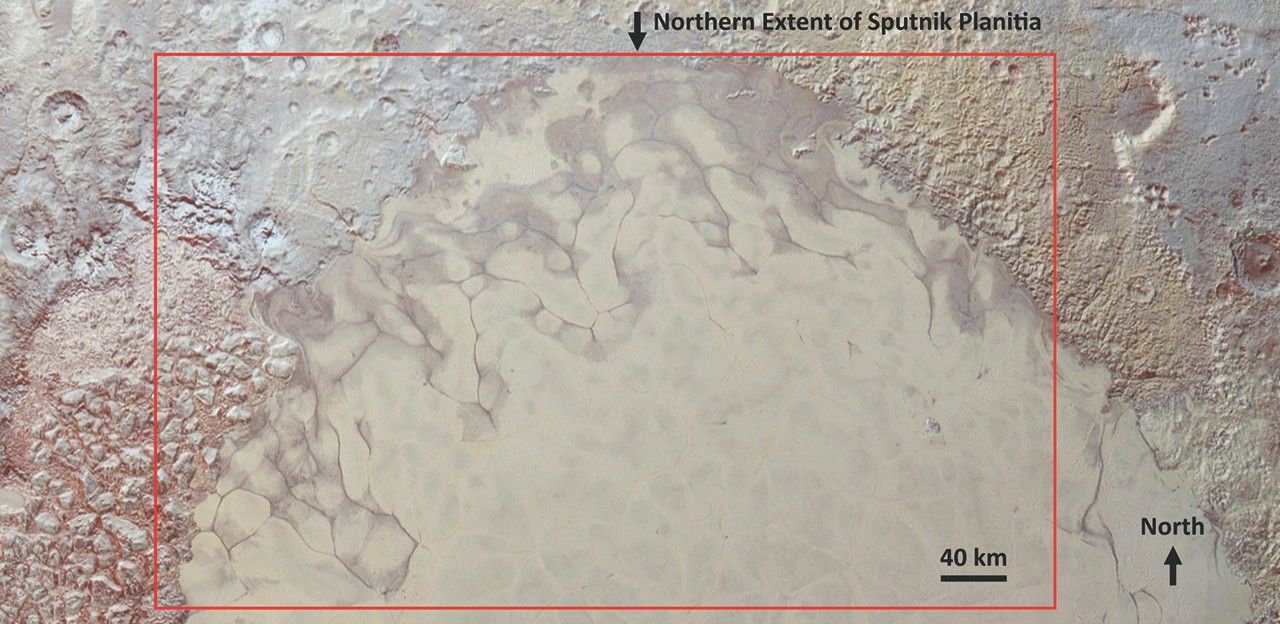
[NASA] “Pluto never stops surprising us,” said Alan Stern, principal investigator of New Horizons and lead study author from the Southwest Research Institute in Boulder, Colorado. “In addition to suggesting that liquids have recently expressed themselves on Pluto’s surface, this result also suggests a new kind of time-variable feature on Pluto.”
The Sputnik Planitia is a vast, frozen nitrogen glacier on Pluto, larger than the U.S. states of Texas and Oklahoma combined. In 2015, New Horizons’ images of the northernmost portions of this region revealed city-sized geologic convection cells on Sputnik Planitia separated by both thin dark linear and more diffuse dark features, suggesting historical liquid flows.
Now the new research, published July 31 in the Planetary Science Journal, indicates that these dark linear and diffuse features may be occasionally and temporarily wetted, perhaps from time to time, by a liquid, most likely liquid nitrogen. The journal paper’s authors include both planetary science experts in Pluto and experts in terrestrial glaciology.
Surface patterns on northern Sputnik Planitia have been darkened in ways that resemble glacial features on Earth that have been wetted by rain or by the subsurface emergence of liquids to the surface. Pluto’s atmospheric and thermal conditions make liquid nitrogen rain physically impossible, suggesting that liquid nitrogen is flowing up from underneath the glacier.

The northern and eastern portions of SP; north is to the top. Upper left panel: panchromatic image of SP; arrows point to representative convection cells. Upper right panel: color image of SP; the direction of north is shown, along with a scale bar in each of these panels. Lower left panel: geological map (from O. L. White et al. 2017); a scale bar as a function of latitude is shown to the lower left; the red rectangle box here indicates the region where the upper panels lie. Lower right panel: inset taken from the red boxed area in the upper left panel showing convection cells and call outs for a typical diffuse dark apron (DDA) and a typical dark, narrow feature (DNF). — The Planetary Science Journal
Evidence for Possible N2 Basal Flow beneath Pluto’s Northern Sputnik Planitia, The Planetary Science Journal
Astrobiology, astrogeology,