Jets and Superrotation in Deep and Shallow Planetary Atmospheres
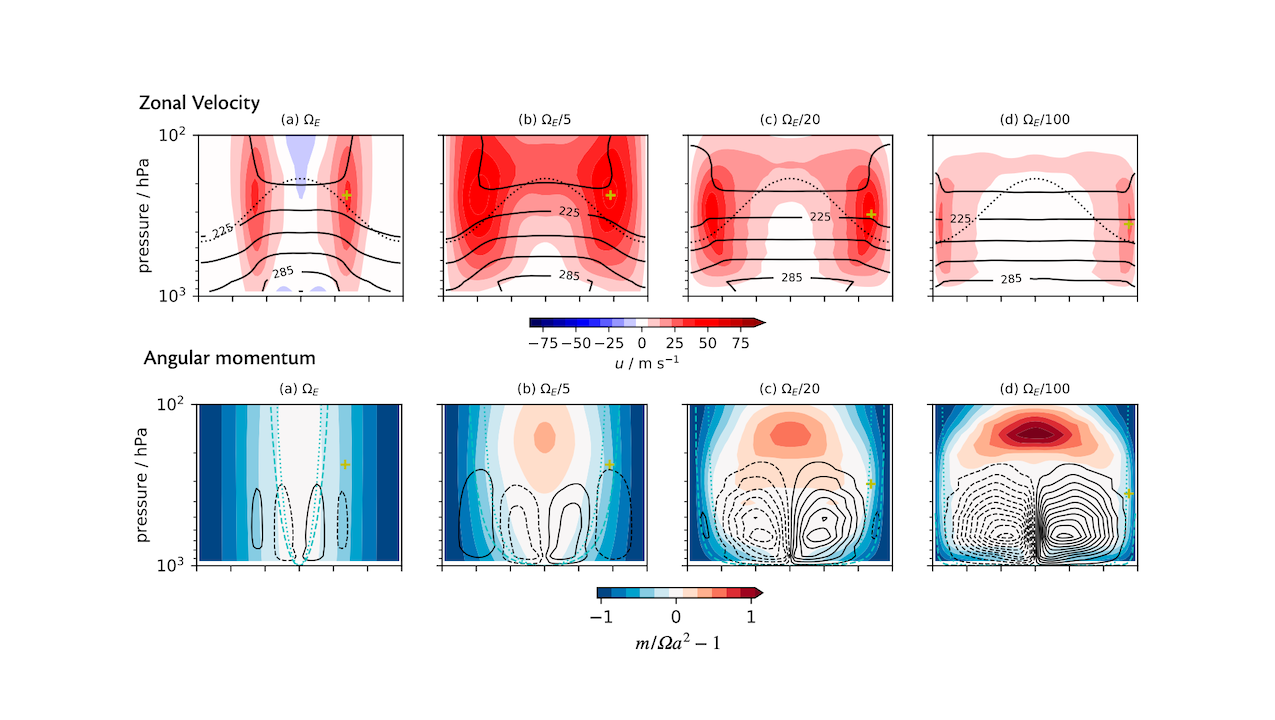
Zonal flows in planetary atmospheres are ubiquitous, and nearly all the planets in the Solar System have flows that are zonally rather than meridionally aligned. Jets, which are essentially concentrated streams of fluid that are distinct from a more quiescent background, are less common but can also be found in both deep and shallow atmospheres.
Superrotation, which in most circumstances simply means prograde motion (relative to the planetary rotation) at the equator, is less common but can be found in both deep and shallow planetary atmospheres, and in both quickly and slowly-rotating atmospheres: Jupiter, Saturn, Venus and Titan all have superrotating atmospheres.
Jets, especially superrotating jets, imply some form of `antidiffusion’ of momentum, meaning that momentum (or angular momentum) must be transported upgradient. This article discusses some of the mechanisms that give rise to jets and superrotation in both deep and shallow planetary atmospheres, on both slow and fast rotators, contrasting and comparing the processes involved.
Topics discussed include the roles of convection in deep atmospheres, geometric and topographic β-effects, potential-vorticity homogenization, wave–mean-flow interaction and tidal locking in exoplanets.
Geoffrey K Vallis, Loren I. Matilsky, Quentin Nicolas
Comments: Accepted in Phil Trans Roy Soc. 10 figures, 30 pages
Subjects: Earth and Planetary Astrophysics (astro-ph.EP)
Cite as: arXiv:2606.00443 [astro-ph.EP](or arXiv:2606.00443v1 [astro-ph.EP] for this version)
https://doi.org/10.48550/arXiv.2606.00443
Focus to learn more
Submission history
From: Geoff Vallis
[v1] Sat, 30 May 2026 00:21:49 UTC (3,190 KB)
https://arxiv.org/abs/2606.00443
Astrobiology, exoplanet,