Building a Roadmap for Hubble Science into the 2030s: Revealing Atmospheric Structure and Evolution in Substellar Worlds Using HST
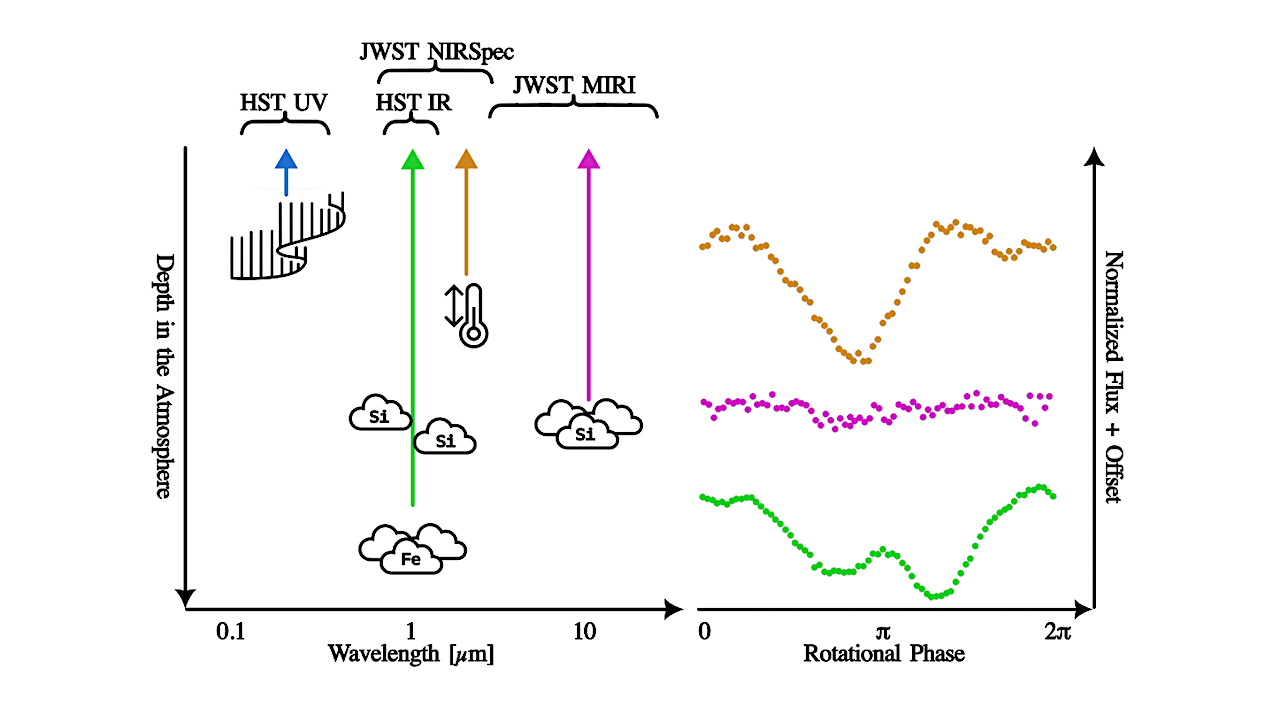
Substellar objects occupy a unique place in our universe, bridging the gap between the smallest stars and the largest planets, and serving as powerful laboratories for understanding extrasolar atmospheric physics without the contaminating glare of a host star.
Previous studies into the atmospheric structure of these objects have revealed clouds, disequilibrium chemistry, thermal inversions, and auroral processes which each contribute to wavelength-dependent brightness variations.
HST remains uniquely positioned to address key open questions in the field, such as resolving the vertical atmospheric structure, long term evolution of the atmosphere, and detection of UV aurora in the upper atmosphere, primarily in conjunction with other facilities that probe wavelength regimes that cannot be reached with instruments on HST.
We advocate for three large scale initiatives and argue that the study of the atmospheres of substellar worlds directly prepares the community for atmospheric characterization with the Habitable Worlds Observatory.
Allison M. McCarthy, Merle A. Schrader, Johanna M. Vos, Sven Kiefer, Cian O’Toole, Michael K. Plummer, Michael Poon, Daniella Bardalez Gagliuffi, Samuel Beiler, John E. Gizis, Melodie M. Kao, Gabriel-Dominique Marleau, Elisabeth C. Matthews, Philip S. Muirhead, Evert Nasedkin, Natalia Oliveros-Gomez, J. Sebastian Pineda, Kimberly Ward-Duong
Comments: 8 pages, 1 figure
Subjects: Instrumentation and Methods for Astrophysics (astro-ph.IM); Earth and Planetary Astrophysics (astro-ph.EP); Solar and Stellar Astrophysics (astro-ph.SR)
Cite as: arXiv:2606.18299 [astro-ph.IM] (or arXiv:2606.18299v1 [astro-ph.IM] for this version)
https://doi.org/10.48550/arXiv.2606.18299
Focus to learn more
Submission history
From: Allison McCarthy
[v1] Tue, 16 Jun 2026 00:57:41 UTC (235 KB)
https://arxiv.org/abs/2606.18299
Astrobiology, Astrochemistry,