Direct Imaging Constraints on Binary Planets and Exomoons around Epsilon Indi A b
Epsilon Indi A b is a directly imaged ∼6MJup exoplanet orbiting a nearby (3.6 pc) K-dwarf at ∼30 AU.
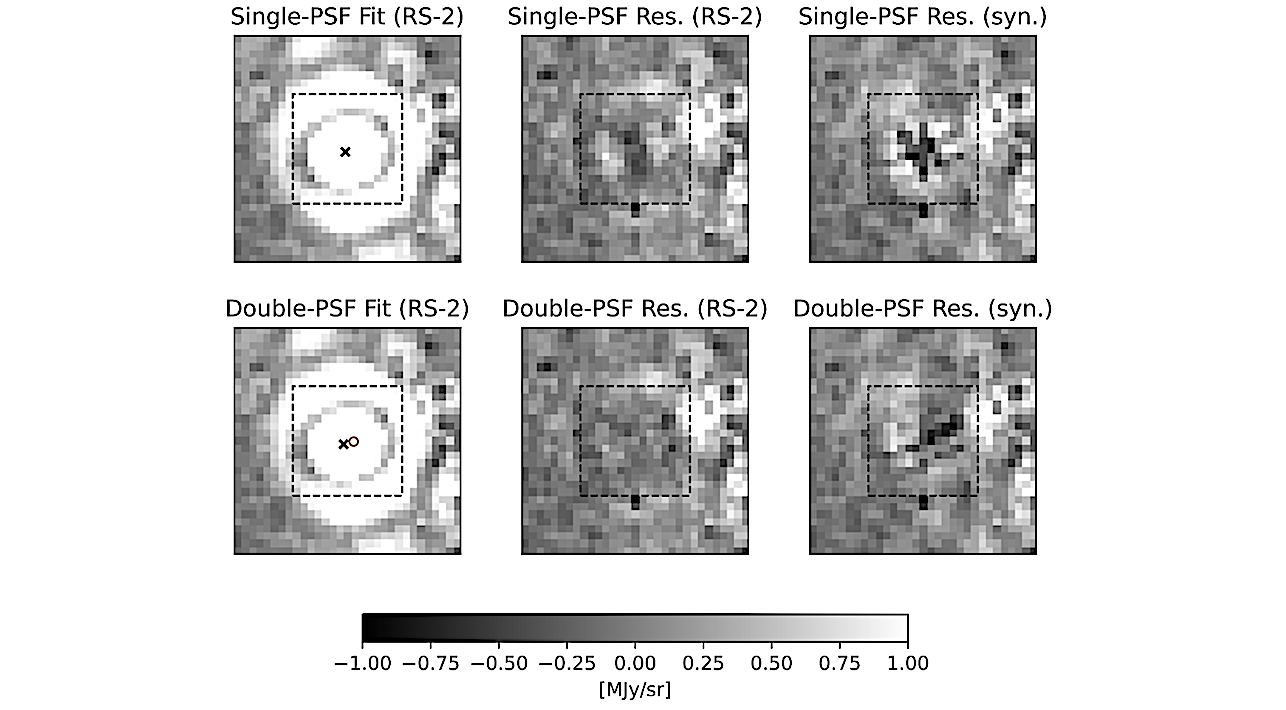
We analyze archival JWST/MIRI 15 μm coronagraphic imaging of this planet to search for directly imaged satellites orbiting Eps Ind A b. Within the planet’s Hill sphere (radius RH≈2.3 AU or 1.3λ/D), we compare single- and double-PSF models using Bayesian evidence. We find that a double-PSF (binary planet) fit is preferred.
This apparent preference can most plausibly be explained by systematics, although follow-up observations would be required to fully rule out a binary planet interpretation. We construct a contrast curve of the exoplanet after removing this feature, demonstrating sensitivity to companions as faint as 0.03× the F1550C flux of Eps Ind A b (equivalent to T=130 K, 1.3MJup) at large separations (>2 AU).
We also demonstrate sensitivity to brighter companions 0.2× the F1550C flux of Eps Ind A b (equivalent to T=180 K, 2.5MJup) down to separations of 0.52 AU (1.3 pixels; 0.29λ/D; 144 mas). This study demonstrates that JWST/MIRI can directly detect exomoons or binary planets inside the Hill sphere of directly imaged exoplanets orbiting neighboring stars.
Matson Garza (1), Mary Anne Limbach (2), Rachel Bowens-Rubin (2 and 3), Matthew De Furio (4), Elisabeth C. Matthews (5), Kyle Franson (6), Sarah C. Millholland (1), Logan A. Pearce (2), Andrew Vanderburg (7) ((1) Department of Physics, Massachusetts Institute of Technology, (2) Department of Astronomy, University of Michigan, (3) Eureka Scientific Inc., (4) Department of Astronomy, The University of Texas at Austin, (5) Max Planck Institute for Astronomy, (6) Department of Astronomy and Astrophysics, The University of California, Santa Cruz, (7) Center for Astrophysics, Harvard & Smithsonian)
Comments: Accepted to AJ, 14 pages with 5 figures
Subjects: Earth and Planetary Astrophysics (astro-ph.EP)
Cite as: arXiv:2604.23448 [astro-ph.EP] (or arXiv:2604.23448v1 [astro-ph.EP] for this version)
https://doi.org/10.48550/arXiv.2604.23448
Focus to learn more
Submission history
From: Matson Garza
[v1] Sat, 25 Apr 2026 21:33:52 UTC (275 KB)
https://arxiv.org/abs/2604.23448
Astrobiology, exoplanet,