Astrometric Exoplanet Detection Survives Solar-like Stellar Contamination
Astrometric monitoring of stars provides a promising method for discovery of low-mass planets around nearby Sun-like stars.
The astronomical community has proposed several telescopes designed to perform high-precision astrometric observations. One limiting factor intrinsic to stars is the astrometric noise – or “jitter” – induced by surface stellar activity such as starspots and faculae. Despite previous estimates, the relative size of this signal has not been empirically measured from direct photometric observations.
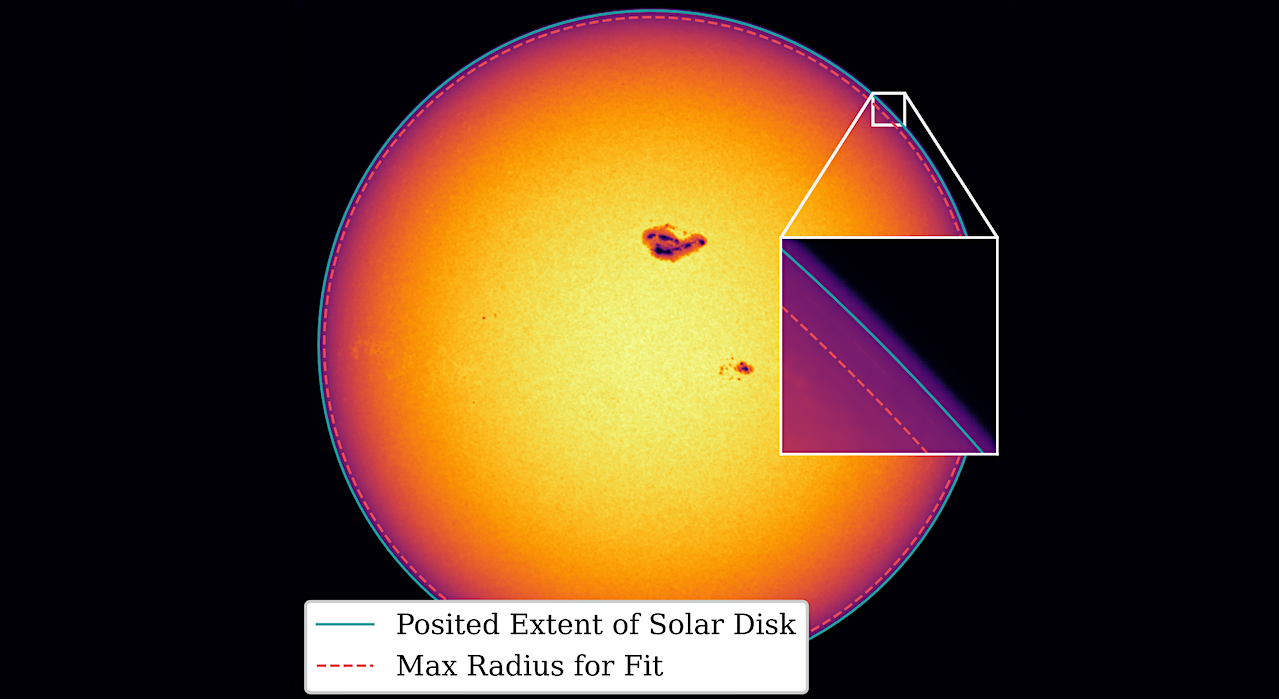
We analyse high-resolution images of the Sun to quantify the photometric centroid jitter across three narrow wavelength regions over nearly a decade, spanning high and low activity periods of the Solar cycle. We compare our findings to previous theoretical estimates.
We scale this jitter to simulate how a Solar-twin would appear at various distances, establishing an astrometric noise floor below which detection is significantly complicated by stellar activity. We also introduce starspot simulations that augment our data. We find the typical astrometric jitter of the Sun at 𝜆 = 607.2 ± 0.25nm to be 0.342𝜇as pc, ranging between 0.058𝜇as pc and 1.294𝜇as pc for low and high activity periods, respectively.
This is lower than the expected ≈ 3𝜇as astrometric signal that an Earth-like planet would produce around a Sun-like star, at 1 pc. Therefore, the astrometric noise floor imposed by intrinsic stellar activity sets a detection limit below one Earth but greater than Mars around Solar-analog stars, making instrument precision the limiting factor for Earth-like exoplanet searches.
Conaire Deagan, Benjamin T. Montet, P. Tuthill, M. Ferraro, R. Lyu, E. Sheehan
Comments: 20 pages, 14 Figures
Subjects: Solar and Stellar Astrophysics (astro-ph.SR); Earth and Planetary Astrophysics (astro-ph.EP); Instrumentation and Methods for Astrophysics (astro-ph.IM)
Cite as: arXiv:2605.18953 [astro-ph.SR] (or arXiv:2605.18953v1 [astro-ph.SR] for this version)
https://doi.org/10.48550/arXiv.2605.18953
Focus to learn more
Submission history
From: Conaire Deagan
[v1] Mon, 18 May 2026 18:00:03 UTC (4,002 KB)
https://arxiv.org/abs/2605.18953
Astrobiology,