Star-planet Interaction In The Proxima System
(Abridged) We search for evidence of star-planet magnetic interactions in the nearby Proxima Centauri planetary system using high-quality, high-spectral-resolution optical observations.
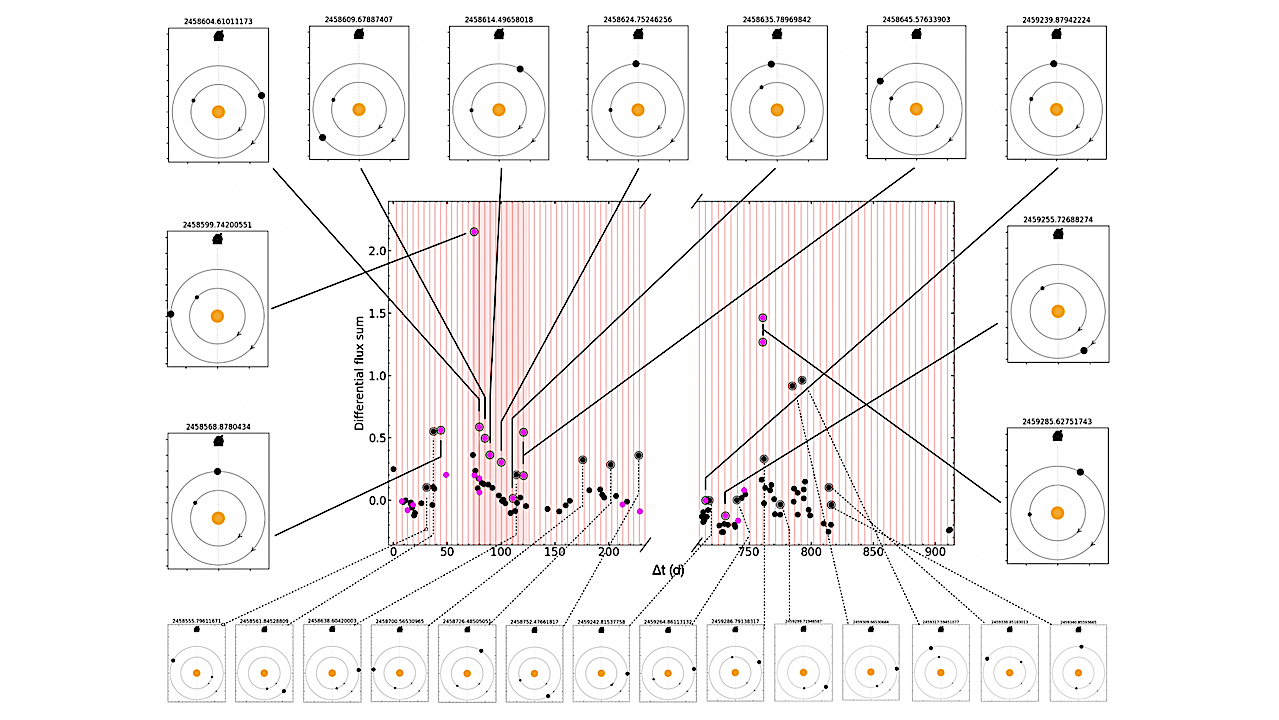
We measure a photospheric stellar rotation period of 84.9 +/- 0.6 d and a half-rotation period of 44.3 +/- 0.2 d, consistent with previous studies. Using FeI absorption and emission lines, we find that Proxima Centauri was flaring during 4.8 +/- 4.7 % of the observing time, with significant statistical evidence (>99.8 %) of flare events likely phase-locked to the inner Mars-mass planet Proxima d.
Modeling the star-planet interaction via the helicity-driven reconnection mechanism with the Poynting flux formalism, we estimate a likely polar magnetic field of -16 G for Proxima d (assuming a Mars-sized radius), with a plausible range of 3-280 G accounting for radial and dipolar stellar magnetic field configurations, planetary radii comparable to Mars and Earth, and the observed range of stellar flare intensities. This represents the first such estimate for a terrestrial exoplanet.
Evidence for a potential star-planet interaction with the outer, Earth-mass Proxima b arises not from phase-locked flare clustering, but from modulation of flare intensities. Applying a prewhitening analysis to the full time series of combined chromospheric Halpha, NaI D1 and D2, and CaII H &K lines reveals peaks, in order, at half the stellar rotation period, Proxima b’s orbital period, the full stellar rotation, and Proxima d’s orbital period.
All evidence suggests that both planets show magnetic interaction with their host star. Focusing on flaring epochs only, the periodogram of these chromospheric lines shows a peak consistent with the synodic period between half the stellar rotation and the mutual synodic period of Proxima b and d, implying prograde stellar rotation and planetary orbits.
M. R. Zapatero Osorio, V. J. S. Béjar, A. Suárez Mascareño, R. Rebolo, S. Cristiani, G. Micela, P. A. Miles-Páez, N. C. Santos, E. Pallé, J. I. González Hernández, M. Damasso, A. Castro-González, C. J. A. P. Martins, F. Pepe, A. Sozzetti, B. Lavie, J. Rodrigues
Comments: Accepted for publication in A&A. The quality of some figures was reduced to comply with arXiv requirements
Subjects: Earth and Planetary Astrophysics (astro-ph.EP); Solar and Stellar Astrophysics (astro-ph.SR)
Cite as: arXiv:2605.22925 [astro-ph.EP] (or arXiv:2605.22925v1 [astro-ph.EP] for this version)
https://doi.org/10.48550/arXiv.2605.22925
Focus to learn more
Submission history
From: Maria Rosa Zapatero Osorio
[v1] Thu, 21 May 2026 18:02:52 UTC (24,782 KB)
https://arxiv.org/abs/2605.22925
Astrobiology, exoplanet,