TOI-4616 b: A Benchmark Earth-sized Planet Transiting A Nearby M4 Dwarf
Rocky exoplanets are particularly abundant around M-type stars. Their small radii and low luminosities provide favourable conditions for detecting transiting terrestrial planets and probing their atmospheric properties.
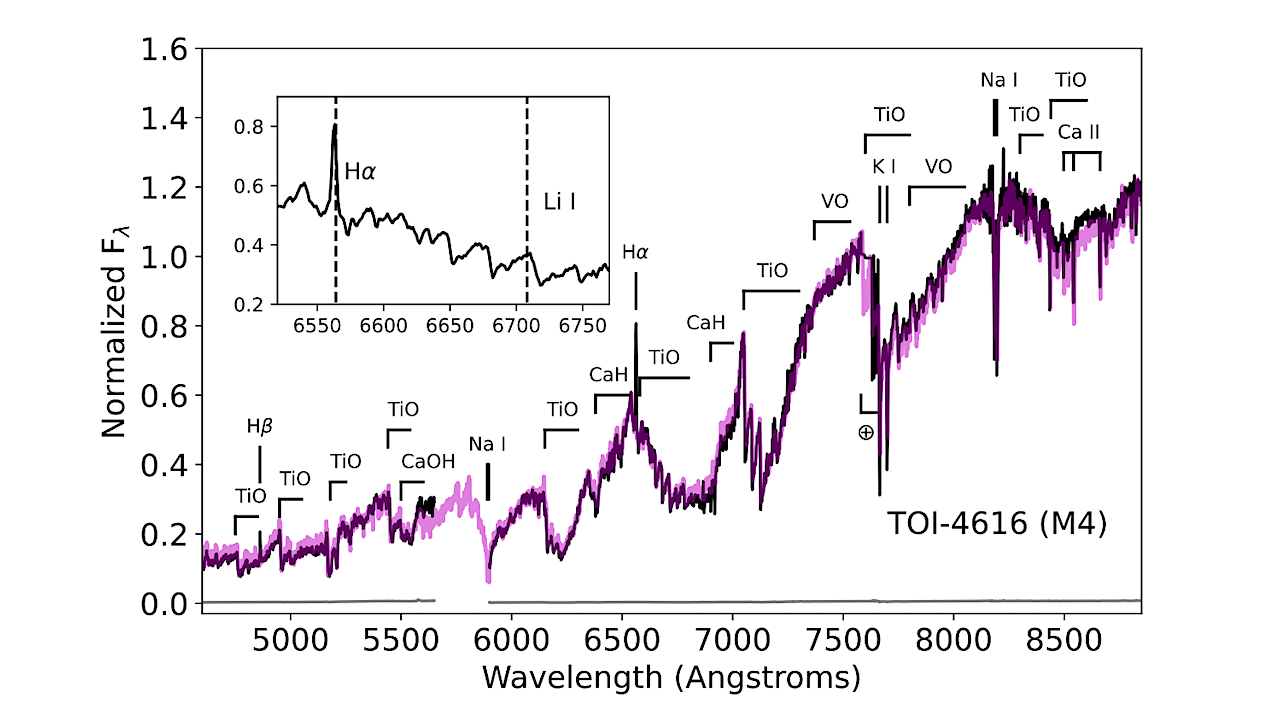
We report the discovery and statistical validation of TOI-4616 b, an Earth-sized planet transiting a nearby mid-M dwarf observed by the Transiting Exoplanet Survey Satellite (TESS). We confirm the planetary nature of the signal and determine the system parameters by combining TESS photometry with ground-based multi-band transit observations, high-resolution imaging, and optical and near-infrared spectroscopy.
The host star lies at a distance of 28.10 +(-) 0.07 pc and has a radius of 0.1889 +(-)0.0096 solar radii, a mass of 0.1881 +(-) 0.0094 solar masses, and an effective temperature of 3150 +(-) 75 K. TOI-4616 b has a radius of 1.22 Earth radii and an orbital period of 1.55 days. The planet receives an incident flux of approximately 40 times that of Earth, corresponding to an equilibrium temperature of about 525 K. This places TOI-4616 b in a regime intermediate between Earth-sized planets orbiting early M dwarfs and those around ultra-cool hosts.
Statistical validation with the TRICERATOPS framework, supported by high-resolution imaging and chromatic transit constraints, yields a false-positive probability of 0.0135, below the recommended validation threshold of 0.015, confirming TOI-4616 b as a validated planet. Owing to its proximity to Earth, well-constrained stellar properties, and extensive multi-band follow-up, TOI-4616 b constitutes a valuable benchmark system for comparative studies of terrestrial planets around mid-M dwarfs and for future atmospheric investigations.
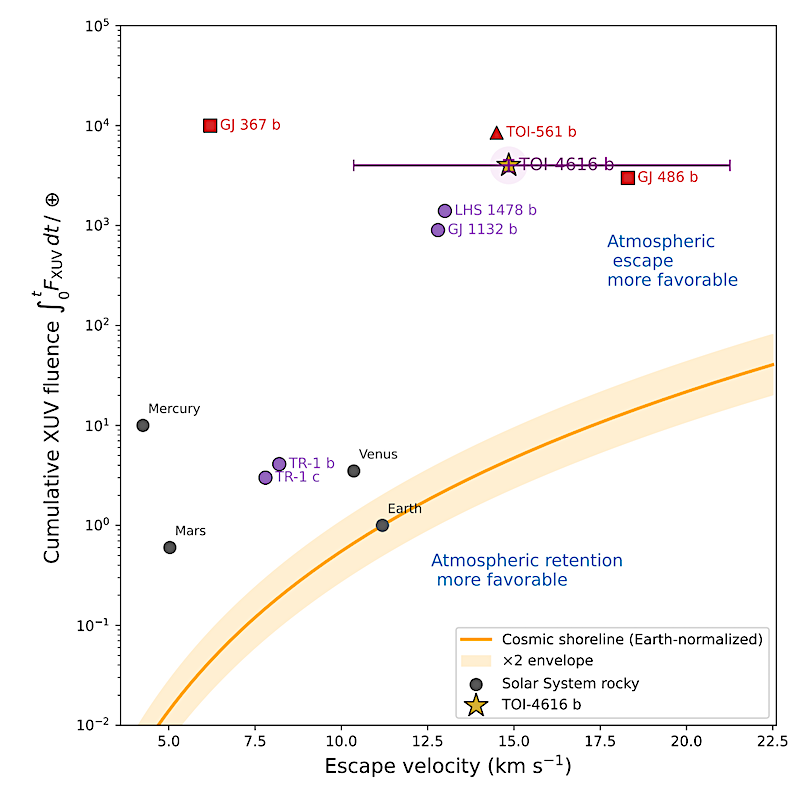
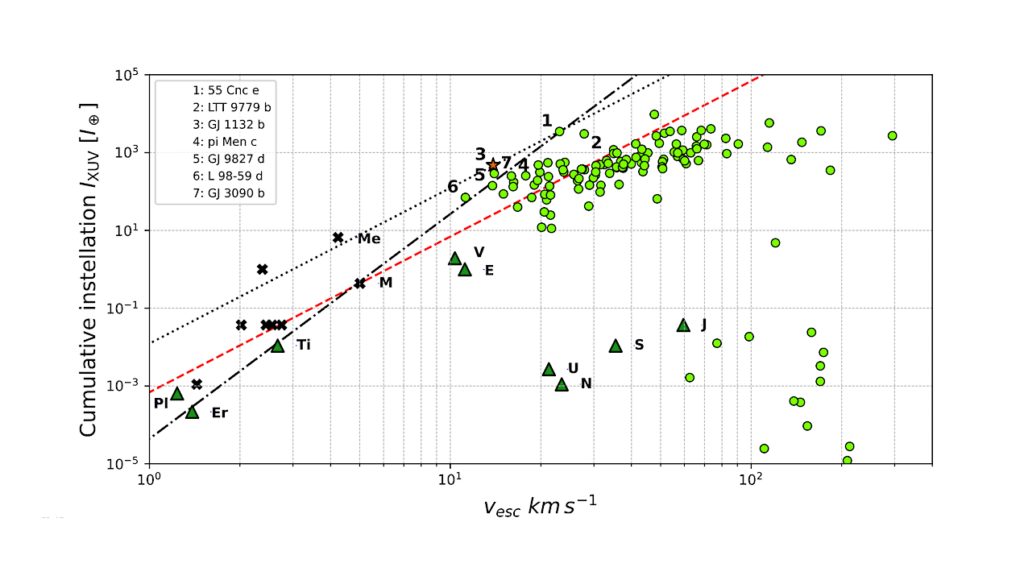
Location of TOI-4616 b in the cumulative XUV fluence–escape velocity plane, shown in the context of the empirical cosmic shoreline. The orange curve and shaded region indicate the Solar-System-derived cosmic shoreline relation (Zahnle & Catling 2017) and its uncertainty envelope, separating regimes where atmospheres are expected to be retained (below) or efficiently eroded (above). Solar System rocky planets are shown for reference. TOI-4616 b (purple star) lies well above the shoreline, in a region where atmospheric survival is nominally disfavoured, at cumulative XUV fluence comparable to or exceeding that of TOI-561 b. The location of TOI-561 b—despite recent JWST evidence for a substantial atmosphere—highlights that the cosmic shoreline is not a strict boundary and motivates TOI-4616 b as a stringent test case for atmospheric escape and survival under extreme irradiation. — astro-ph.EP
F. Zong Lang, B. O. Demory, Y. Gomez Maqueo Chew, Y. Schmid, M. Timmermans, F. J. Pozuelos, M. Gillon, Artem Y. Burdanov, Benjamin V. Rackham, Didier Queloz, Keivan G. Stassun, Khalid Barkaoui, Amaury Triaud, Julien de Wit, S. Zuniga-Fernandez, A. J. Burgasser, Elsa Ducrot, Madison G. Scott, D. Sebastian, A. Soubkiou, M. Lendl, I. Plauchu-Frayn, U. Schroffenegger, Erik Meier V., P. Pedersen, A. Khandelwal, Roman Gerasimov, C. Aganze, Chih-Chun Hsu, J. M. Jenkins, Aishwarya R. Iyer, C. Watkins, C. A. Theissen, K. A. Collins, H. P. Osborn, A. Shporer, Claudia Jano Munoz, Toshi Suganuma, Norio Narita, Akihiko Fukui, F. Murgas, J. de Leon, Enric Palle, Yasmin Davis, D. Kitzmann, M. Pichardo Marcano, M. J. Hooton
Comments: Submitted to MNRAS, 22 pages, 24 figures, 3 tables
Subjects: Earth and Planetary Astrophysics (astro-ph.EP)
Cite as: arXiv:2603.10905 [astro-ph.EP] (or arXiv:2603.10905v1 [astro-ph.EP] for this version)
https://doi.org/10.48550/arXiv.2603.10905
Focus to learn more
Submission history
From: Francis Zong Lang
[v1] Wed, 11 Mar 2026 15:48:15 UTC (9,222 KB)
https://arxiv.org/abs/2603.10905
Astrobiology, Exoplanet,