The Efficient Delivery Of Highly-siderophile Elements To The Core Creates A Mass Accretion Catastrophe For The Earth
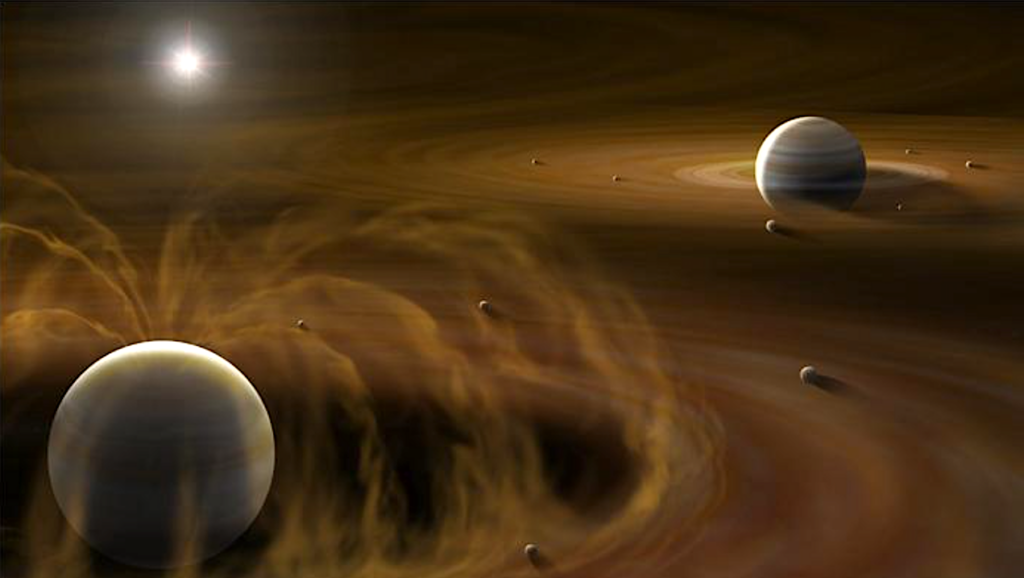
The excess abundance of highly siderophile elements (HSEs), as inferred for the terrestrial planets and the Moon, is thought to record a `late veneer’ of impacts after the giant impact phase of planet formation.
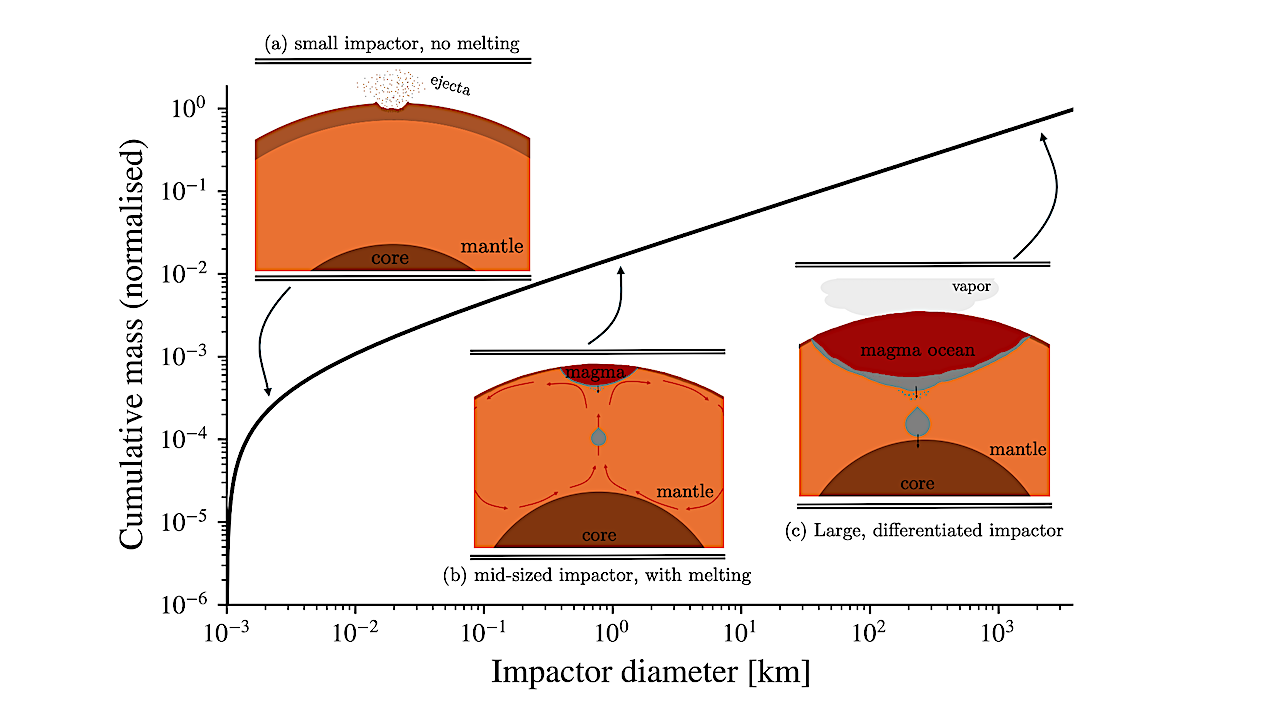
Estimates for total mass accretion during this period typically assume all HSEs delivered remain entrained in the mantle. Here, we present an analytical discussion of the fate of liquid metal diapirs in both a magma pond and a solid mantle, and show that metals from impactors larger than approximately 1 km will sink to Earth’s core, leaving no HSE signature in the mantle.
However, by considering a collisional size distribution, we show that to deliver sufficient mass in small impactors to account for Earth’s HSEs, there will be an implausibly large mass delivered by larger bodies, the metallic fraction of which lost to Earth’s core.
There is therefore a contradiction between observed concentrations of HSEs, the geodynamics of metal entrainment, and estimates of total mass accretion during the late veneer. To resolve this paradox, and avoid such a mass accretion catastrophe, our results suggest that large impactors must contribute to observed HSE signatures.
For these HSEs to be entrained in the mantle, either some mechanism(s) must efficiently disrupt impactor core material into ≤0.01 mm fragments, or alternatively Earth accreted a significant mass fraction of oxidised (carbonaceous chondrite-like) material during the late veneer.
Estimates of total mass accretion accordingly remain unconstrained, given uncertainty in both the efficiency of impactor core fragmentation, and the chemical composition of the late veneer.
Richard J. Anslow, Maylis Landeau, Amy Bonsor, Jonathan Itcovitz, Oliver Shorttle
Comments: Accepted for publication in JGR: Planets
Subjects: Earth and Planetary Astrophysics (astro-ph.EP)
Cite as: arXiv:2603.17961 [astro-ph.EP] (or arXiv:2603.17961v1 [astro-ph.EP] for this version)
https://doi.org/10.48550/arXiv.2603.17961
Focus to learn more
Submission history
From: Richard Anslow
[v1] Wed, 18 Mar 2026 17:31:17 UTC (1,407 KB)
https://arxiv.org/abs/2603.17961
Astrobiology,