Exoplanet Orbital Distribution Around FGK Sun-like Host Stars I: Planet Occurrence Rate Derived From The Kepler Mission And Theoretical Interpretations From Planet Formation
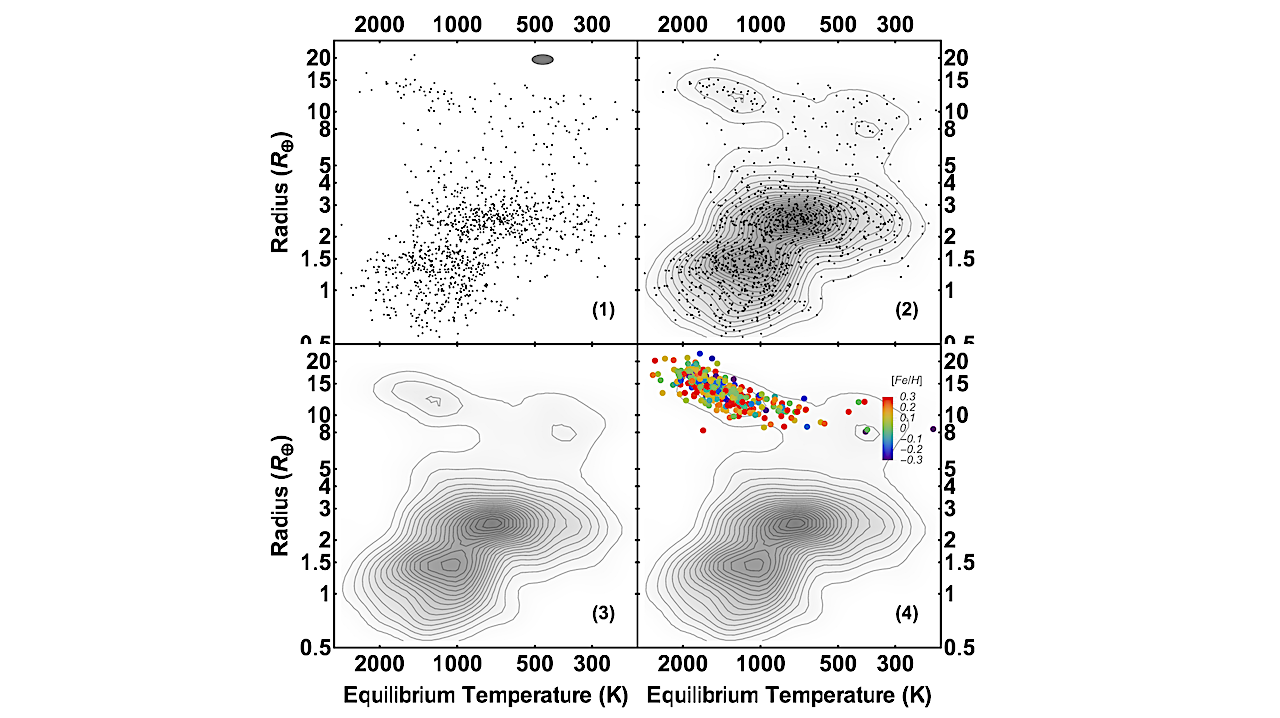
Recent astronomical observations, in particular from the Kepler and TESS missions and their related follow-ups, have revealed an abundance of exoplanets in the size range between Neptune (4 Earth radii) and Earth (1 Earth radii ), as well as a low occurrence rate of planets around twice the radius of Earth (2 Earth radii).
This paper uses statistical methods, in particular, the survival function analysis, to address the known exoplanet population observed mainly from the Kepler’s primary mission, in order to mathematically elucidate the orbital distributions (expressed in either the orbital period P or the orbital semi-major axis a), for each of the host stars, in both a collective way, and also separately for the planets grouped into various radius bins.
We uncover a log-uniform distribution for the majority of planets except the giants. Based on the results of the statistics, we then visit several possible formation scenarios and pathways for planets in different size ranges, in order to explain the results from a theoretical point-of-view.
Li Zeng, Stephanie C. Werner, Stein B. Jacobsen, Elena Mamonova, Reidar G. Trønnes, Ramon Brasser
Comments: submitted to MNRAS. comments welcome!:)
Subjects: Earth and Planetary Astrophysics (astro-ph.EP)
Cite as: arXiv:2604.08406 [astro-ph.EP] (or arXiv:2604.08406v1 [astro-ph.EP] for this version)
https://doi.org/10.48550/arXiv.2604.08406
Focus to learn more
Submission history
From: Li Zeng
[v1] Thu, 9 Apr 2026 16:03:40 UTC (2,235 KB)
https://arxiv.org/abs/2604.08406
Astrobiology, exoplanet,