Spectral Signatures From The Habitable Zone
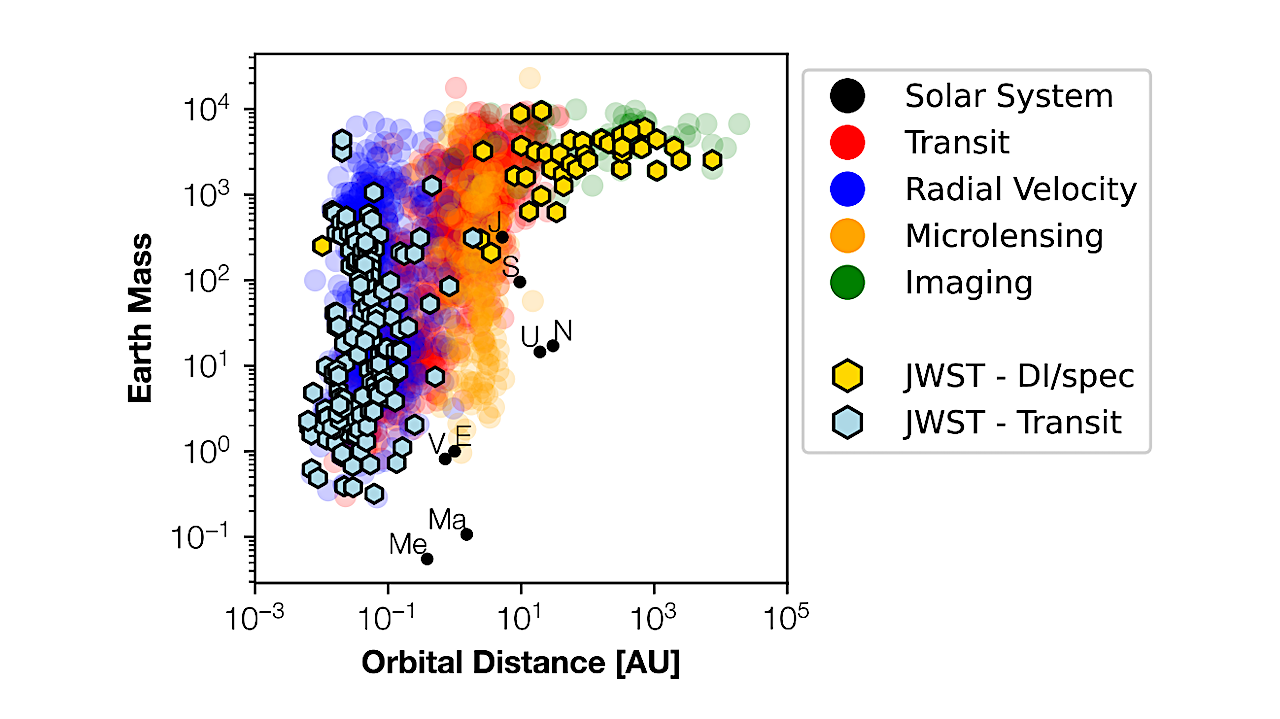
This work describes the context and approach for the detection of spectroscopic signatures from planets in the habitable zone of nearby stars.
By understanding the limitations of current observatories, future telescopes can be understood, and their ability to characterize the atmospheres of exoplanets estimated. An example calculation is given for the signal-to-noise analysis for a planet like the current Earth of oxygen as a biosignature, and (an enhanced abundance) of hydrogen iodine as a technosignature.
In the optimistic estimate, Earth is easily detected, O2 characterized in 20 hours, but signals from enhance HI are only visible after hundreds of hours, indicating the signals are too weak to realistically constrain.
Vincent Kofman
Comments: In Advancing the Search for Technosignatures, Proceedings of IAU Symposium #404 (forthcoming)
Subjects: Earth and Planetary Astrophysics (astro-ph.EP)
Cite as: arXiv:2604.08993 [astro-ph.EP] (or arXiv:2604.08993v1 [astro-ph.EP] for this version)
https://doi.org/10.48550/arXiv.2604.08993
Focus to learn more
Submission history
From: Vincent Kofman
[v1] Fri, 10 Apr 2026 05:57:46 UTC (523 KB)
https://arxiv.org/abs/2604.08993
Astrobiology, exoplanet,