The Atmosphere Of K2-18 b: The Role Of Hazes, Clouds And Photoelectrons
The atmospheric characterisation of temperate exoplanets is becoming accessible with JWST, providing a critical connection between Solar System planets and the more commonly observed hot-Jupiters.
K2-18 b, a temperate sub-Neptune orbiting an M dwarf, has emerged as a benchmark case following extensive JWST observations and ongoing debate regarding its atmospheric composition. We investigate K2-18 b using a self-consistent forward model to constrain its metallicity, composition, and thermal structure, with particular emphasis on the role of disequilibrium chemistry, photochemical hazes and clouds. For the first time in this context, we also assess the impact of photoelectrons on the atmospheric chemistry of an exoplanet.
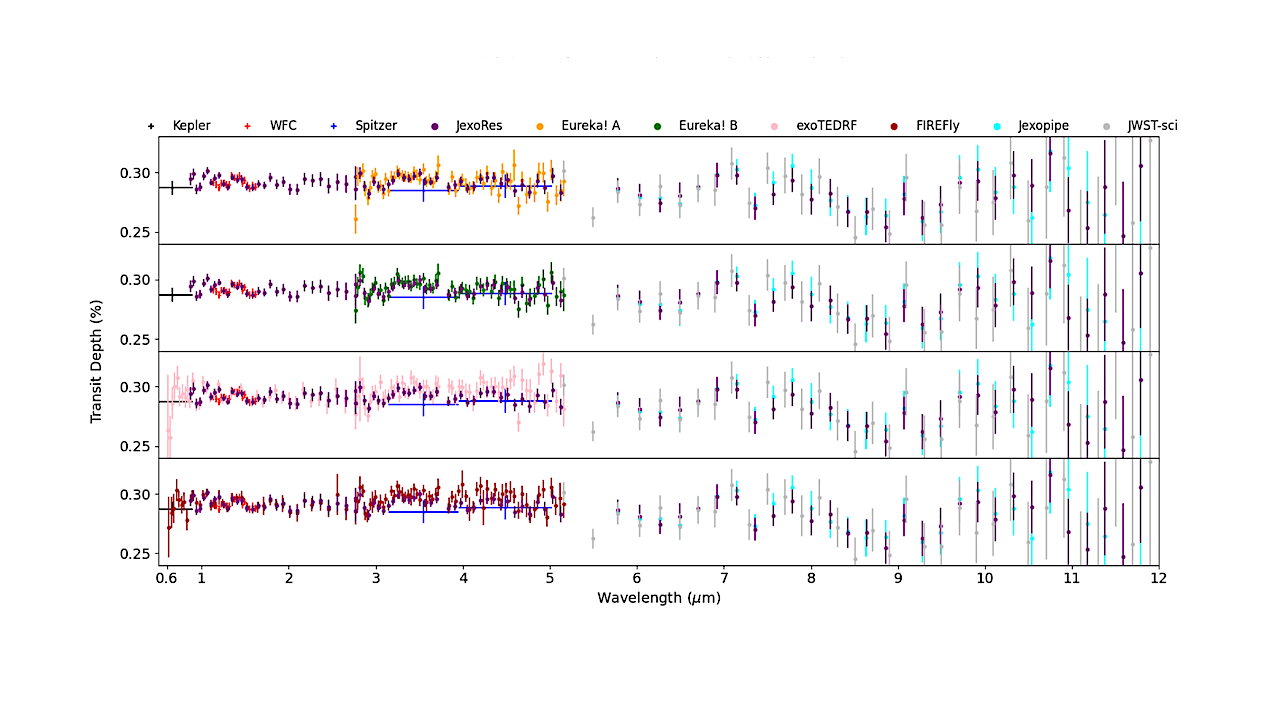
We explore a wide range of metallicities and intrinsic temperatures, evaluate haze and cloud formation, and compare the resulting transmission spectra with available JWST observations from multiple independent pipelines.
We find that a high metallicity (200-400xsolar) H2-rich atmosphere consistently reproduces the observed transit spectra, independent of the data reduction pipeline used. The atmospheric composition is strongly shaped by disequilibrium chemistry, with CH4 dominating the spectrum alongside contributions from CO2 and OCS, and a potential contribution from C2H4 at mid-infrared wavelengths.
Photoelectrons enhance the production of several disequilibrium species, particularly nitrogen-bearing molecules. Photochemical hazes play a key role in shaping the thermal structure, producing a temperature minimum near the 10-100 mbar range that enables efficient H2O condensation, suppressing its gaseous abundance.
Under sufficiently strong haze cooling, NH4SH condensation provides a natural explanation for the apparent absence of NH3 in the observed spectra. No additional molecular species beyond those considered here are required to reproduce the observed spectra.
P. Lavvas, R. Liu, G. Tinetti, S. Paraskevaidou, P. Drossart, A. Coustenis
Subjects: Earth and Planetary Astrophysics (astro-ph.EP)
Cite as: arXiv:2603.26474 [astro-ph.EP] (or arXiv:2603.26474v1 [astro-ph.EP] for this version)
https://doi.org/10.48550/arXiv.2603.26474
Focus to learn more
Submission history
From: Panayotis Lavvas
[v1] Fri, 27 Mar 2026 14:40:11 UTC (3,492 KB)
https://arxiv.org/abs/2603.26474
Astrobiology, Astrochemistry, exoplanet,