The Role of Formation Location in Shaping Sulfur-, Nitrogen-, and Carbon-Bearing Species in Super-Earth and Sub-Neptune Atmospheres
Atmospheric compositions of sub-Neptunes and super-Earths are often interpreted as tracers of formation location relative to volatile ice lines.
However, prolonged magma oceans can chemically equilibrate with primordial atmospheres and modify accreted volatile signatures.
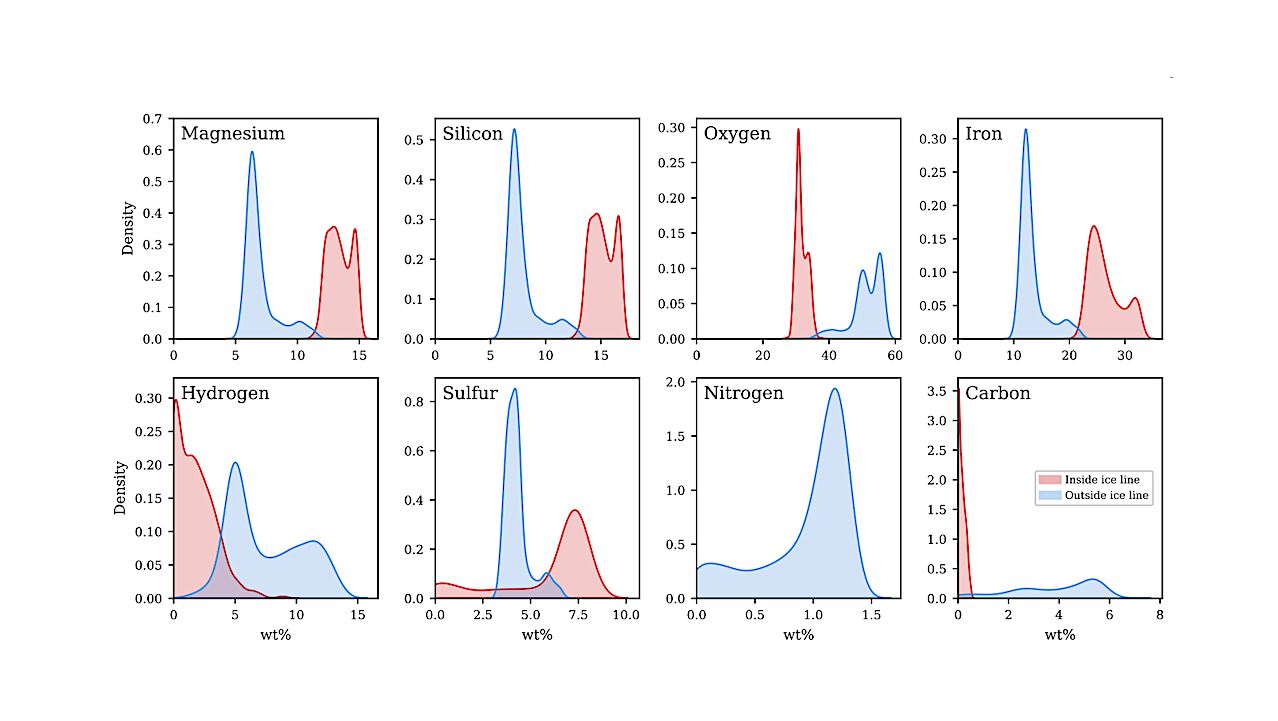
In this study, we couple a synthetic planet population from the Bern Generation III formation model to an extended global chemical equilibrium framework including sulfur and nitrogen chemistry, and compare accreted and equilibrated compositions for ∼ 1200 young pla
nets shortly after formation (∼ 40 Myr) formed inside and outside the water ice line. We find that interior-atmosphere equilibration systematically alters elemental ratios and molecular abundances. The atmospheric C/O ratio shifts relative to the accreted state and remains systematically higher for planets formed outside the ice line.
Nitrogen-bearing species NH3, N2 are strongly depleted through dissolution into the silicate melt, while minor amounts of HCN are produced, leading to low atmospheric nitrogen abundances. Sulfur-bearing species remain more abundant than nitrogen-bearing species; during equilibration, accreted H2S partitions into the interior and small amounts of SO2 form, but overall sulfur abundances depend only weakly on formation location. Silicon-bearing gases (SiH4, SiO) are generated in substantial amounts, with narrower distributions for planets formed outside the ice line.
We identify atmospheric C/O, SiH4, and H2O as potential indicators of formation location, while nitrogen depletion emerges as a generic outcome of magma ocean equilibration.
Comparison with characterized sub-Neptunes such as TOI-270 d, K2-18 b, and GJ 3470 b shows broad consistency with oxygen-dominated, metal-rich atmospheres shaped by interior-atmosphere exchange.
Aaron Werlen, Remo Burn, Caroline Dorn, Lukas Felix, Annika Salmi
Comments: resubmitted to ApJ after revision
Subjects: Earth and Planetary Astrophysics (astro-ph.EP)
Cite as: arXiv:2605.15170 [astro-ph.EP] (or arXiv:2605.15170v1 [astro-ph.EP] for this version)
https://doi.org/10.48550/arXiv.2605.15170
Focus to learn more
Submission history
From: Aaron Werlen
[v1] Thu, 14 May 2026 17:55:57 UTC (440 KB)
https://arxiv.org/abs/2605.15170
Astrobiology, Exoplanet, Astrochemistry,