Spatial Analysis Of PAH Molecules In The Pillars Of Creation Using JWST
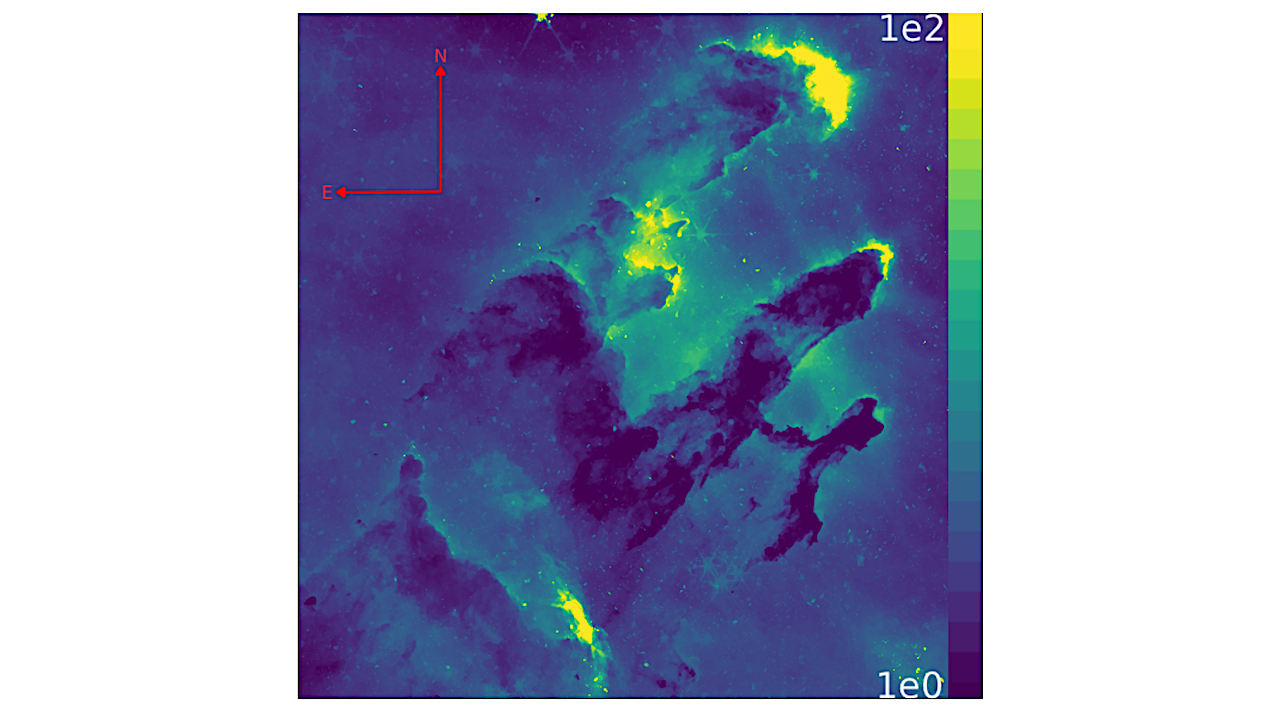
I present a spatially resolved analysis of the polycyclic aromatic hydrocarbon (PAH) population in the Pillars of Creation within the Eagle Nebula (M16) using the James Webb Space Telescope’s (JWST) Mid Infrared Instrument (MIRI) and Near Infrared Camera (NIRCam) imaging.
By using mid infrared PAH sensitive bands, I derive resolved maps of PAH size and ionization state across the pillars and connect these directly to variations in the radiation field and gas structure. I present the first spatial maps of PAH ionization and size in the Pillars of Creation.
The analysis reveals clear internal gradients that show the PAH population is strongly shaped by local conditions within the cloud, such as the local radiation intensity and orientation of the nebular structure. The intensely radiated regions show a neutral and large PAH population, possibly due to electron recombination in these regions.
I measure a mean PAH size of 198 carbon atoms with an error bar of 1.22 for M16 and use the resolved emission structure to obtain a first-order estimate of the electron density in the molecular cloud. These results provide direct evidence that PAH properties in M16 are governed by the interplay between radiation and density on sub-cloud scales, demonstrating the power of JWST imaging to probe dust processing in star-forming regions.
Pranav R. Iyengar
Subjects: Astrophysics of Galaxies (astro-ph.GA)
Cite as: arXiv:2603.15458 [astro-ph.GA] (or arXiv:2603.15458v1 [astro-ph.GA] for this version)
https://doi.org/10.48550/arXiv.2603.15458
Focus to learn more
Submission history
From: Pranav Iyengar
[v1] Mon, 16 Mar 2026 15:56:08 UTC (4,252 KB)
https://arxiv.org/abs/2603.15458
Astrobiology, Astrochemistry,